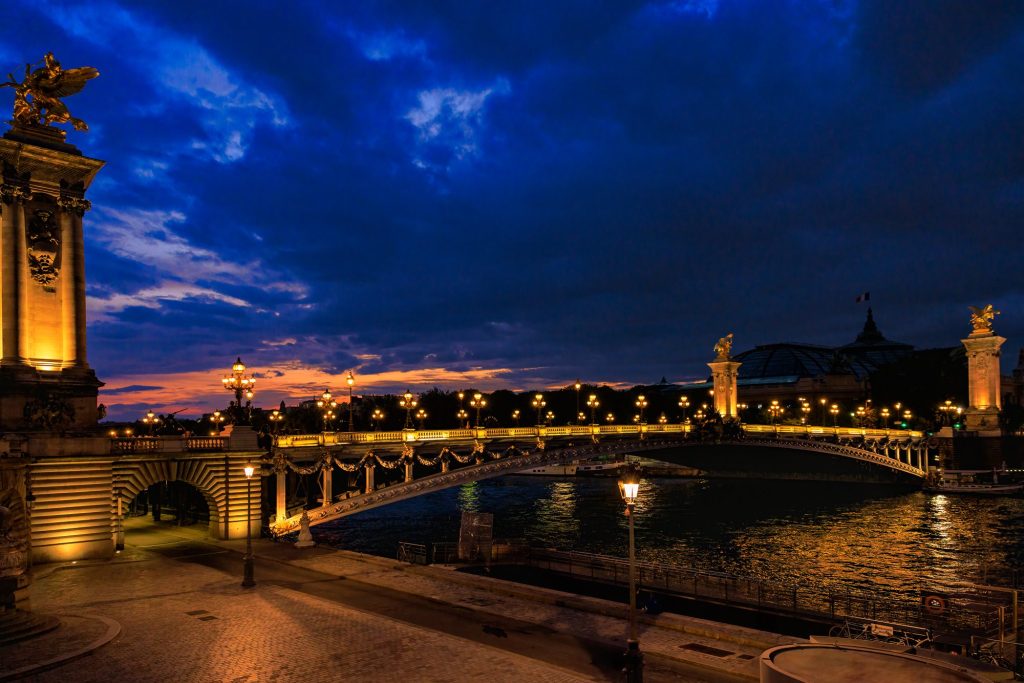
The Pont Alexandre III is a deck arch bridge that spans the Seine in Paris. It connects the Champs-Élysées quarter with those of the Invalides and Eiffel Tower. The bridge is widely regarded as the most ornate, extravagant bridge in the city. It has been classified as a French monument historique since 1975.
The Beaux-Arts style bridge, with its exuberant Art Nouveau lamps, cherubs, nymphs and winged horses at either end, was built between 1896 and 1900. It is named after Tsar Alexander III, who had concluded the Franco-Russian Alliance in 1892. His son Nicholas II laid the foundation stone in October 1896. The style of the bridge reflects that of the Grand Palais, to which it leads on the right bank.
The next bridge upstream on the Seine is Pont de la Concorde and the next bridge downstream is Pont des Invalides, which is the lowest bridge crossing the Seine.
Downie likes to walk and so do I. His book is divided into “Paris People”, “Paris Places” and “Paris Phenomena.” It is the places that interested me the most. For example, Downie describes a long walk along the Seine that I decided to replicate. It transformed my view of Paris because I learned how much of the city revolves around the river. I also learned just how small the city is geographically and how it seems that almost every centimeter of the city has been lovingly cultivated.
The walk begins at France’s gigantic national library — Bibliothèque nationale de France. This is the largest library I have ever seen; it houses more than 15 million books and journals. It is located near the Métro station Bibliothèque François Mitterrand right along the Seine. But not much else is nearby. The location feels desolate, modern and suburban, although the library remains within Paris’s Périphérique or beltway.
However, it was unclear to me from reading the book where the walk ended so I emailed the author who cheerfully responded with the details and even suggested a nice, reasonably priced restaurant for lunch right along the walk. The restaurant is La Fregate and is at the only spot on the walk where you have to go up to the sidewalk from the river.
I watched the city transform from stark, modern suburbs and eventually came upon Notre Dame and the Eiffel Tower and on to its terminus at the Pont Mirabeau. I will never forget Le Pont Mirabeau after reading Guillaume Apollinaire’s poem in high school breathing life and love into the bridge. Seeing Le Pont Mirabeau at the end of this day-long walk was special.
The entire walk was about 10 km or 6.2 miles. The transformations within that short distance speak volumes about Paris.
At Downie’s suggestion, I also visited Buttes-Chaumont park which is even more impressive than Mr. Downie describes. He knows Place des Vosges like the back of his hand so that chapter is exceptional.
On top of the wonderful details that make Paris come to life, Downie’s prose shows a love and mastery of the English language that I appreciate. This gem of a book will teach you so much about Paris and make you want to return again and again or just to go to Paris and remain as Downie has.
LE PONT MIRABEAU
Guillaume Apollinaire

Sous le pont Mirabeau coule la Seine
   Et nos amours
         Faut-il qu’il m’en souvienne
La joie venait toujours après la peine

        Vienne la nuit sonne l’heure
        Les jours s’en vont je demeure

Les mains dans les mains restons face à face
   Tandis que sous
        Le pont de nos bras passe
Des éternels regards l’onde si lasse

        Vienne la nuit sonne l’heure
        Les jours s’en vont je demeure


L’amour s’en va comme cette eau courante
  L’amour s’en va
    Comme la vie est lente
Et comme l’Espérance est violente

          Vienne la nuit sonne l’heure
          Les jours s’en vont je demeure

Passent les jours et passent les semaines
    Ni temps passé
    Ni les amours reviennent
Sous le pont Mirabeau coule la Seine

          Vienne la nuit sonne l’heure
          Les jours s’en vont je demeure