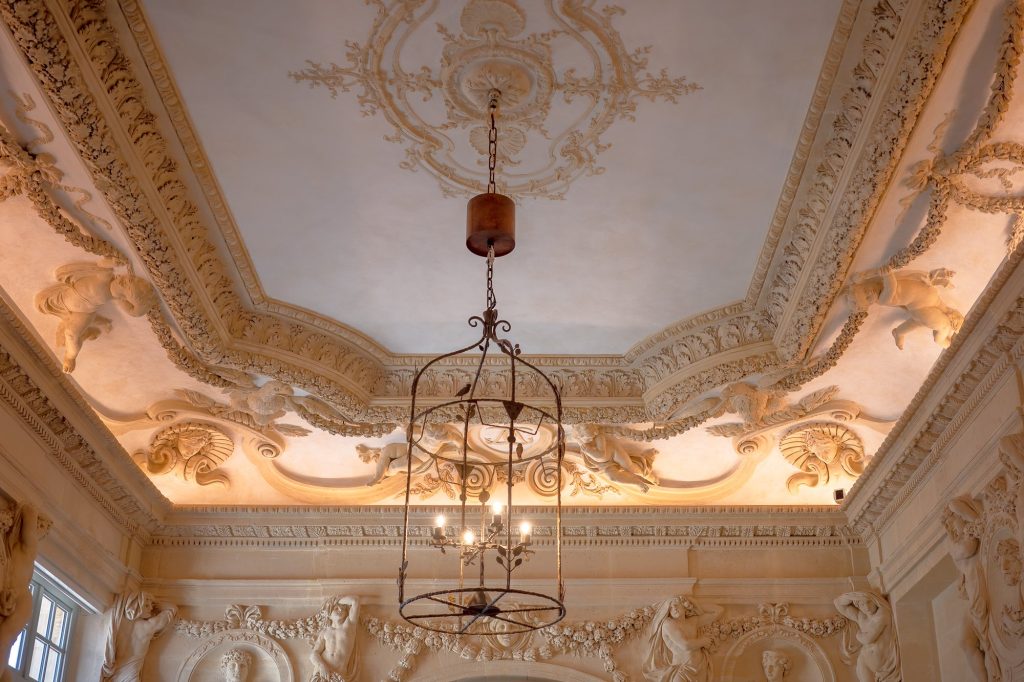
The Bibliothèque Mazarine, or Mazarin Library, is located within the Palais de l’institut de France, or the Palace of the Institute of France (previously the Collège des Quatre-Nations of the University of Paris), at 23 quai de Conti in the 6th arrondissement, on the Left Bank of the Seine facing the Pont des Arts and the Louvre. Originally created by Cardinal Mazarin (1602–1661) as his personal library in the 17th century, it today has one of the richest collections of rare books and manuscripts in France, and is the oldest public library in the country.
The library today contains about 600,000 volumes. The oldest part of the collection, brought together by Mazarin, contains about 200,000 volumes on all subjects. The more modern collections specialize in French history, particularly religious and literary history of the Middle Ages (12th–15th centuries) and the 16th and 17th centuries. Other specialities are the history of the book and the local and regional history of France.
One of two theaters (the other being the Théâtre de la Ville) built on the site of a châtelet, a small castle or fortress, it was designed by Gabriel Davioud (1824-1881) at the request of Baron Haussmann between 1860 and 1862. Originally named the Théâtre Impérial du Châtelet, it has undergone remodeling and name changes over the years. Currently it seats 2,500 people. The theater was registered as a historic monument on November 14, 1979.
Since 1979, the theatre has been operated by the City of Paris, and, after undergoing a major restoration, re-opened in 1980 under the name Théâtre Musical de Paris. It was acoustically re-modeled again in 1989 and reverted to the Théâtre du Châtelet name.
From 2017 to 2019, the theatre was closed for a $34.7 million renovation. While the main purpose of the renovation was to renew electrical circuits, fire safety and security, the Grand Salle was returned to its appearance of 1862 and the Grand Foyer to its Napoleon III style. Outside of the theatre, allegorical statues symbolizing dance, music, comedy and drama which were removed at the end of the 19th century were restored.
The Hotel Harrington, once known as “Washington’s Tourist Hotel,” closed its doors on December 12, 2023, after more than 109 years of continuous operation.
Opened on March 1, 1914—when Woodrow Wilson was President and the world stood on the edge of war—the Harrington quickly became a fixture in downtown Washington. Located just steps from the White House and the National Mall, it earned the distinction of being the city’s longest-operating hotel and, for generations, a true Washington institution.
I walked past it countless times but never stepped inside. Now, that chance is gone.
Below is a circa-1932 postcard of E Street NW, looking west at 11th Street. On the right, the Thrift Shop at 1011 E Street is doing brisk Depression-era business; on the left stands the Hotel Harrington. A distinguished bank building once occupied the northwest corner, but it too has vanished.
Grainy, circa-1932 postcard of E Street NW facing west at 11th Street. The Thrift Shop, at 1011 E St NW, is on the right, doing brisk Depression-era business. Harrington Hotel on the left. Note the distinguished bank building, long gone, on the northwest corner of 11th and E. (Source: Streets of Washington on Flickr)
The following photo of the Hotel Harrington is from the archives of the Library of Congress:
Historic American Buildings Survey, C., Hoachlander, A., photographer. (1933) Hotel Harrington, Eleventh & E Streets, Northwest, Washington, District of Columbia, DC. Washington D.C. Washington, 1933. Price, V. B., trans Documentation Compiled After. [Photograph] Retrieved from the Library of Congress, https://www.loc.gov/item/dc0989/.
Paris-Charles de Gaulle airport (CDG) opened on March 13, 1974. It has three terminals. Terminal 1 (shown above) is the oldest terminal. It was inaugurated on March 8, 1974 by French Prime Minister Pierre Messmer (1916-2007), after eight years of construction.
Designed by the young architect Paul Andreu (1938-2018), this first terminal featured an innovative design of brutalist architecture. It has a central circular building linked to seven satellites. Designed to facilitate the distribution of passenger flows, this singular structure earned the terminal its nickname, which is still used today, the Camembert.
The first Air France flight from Paris-Charles de Gaulle took off on April 30, 1974. The Caravelle F-BHRA, the first aircraft of its type delivered to Air France, took off for Belgrade and Sofia, with a crew led by flight captain Henri Cibert.
Paris-Charles de Gaulle is the busiest airport within the European Union. In 2022, it handled 57,474,033 passengers and 34,657 aircraft movements, thus making it the world’s ninth busiest airport and Europe’s third busiest airport (after Istanbul and Heathrow) in terms of passenger numbers.
The Library of Congress in Washington, DC is the largest library in the world, with millions of books, films and video, audio recordings, photographs, newspapers, maps and manuscripts in its collections. The Library is the main research arm of the U.S. Congress and the home of the U.S. Copyright Office.
Congress moved to Washington, D.C. in 1800 after holding sessions for eleven years in temporary national capitals in New York City and Philadelphia. Also in 1800, as part of an act of Congress providing for the removal of the new national government from Philadelphia to Washington, President John Adams approved an act of Congress providing $5,000 for books for the use of Congress—the beginning of the Library of Congress.
However, in 1814, the British burned Washington, destroying the Capitol and the small congressional library in its north wing. Former President Thomas Jefferson offered to sell his comprehensive personal library of 6,487 books to rebuild the Library of Congress. Congress accepted his offer in 1815. Jefferson’s concept of universality is the rationale for the comprehensive collecting policies of today’s Library of Congress.
The Library of Congress is among Washington’s top attractions. Every Library of Congress visitor must reserve timed-entry pass. Passes are available here. It’s worth planning ahead as slots fill up.
The Musée Picasso is an art gallery located in the Hôtel Salé in rue de Thorigny, in the Marais district of Paris, dedicated to the work of the Spanish artist Pablo Picasso (1881–1973). The hôtel Salé is probably, as Bruno Foucart wrote in 1985, “the grandest, most extraordinary, if not the most extravagant, of the grand Parisian houses of the 17th century”.
The museum collection includes more than 5,000 works of art (paintings, sculptures, drawings, ceramics, prints, engravings and notebooks) and tens of thousands of archived pieces from Picasso’s personal repository, including the artist’s photographic archive, personal papers, correspondence, and author manuscripts. A large portion of items were donated by Picasso’s family after his death, in accord with the wishes of the artist, who lived in France from 1905 to 1973.
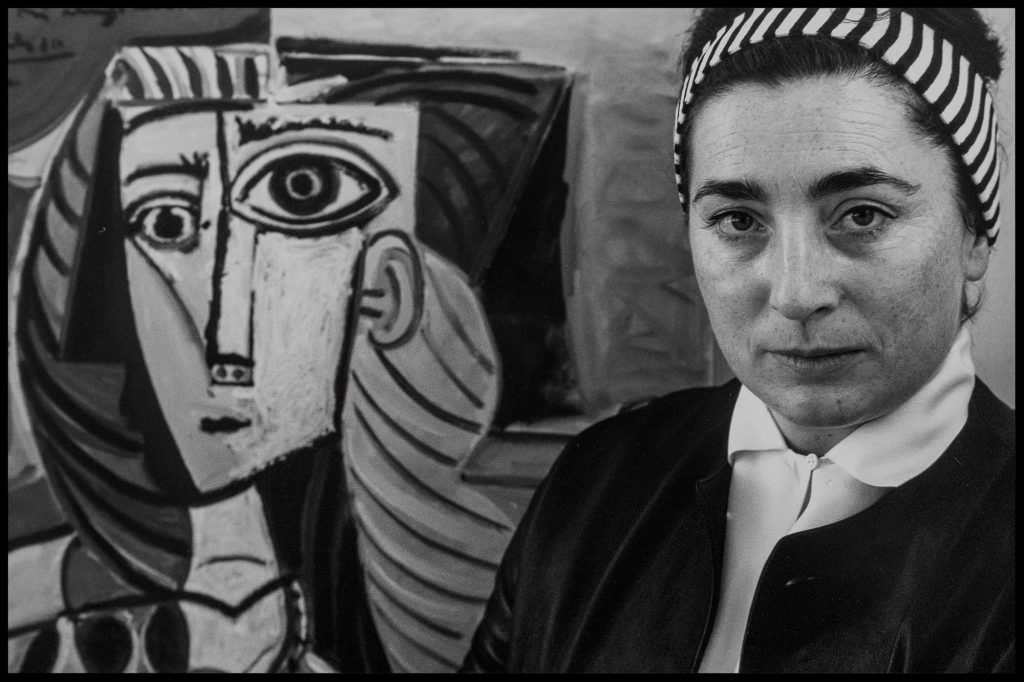
Photograph of Jaqueline Roque by David Douglas Duncan at the Musée Picasso
Jacqueline Roque (1927–1986) (shown above) was best known as the muse and second wife of Pablo Picasso. Their marriage lasted 11 years until his death, during which time he created over 400 portraits of her, more than any of Picasso’s other loves. Here, she poses with her striking portrait created in California. The photograph was made by David Douglas Duncan (1916-2018), an American photojournalist, known for his combat photographs and for his extensive domestic photography of Pablo Picasso and his wife Jacqueline.
The Musée Jacquemart-André is a private museum located at 158 Boulevard Haussmann in the 8th arrondissement of Paris. The museum was created from the private home of Édouard André (1833–1894) and Nélie Jacquemart (1841–1912) to display the art they collected during their lives.
Édouard André, the scion of a Protestant banking family, devoted his considerable fortune to buying works of art. He then exhibited them in his new mansion built in 1869 by the architect Henri Parent, and completed in 1875.
André married a well-known society painter, Nélie Jacquemart, who had painted his portrait ten years earlier. The couple travelled in Italy, amassing one of the finest collections of Italian art in France. When Edouard André died, Nélie Jacquemart completed the decoration of the Italian Museum and travelled in the Orient to add more precious works to the collection. Faithful to the plan agreed with her husband, she bequeathed the mansion and its collections to the Institut de France as a museum, and it opened to the public in 1913.
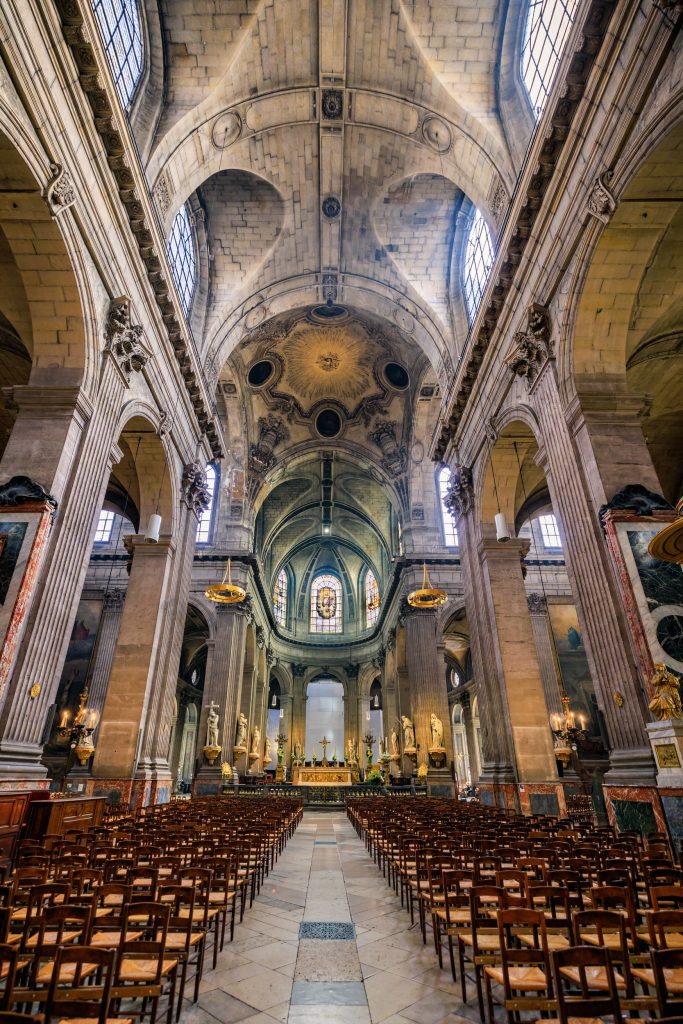
The Church of Saint-Sulpice is a Roman Catholic church in Paris, on the east side of Place Saint-Sulpice, in the Latin Quarter of the 6th arrondissement. It is only slightly smaller than Notre-Dame and thus the second-largest church in the city. It is dedicated to Sulpitius the Pious, a seventh century bishop and saint.
The present church is the second building on the site, erected over a Romanesque church originally constructed during the 13th century. Additions were made over the centuries, up to 1631. The current building was founded in 1646 by parish priest Jean-Jacques Olier (1608–1657) who had established the Society of Saint-Sulpice, a clerical congregation, and a seminary attached to the church.
The church is mentioned in Dan Brown’s 2003 novel The Da Vinci Code, an international bestseller that brought crowds of tourists to Saint-Sulpice.
The Marquis de Sade and Charles Baudelaire were baptized in Saint-Sulpice in 1740 and 1821, respectively. The church also saw the marriage of Victor Hugo to Adèle Foucher in 1822.
The Memorial honors Dwight D. Eisenhower, the Supreme Commander of the Allied Forces in Europe during World War II and the 34th President of the United States.
The Memorial is across the street from the National Air and Space Museum and is surrounded by the U.S. Department of Education, the Federal Aviation Administration, Voice of America, and the U.S. Department of Health and Human Services in Southwest Washington.
Architect Frank Gehry designed the Memorial. Gehry was born in Toronto in 1929 as Frank Owen Goldberg. His father was born in Brooklyn to Russian Jewish parents, and his mother was a Polish Jewish immigrant. Gehry has won major commissions and established himself as one of the world’s most notable architects. For example, his works include the Walt Disney Concert Hall (2003) in downtown Los Angeles.
Gehry’s design features three bronze statues of Eisenhower by the Russian-born sculptor Sergey Eylanbekov, one featuring General Eisenhower with troops from the 101st Airborne the day before the invasion of Normandy, another sculpture depicting President Eisenhower in the White House surrounded by civilian and military advisors, and a third portraying “Little Ike” in his boyhood.
The Memorial highlights passages from notable Eisenhower addresses. Framing the entire memorial is a stainless steel woven tapestry by artist Tomas Osinski , who was born in Poland. The tapestry depicts the cliffs at Pointe du Hoc on the Normandy coastline. Pointe du Hoc was the highest point between the American sector landings at Utah Beach to the west and Omaha Beach to the east. On D-Day, the United States Army Ranger Assault Group attacked and captured Pointe du Hoc after scaling the cliffs.
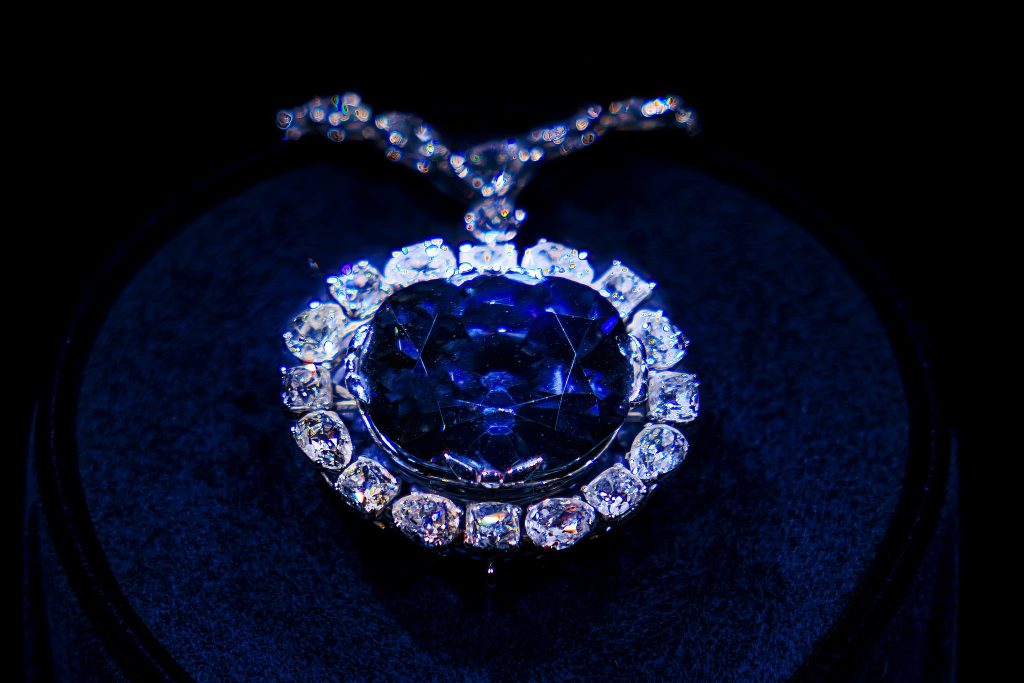
The Hope Diamond is a 45.52-carat diamond originally extracted in the 17th century from the Kollur Mine in Guntur, India. It is blue in color due to trace amounts of boron.
The earliest records of the diamond show that French gem merchant Jean-Baptiste Tavernier purchased it in 1666 as the Tavernier Blue. The stone was cut and renamed the French Blue (Le bleu de France); Tavernier sold the stone to King Louis XIV of France in 1668.
On September 11, 1792, while Louis XVI and his family were imprisoned in the Square du Temple during the early stages of the French Revolution’s Reign of Terror, a group of thieves broke into the Royal Storehouse—the Hôtel du Garde-Meuble de la Couronne (now Hôtel de la Marine)—stealing most of the Crown Jewels in a five-day looting spree. While many jewels were later recovered, including other pieces of the Order of the Golden Fleece, the French Blue was not among them and it disappeared from history.
In 1812, a deep blue diamond described by John Francillion as weighing 177 grains (4 grains = 1 carat) was documented as being in the possession of London diamond merchant, Daniel Eliason. Strong evidence indicates that the stone was the recut French Blue and the same stone known today as the Hope Diamond.
Several references suggest that it was acquired by King George IV of the United Kingdom. At his death, in 1830, the king’s debts were so enormous that the blue diamond was likely sold through private channels.
The first reference to the diamond’s next owner is found in the 1839 entry of the gem collection catalog of the well-known Henry Philip Hope, the man from whom the diamond takes its name. Unfortunately, the catalog does not reveal where or from whom Hope acquired the diamond or how much he paid for it.
Following the death of Henry Philip Hope in 1839, and after much litigation, the diamond passed to his nephew Henry Thomas Hope and ultimately to the nephew’s grandson Lord Francis Hope. In 1901 Lord Francis Hope obtained permission from the Court of Chancery and his sisters to sell the stone to help pay off his debts. It was sold to a London dealer who quickly sold it to Joseph Frankels and Sons of New York City, who retained the stone in New York until they, in turn, needed cash. The diamond was next sold to Selim Habib who put it up for auction in Paris in 1909. It did not sell at the auction but was sold soon after to C.H. Rosenau and then resold to Pierre Cartier that same year.
In 1910 the Hope Diamond was shown to Mrs. Evalyn Walsh McLean, of Washington D.C., at Cartier’s in Paris, but she did not like the setting. Cartier had the diamond reset and took it to the U.S. where he left it with Mrs. McLean for a weekend. This strategy was successful. The sale was made in 1911 with the diamond mounted as a headpiece on a three-tiered circlet of large white diamonds. Sometime later it became the pendant on a diamond necklace as we know it today. Mrs. McLean’s flamboyant ownership of the stone lasted until her death in 1947.
Harry Winston Inc. of New York City purchased Mrs. McLean’s entire jewelry collection, including the Hope Diamond, from her estate in 1949.
For the next 10 years the Hope Diamond was shown at many exhibits and charitable events world wide by Harry Winston Inc., including as the central attraction of their Court of Jewels exhibition. On November 10, 1958, they donated the Hope Diamond to the Smithsonian Institution, and almost immediately the great blue stone became its premier attraction. It’s on display at the National Museum of Natural History.