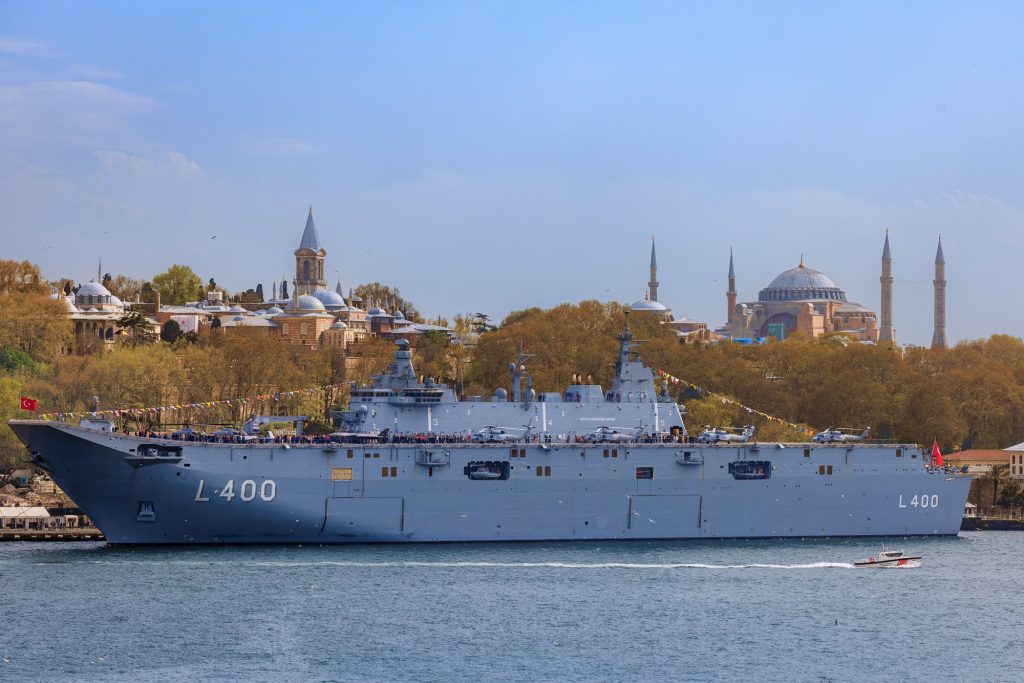
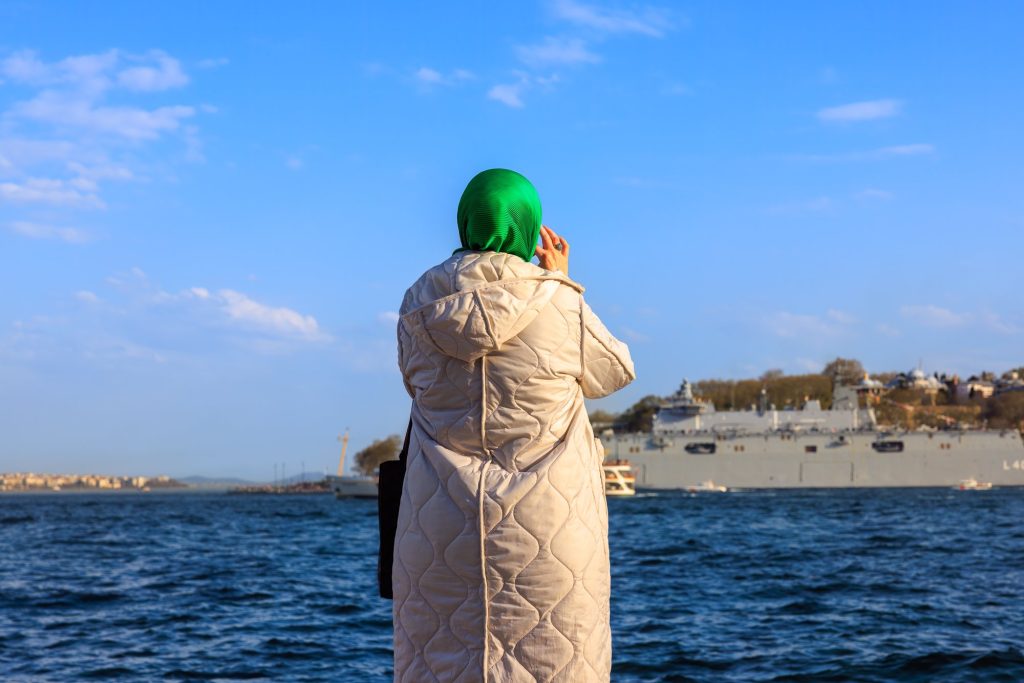
The Turkish Navy received its largest vessel on April 10, 2023. I had the good fortune to see it up close while I was visiting Istanbul. The new ship was docked very near my cruise ship.
According to Reuters, Turkey aims to extend its drone capabilities from land-based to naval operations amid increased regional tensions as war rages in Ukraine on the other side of the Black Sea.
The ship is called the Anadolu (L-400). It is an amphibious assault ship that can be configured as a V/STOL (vertical and/or short take-off and landing) aircraft carrier. It is named after the peninsula of Anatolia (Turkish: Anadolu) which forms the majority of the landmass of Turkey. Construction began in 2016 in Istanbul. The TCG Anadolu was commissioned on April 10, 2023.
The TCG Anadolu can handle only light aircraft, chiefly helicopters and jets that can take off from shorter runways. Even so, the ship is impressive. It has a 5,440 m2 (58,600 sq ft) flight deck and a 990 m2 (10,700 sq ft) aviation hangar which can accommodate either 12 medium-sized helicopters or 8 Boeing CH-47F Chinook heavy-lift helicopters. When the aviation hangar and the light cargo garage are unified, the ship can carry up to 25 medium-sized helicopters. Alternatively, the ship can carry up to 10 American-made F-35B STOVL fighter jets and 12 medium-sized helicopters, with the possibility of hosting six more helicopters on the flight deck of the ship.
The new ship is a source of national pride for Turkey.
The 50-acre park was originally beneath the Potomac River. Near the end of the nineteenth century, the U.S. Army Corps of Engineers initiated a dredging project that created the land that became Potomac Park. The U.S. Navy built the Main Navy and Munitions Buildings as temporary offices on the land during World WarI. The buildings were demolished in 1971. President Nixon later ordered that a park be established on the land, and in 1976, Constitution Gardens was dedicated as a “living legacy American Revolution Bicentennial tribute.” Constitution Gardens has been a separate park unit since 1982.
In 1868, a statue of 16th President Abraham Lincoln sculpted by Lot Flannery was erected on the south side of the former District of Columbia City Hall building (“Old City Hall”) at Judiciary Square. This became the first public monument in Lincoln’s honor. The monument appeared just three years after Lincoln’s assassination on April 15, 1865, at the age of 56.
The Washington Post reports that 20,000 people gathered to witness the monument’s dedication. All federal and municipal offices were closed. Flags flew at half-mast and cannons boomed every half-hour. Many consider this monument to be the best likeness of Lincoln.
The building itself was built in 1820. It was designed by George Hadfield, who supervised construction of the United States Capitol from October 1795 to May 1798. Hadfield was born in Livorno, Italy in 1763.
The building now houses the District of Columbia Court of Appeals, the highest court of the District of Columbia. Established in 1970, it is equivalent to a state supreme court, except that its authority is derived from the United States Congress rather than from the inherent sovereignty of the states.
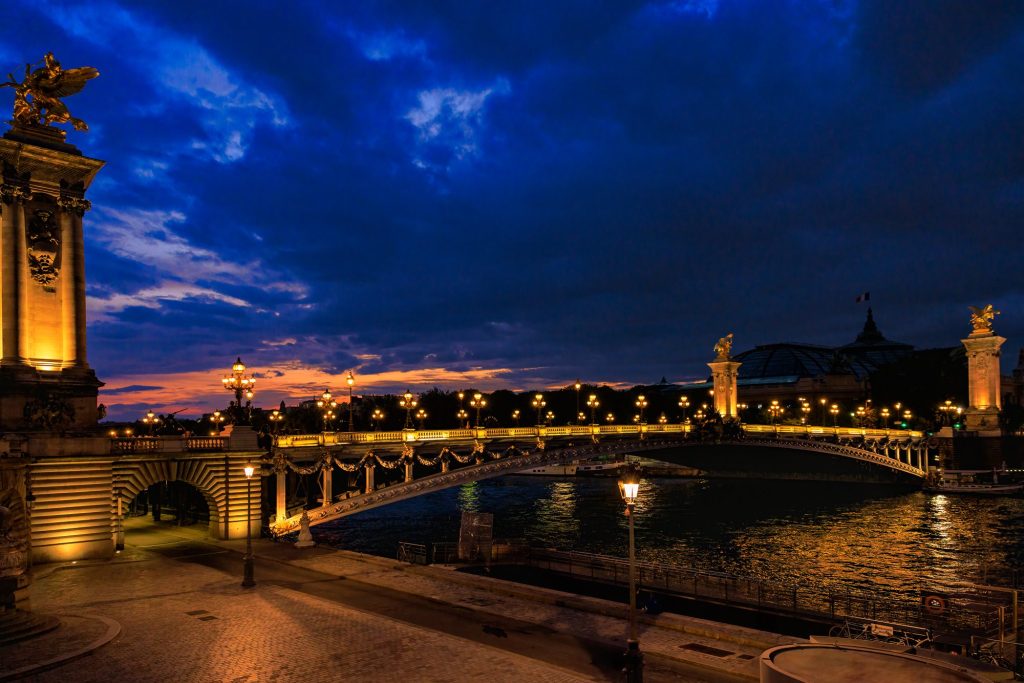
The Pont Alexandre III is a deck arch bridge that spans the Seine in Paris. It connects the Champs-Élysées quarter with those of the Invalides and Eiffel Tower. The bridge is widely regarded as the most ornate, extravagant bridge in the city. It has been classified as a French monument historique since 1975.
The Beaux-Arts style bridge, with its exuberant Art Nouveau lamps, cherubs, nymphs and winged horses at either end, was built between 1896 and 1900. It is named after Tsar Alexander III, who had concluded the Franco-Russian Alliance in 1892. His son Nicholas II laid the foundation stone in October 1896. The style of the bridge reflects that of the Grand Palais, to which it leads on the right bank.
The next bridge upstream on the Seine is Pont de la Concorde and the next bridge downstream is Pont des Invalides, which is the lowest bridge crossing the Seine.
I visited Washington for the first time as part of a weekend trip organized by my high school’s French club in the 1970s. We ate at Maison des Crêpes. I enjoyed it. The restaurant is long gone but I remember it and my trip when I pass by its former location in Georgetown.
The Streets of Washington blog recently shared this photograph of the Maison des Crêpes on Flickr and explained its history:
Maison des Crepes originally opened as La Crepe in 1967 at 1305 Wisconsin Avenue NW in Georgetown. It was the creation of Paris-born Jacques Vivien (1925-2010), who began his Washington career as the maitre d’ at The Jockey Club. Vivien was riding a fashion craze for creperies when he opened Washington’s first. He decorated the restaurant in French provincial style and had his waitresses decked out in Breton costumes. Eventually two other locations would open, and all would remain popular, especially with tourists, despite sometimes poor reviews from local dining critics. The original restaurant in Georgetown closed in the early 1980s.
This brought back nice memories. That weekend trip was wonderful.
The Streets of Washington blog and Flickr feed show many vintage and hard to find images from postcards and other ephemera about historic places in the Washington, D.C. area. It is fascinating to see how the nation’s capital has evolved.
I was born and raised in Pittsburgh. I attended the University of Pittsburgh, which is an urban campus. After moving to Washington, I always liked the George Washington University (GW) campus. I could relate to it as an urban campus in the Foggy Bottom neighborhood of Washington.
For years I enjoyed the burgers and fries at Lindy’s Red Lion (“The Best Little Carry-Out in Washington”). It was an institution on the GW campus. It was rumored that President Gerald Ford liked Lindy’s burgers and as President would send Secret Service agents to pick up burgers for him from Lindy’s. In 2008, The GW Hatchet confirmed this rumor with the owner of Lindy’s. I sure hope it’s true. I have fond memories of Lindy’s and the friendly people who worked there.
Lindy’s closed in June of 2018 and was then vacant. It is now a barber shop.
Downie likes to walk and so do I. His book is divided into “Paris People”, “Paris Places” and “Paris Phenomena.” It is the places that interested me the most. For example, Downie describes a long walk along the Seine that I decided to replicate. It transformed my view of Paris because I learned how much of the city revolves around the river. I also learned just how small the city is geographically and how it seems that almost every centimeter of the city has been lovingly cultivated.
The walk begins at France’s gigantic national library — Bibliothèque nationale de France. This is the largest library I have ever seen; it houses more than 15 million books and journals. It is located near the Métro station Bibliothèque François Mitterrand right along the Seine. But not much else is nearby. The location feels desolate, modern and suburban, although the library remains within Paris’s Périphérique or beltway.
However, it was unclear to me from reading the book where the walk ended so I emailed the author who cheerfully responded with the details and even suggested a nice, reasonably priced restaurant for lunch right along the walk. The restaurant is La Fregate and is at the only spot on the walk where you have to go up to the sidewalk from the river.
I watched the city transform from stark, modern suburbs and eventually came upon Notre Dame and the Eiffel Tower and on to its terminus at the Pont Mirabeau. I will never forget Le Pont Mirabeau after reading Guillaume Apollinaire’s poem in high school breathing life and love into the bridge. Seeing Le Pont Mirabeau at the end of this day-long walk was special.
The entire walk was about 10 km or 6.2 miles. The transformations within that short distance speak volumes about Paris.
At Downie’s suggestion, I also visited Buttes-Chaumont park which is even more impressive than Mr. Downie describes. He knows Place des Vosges like the back of his hand so that chapter is exceptional.
On top of the wonderful details that make Paris come to life, Downie’s prose shows a love and mastery of the English language that I appreciate. This gem of a book will teach you so much about Paris and make you want to return again and again or just to go to Paris and remain as Downie has.
LE PONT MIRABEAU
Guillaume Apollinaire

Sous le pont Mirabeau coule la Seine
   Et nos amours
         Faut-il qu’il m’en souvienne
La joie venait toujours après la peine

        Vienne la nuit sonne l’heure
        Les jours s’en vont je demeure

Les mains dans les mains restons face à face
   Tandis que sous
        Le pont de nos bras passe
Des éternels regards l’onde si lasse

        Vienne la nuit sonne l’heure
        Les jours s’en vont je demeure


L’amour s’en va comme cette eau courante
  L’amour s’en va
    Comme la vie est lente
Et comme l’Espérance est violente

          Vienne la nuit sonne l’heure
          Les jours s’en vont je demeure

Passent les jours et passent les semaines
    Ni temps passé
    Ni les amours reviennent
Sous le pont Mirabeau coule la Seine

          Vienne la nuit sonne l’heure
          Les jours s’en vont je demeure