Rotorua is different from other places in New Zealand. The difference is not subtle.
It has one of the largest and most visible Māori populations in the country. Over 40% of Rotorua’s residents are Māori—well above the national average—and the region sits within the traditional rohe of Te Arawa iwi. That presence is not confined to cultural sites or performances. It is part of everyday life.
Rotorua Primary School, where Māori culture and modern education come together in everyday life.
You hear te reo Māori—the Māori language—spoken in schools and in public spaces. Marae are part of the landscape. Cultural expression is visible, but more importantly, it is continuous. It does not feel preserved for visitors. It feels lived.
For most of my life, Australia and New Zealand felt almost theoretical — names at the bottom of the map, separated from my daily reality by oceans and time zones. I had traveled far before, but never that far. The idea of seventeen hours in the air — followed by another eighteen on the return — felt less like travel and more like a test of endurance.
Distance has a psychological weight. It suggests effort. Risk. Fatigue.
And yet, this year, I decided to go.
I flew from San Francisco to Singapore — roughly seventeen hours suspended above the Pacific. I spent a couple of days exploring Singapore, then continued on to Melbourne for the Australian Open. From there I traveled through Australia and New Zealand, moving across landscapes that seemed improbably wide, watching light linger late into the evening as if the day itself resisted ending.
On the way home, I flew from Auckland to Singapore, paused briefly at Changi Airport, and then boarded Singapore Airlines Flight 24 to JFK — more than eighteen hours nonstop, one of the longest commercial flights in the world.
By the time I landed in New York, I had crossed half the planet.
Something in me had shifted.
The world no longer felt impossibly large. It felt connected. Reachable.
More surprising still: I realized I was comfortable with ultra-long haul travel. What once seemed daunting had become manageable — even calm.
The Blue Angels, formally named the U.S. Navy Flight Demonstration Squadron, are a flight demonstration squadron of the United States Navy. Formed in 1946, the unit is the second oldest formal aerobatic team in the world, following the Patrouille de France which formed in 1931. The name was picked by the original team when they were planning a show in New York in 1946. One of them came across the name of the city’s famous Blue Angel nightclub in the New Yorker Magazine.
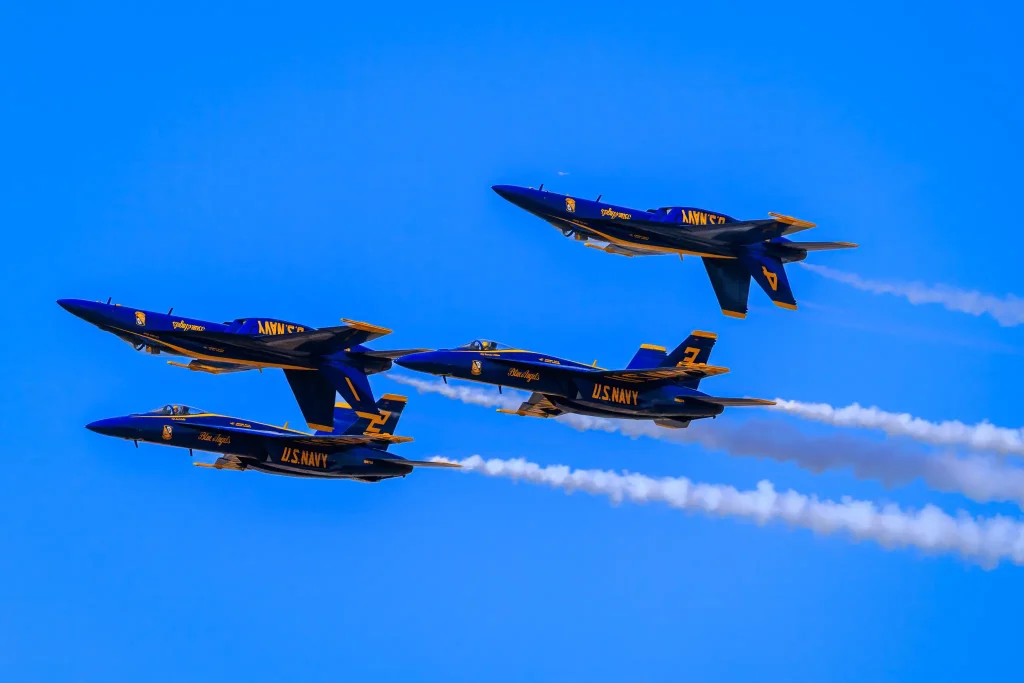
The U.S. Navy Blue Angels in tight diamond formation, slicing through the sky with precision during their airshow performance.
The team has six Navy and one Marine Corps demonstration pilots. They fly the Boeing F/A-18E/F Super Hornet and the Lockheed Martin C-130J Super Hercules. Each aircraft is painted in the Blue Angels’ iconic colors: vivid blue and gold. The sleek paint job, high-gloss finish, and striking design aren’t just for aesthetics—they’re also a point of pride and a hallmark of the professionalism the team embodies.
The Blue Angels typically perform aerial displays in at least 60 shows annually at 32 locations throughout the United States and two shows at one location in Canada. The “Blues” still employ many of the same practices and techniques used in the inaugural 1946 season.
One of the most famous formations of the Blue Angels is the “Diamond” (shown above), where four jets fly in tight, symmetrical formation with mere inches separating their wings. An estimated 11 million spectators view the squadron during air shows from March through November each year. Since 1946, the Blue Angels have flown for more than 505 million spectators.
The mission of the Blue Angels is to showcase the pride and professionalism of the United States Navy and Marine Corps by inspiring a culture of excellence and service to the country through flight demonstrations and community outreach.
The Blue Angels execute a high-speed crossover maneuver, their jets streaking in perfect alignment across a brilliant blue sky.
The Blue Angels and the Air Force Thunderbirds do not fly together. Department of Defense policy explains that the use of military aviation demonstration teams is for recruiting purposes; therefore the teams usually do not fly within 150 miles of each other without special permission.
The Blue Angels are a treasured part of American culture. Their air shows are among the most attended aviation events in the country, often drawing hundreds of thousands of spectators.
I saw the Blue Angels perform at the Sun ’n Fun Aerospace Expo in Lakeland, Florida on April 5, 2025. These photos are from that event. Watching the Blue Angels is an awe inspiring experience and a reminder of the skill and courage of those who serve.
The Club originated from a waiting list that is said to have started in 1964, when Gerhard Pistor, an Austrian journalist, went to a Viennese travel agency requesting a flight to the Moon. The agency forwarded his request to Pan Am, which accepted the reservation two weeks later and replied that the first flight was expected to depart in 2000.
On July 20, 1969, Neil Armstrong became the first human to step foot on the moon.
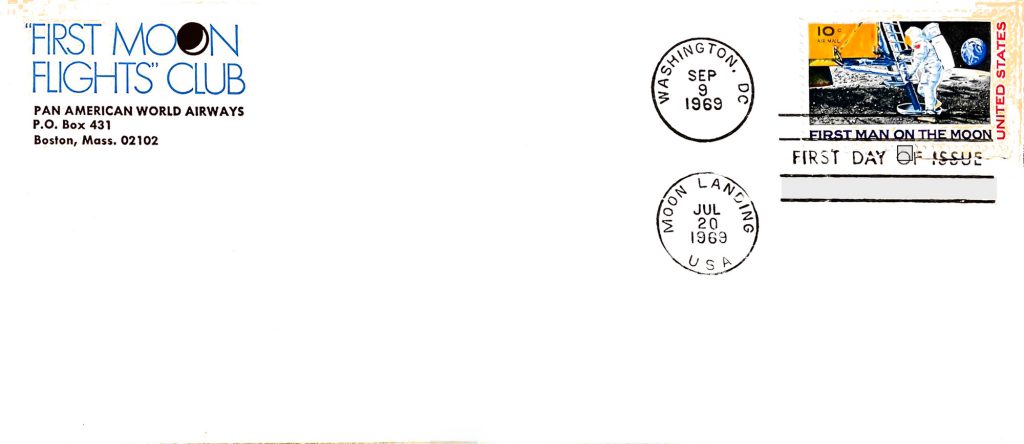
“First Man on the Moon” stamp depicting Neil Armstrong stepping from the Apollo 11 lunar module Eagle.
On September 9, 1969, the United States Postal Service issued a 10 cent postage stamp showing an astronaut walking on the surface of the moon. It was called the “First Man on the Moon” postage stamp. According to the National Postal Museum, the stamp was made from the same master die that the astronauts took with them to the moon. Additionally, it was the largest stamp the United States had issued up to that point.
Pan Am sent members of the “First Moon Flights” Club “First Day of Issue” envelopes. I was excited to get mine and have kept it all this time. I now doubt I will make it to the moon. But it was an exciting thought.
Unfortunately, Pan Am did not survive. It went bankrupt in 1991.
On September 17, 2022, I saw the awe-inspiring “Thunderbirds” air demonstration squadron of the United States Air Force (USAF) perform at Joint Base Andrews in Maryland, the home of Air Force One. The Thunderbirds squadron was was created in 1953 and is based in Nevada.
The USAF Thunderbirds are the third-oldest formal flying aerobatic team (under the same name) in the world, after the French Air Force Patrouille de France formed in 1931 and the United States Navy Blue Angels formed in 1946.
The Thunderbirds Squadron tours the United States and beyond performing aerobatic formation and solo flying in pristine, specially marked aircraft.
The Thunderbirds have performed at over 4,000 airshows worldwide, accumulating millions of miles in hundreds of different airframes over the course of their more than fifty-four years of service. Flying high-performance fighter jets is dangerous. And when flying in extremely close formation, the danger is compounded.
In total, twenty-one Thunderbirds pilots have been killed in the team’s history. Three fatal crashes have occurred during air shows, two of them in jets.
The Thunderbirds perform aerial demonstrations in the F-16C Fighting Falcon. Over 4,600 aircraft have been built since production was approved in 1976. Although no longer being purchased by the U.S. Air Force, improved versions are being built for export customers.