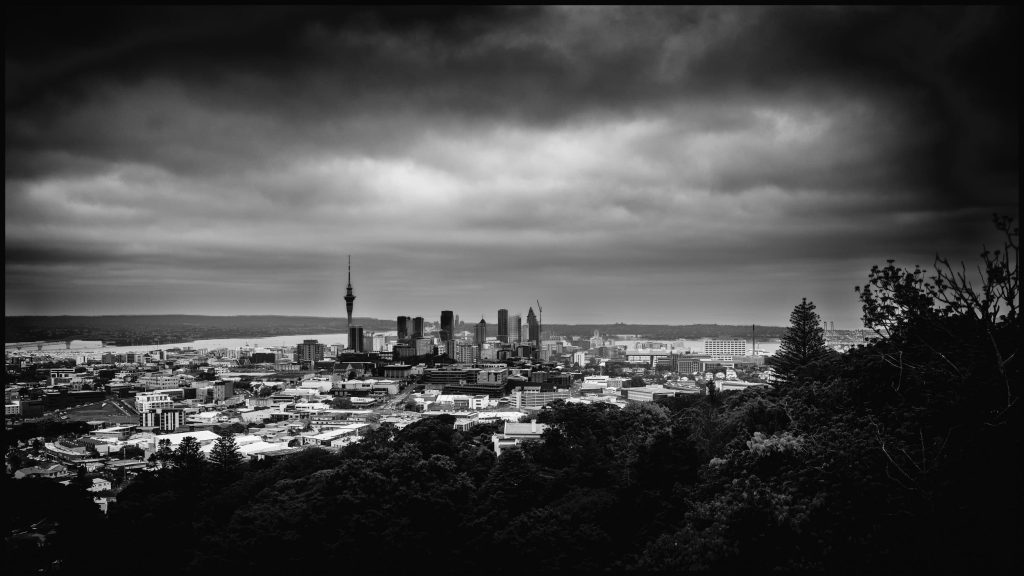
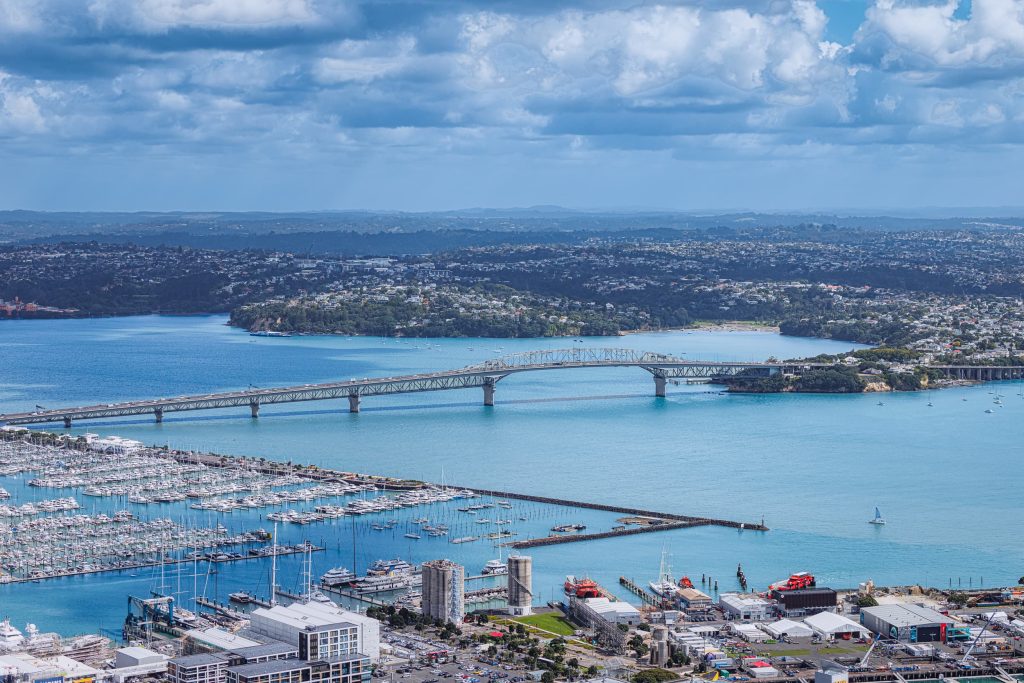
Auckland sits on a narrow isthmus, caught between two bodies of water.
To the north, the Waitematā Harbour opens to the Pacific Ocean. To the south, the Manukau Harbour connects to the Tasman Sea. This geography defines the city. It is New Zealand’s economic center and its primary gateway to the world, home to roughly a third of the country’s population.
I had been told that Auckland was a city to pass through quickly. That proved to be wrong. It simply requires a bit of patience. It is a place that reveals itself gradually, rather than all at once.
It is famously called the “City of Sails,” a nod to the countless yachts tracing the Waitematā. But on the ground, it is a city of hills. Auckland is built across a dormant volcanic field formed over the last 200,000 years, and the terrain never lets you forget it. The streets pitch steeply, and walking requires more effort than you might anticipate.
To truly understand the layout, you have to climb Maungawhau (Mount Eden). It is the highest natural point on the isthmus, a volcanic cone with a sacred, clearly defined crater at its center. Terraces from a former Māori pā are still etched into the slopes—a quiet reminder that this high ground has long been inhabited and defended. From the summit, you can see both harbours and a skyline anchored by the needle of the Sky Tower.
That sense of history is woven throughout the city, often in heavy stone.
Rising from Pukekawa, another dormant volcano within the Auckland Domain, is the Auckland War Memorial Museum (Tāmaki Paenga Hira). Its striking, neoclassical colonnades give it a physical gravity appropriate to its purpose. Originally built to honor the region’s World War I dead—many of whom never returned from across the world—it remains a focal point for remembrance, anchored by a Cenotaph modeled on Whitehall in London. Inside, the museum seamlessly transitions from one of the world’s most extensive collections of Māori and Pacific artifacts into a solemn Hall of Memories.
The surrounding Auckland Domain offers a vast, green relief from the concrete. Tucked inside it are the Wintergardens, a beautiful complex rooted in the 1910s. With its tropical and temperate glasshouses, a sunken pond, and a fernery built into an old quarry, it reflects a much quieter, carefully maintained side of the city.
Auckland’s civic memory takes many forms. On Bastion Point, the Michael Joseph Savage Memorial looks out over the water. It is a restrained, formal obelisk honoring the Prime Minister who laid the foundations of the country’s modern welfare state. Back in the city center, a tile mural commemorates the centenary of women’s suffrage. In 1893, New Zealand became the first self-governing country to grant women the right to vote—an early indicator of the nation’s willingness to embrace social reform long before the rest of the world.
Even the city’s oldest European footprint is still visible. In the Symonds Street Cemetery, established in the 1840s, weathered headstones sit quietly as the modern urban landscape grows up and around them.

Not everything is strictly historical, of course. A ferry ride across the harbour reinforces just how tied the city’s daily rhythm is to the water. A visit to the well-designed Auckland Zoo offered a look at the native kākā parrot. And further out, a day trip to Matamata to see the Hobbiton Movie Set proved surprisingly worthwhile. Even without a deep attachment to the films, the craftsmanship of the set and the striking, rolling landscape make it easy to see how New Zealand cemented its cinematic image globally.
Auckland does not present itself in a single, overwhelming moment. It is shaped by water, built on volcanoes, and layered with a history that isn’t always immediately obvious. It lacks the instant drama of the deep south, but it rewards time and attention.
It is a city entirely worth the stop.