La Grande Arche de la Défense: A Modern Monument to Humanity

La Grande Arche de la Défense (“The Great Arch of the Defense”), originally called La Grande Arche de la Fraternité, is a monumental building in the business district of La Défense, in the commune of Puteaux, west of Paris. Usually referred to simply as La Grande Arche, the 110-meter-high (360 ft) cube is part of the historic axis that runs from the Louvre to the Arc de Triomphe. The distance between the two arches is about 4 km (2.5 miles). Built as one of President François Mitterrand’s Grands Projets, it stands as a symbol of modern France.

In 1982, a national design competition was launched at Mitterrand’s initiative. The winning entry, by Danish architect Johan Otto von Spreckelsen (1929–1987) and engineer Erik Reitzel (1941–2012), reimagined the Arc de Triomphe for the late 20th century. Instead of commemorating military victories, their design celebrated humanity and humanitarian ideals.

Construction began in 1985, led by French civil engineering company Bouygues. In 1986, Spreckelsen resigned and transferred his responsibilities to his associate, French architect Paul Andreu, best known for his work on Charles de Gaulle Airport. Reitzel remained involved until the monument was completed in 1989.

The structure takes the approximate form of a perfect cube, with a width, height, and depth of 110 meters. Some have suggested it resembles a hypercube—or tesseract—projected into three dimensions. Built with a prestressed concrete frame clad in glass and covered in white granite from Bèthel, Italy, the Arche has a striking, minimalist presence.

La Grande Arche was inaugurated in July 1989 during celebrations marking the bicentennial of the French Revolution, including a grand military parade that passed beneath its soaring frame.


Sources: Wikipedia | French moments
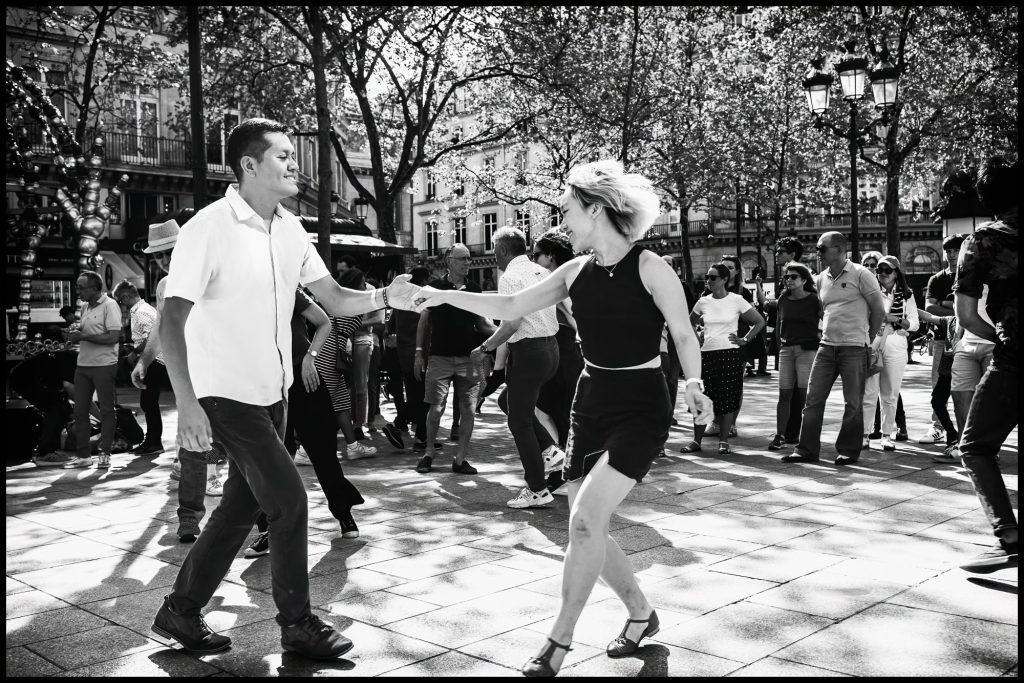

Dancing in the Heart of Paris: Place Colette

Tucked beside the Comédie-Française, Place Colette is more than just a Parisian square—it’s a stage where the city itself performs. Named in 1966 after the writer Colette (1873–1954), following a request by her daughter to then–Minister of Culture André Malraux, the square has since become a beloved gathering spot. On warm evenings, people often come here to dance in public, filling the air with music and movement. It’s a joy to witness, and a reminder of Paris’s enduring spirit of playfulness.

Suggestion: If you’re nearby, try this walking route that includes Place Colette, the Palais-Royal, and surrounding streets. It’s a beautiful way to experience Parisian history and atmosphere at a relaxed pace.

Where Hitler’s Crowds Once Roared

Between 1933 and 1938, Nazi Germany staged massive rallies in Nuremberg. The former Nazi Party Rally Grounds remain the largest surviving complex of National Socialist architecture in today’s Germany. Designed by Hitler’s architect Albert Speer, the vast structures still convey the immense power of Nazi propaganda. Speer was later convicted of war crimes and crimes against humanity at the International Military Tribunal in Nuremberg. He served 20 years in prison and died in London in 1981.

The Zeppelinfeld (Zeppelin Field), shown above, is one of the most striking remains. Its massive grandstand, 360 meters wide, was modeled on the Pergamon Altar of ancient Greece, with square piers inspired by Franco-American architect Paul Philippe Cret. After Germany’s defeat in 1945, American forces famously blew the swastika from its top. The name “Zeppelinfeld” refers to the landing of Count Zeppelin’s airship (LZ6) here in 1909.

I visited in April 2024, on a cold and windy day, with my cousin from Nuremberg who graciously served as my guide. The site felt stark, desolate, and impossibly vast—its scale resisting any attempt to capture it in photographs. Only a handful of visitors were there, but the immensity of the place chilled me. I tried to imagine the grounds filled with uniformed followers of Adolf Hitler, roaring in unison. The thought sent a shiver down my spine.

How could this have happened in Germany—a country with such a deep tradition of culture, learning, and science? Could it happen again? Is it already happening? The pull of the far right has not disappeared; it is rising once more.

What happened here was not inevitable. It can happen again.

Read more