The Tunnel des Tuileries is a tunnel parallel to the Seine at the Quai des Tuileries close to the Louvre. Today, the 861m long (2,825 feet) tunnel is reserved for pedestrians, bicycles and street artists. When it opened in 1967, it was used for one-way traffic from west to east as an integral part of Voie Georges-Pompidou.
In July 2022, colorful lights were installed. Artists have painted several huge frescos inside the tunnel. If you like street art, it’s worth a visit.
I’ve had the pleasure of visiting Berlin twice. The first time was in the early 1980s and the second time in 2018. The transformation was dramatic.
Berlin Before the Fall of the Wall
I visited Berlin in the early 1980s. Berlin was then a divided city. I stayed in the Western zone near the Kurfurstendamm, which at the time was the heart of Berlin. I took a one day bus tour to the East. We crossed through Checkpoint Charlie. The bus was thoroughly searched by East German border guards. In contrast, the American military just let us pass freely.
The West was vibrant with shops, restaurants and people everywhere, In contrast, buildings in the East still showed signs of the bombing it received in the war. There were Soviet style memorials throughout East Berlin.
Our East German guide was openly dispirited and seemed to be reciting a script he was told to speak, especially when he spoke of “warm relations” with the then Soviet Union. At the end of the day, I was glad to be back in the West where I felt free and comfortable.
Berlin in 2018
Kurfurstendamm
In 2018, I went back to Berlin to see an undivided, transformed and reinvented Berlin. The German capital was still under construction 73 years after the end of WWII. I stayed near the Kurfurstendamm so I could compare my experience today with the early 1980s. My hotel — Pension Peters — is a small owner-managed hotel, where I felt more like a temporary resident in a nice Berlin neighborhood rather than a tourist.
I saw the transformation of Berlin immediately. The Kurfurstendamm is no longer the center of town. The heart of Berlin today is in the former East, which was a shambles when I was last there. The Kurfurstendamm is now a nice shopping street in lovely Berlin neighborhood called City West but is no longer the heart of the capital.
The Heart of Berlin
In 2018, Checkpoint Charlie was now nothing more than a tourist attraction with actor guards who, for a few Euros, will pose with you for a nice picture. There was even a “Checkpoint Charlie” McDonald’s across the street. It certainly no longer inspires fear.
David Enzel at Former Checkpoint Charlie, Berlin, Germany
The heart of Berlin is dominated by the Brandenburg Gate and government buildings, including the embassies of the four former occupying powers: the United States, Great Britain, France and Russia.
Berlin is no longer occupied but the former occupiers are nearby as if to say: “We are watching.” Each of the four embassies has a rich history.
The Soviet Union was first of the four major occupiers to move into a post-War embassy in Berlin. The Russian Embassy in Berlin was closed in 1941 when the two countries went to war. Its reconstruction was the first project of the post-war years in the East Berlin. The embassy’s official grand opening was held on the national holiday of the former USSR, on November 7, 1951. It’s Europe’s largest embassy which sends a message all by itself. After the fall of the Soviet Union in 1991, it became the Russian Embassy. (See also Rick Steves Berlin (p. 105). Avalon Publishing. Kindle Edition.)
France occupied its new embassy in October 2002. However, France formally opened it on January 23, 2003. That date was chosen as it was the 40th anniversary of the Élysée Treaty between Germany and France, declaring friendship between France and the former West Germany. French President Jacques Chirac presided. Marking the occasion, German Chancellor Gerhard Schröder and President Chirac issued a declaration affirming Franco-German friendship and their joint determination to “re-found Europe”.
The United States was the last of the four major occupiers to move into a post-War embassy in Berlin. The history of the U.S. Embassy in Berlin is especially complicated. During WWII, the U.S. Embassy in Berlin was severely damaged by Allied bombing. After the war, the embassy ended up just barely inside East Berlin in divided Berlin’s Soviet zone, straddling the demarcation between the Soviet and American sectors.
The Berlin Wall made the site of the former U.S. Embassy, still owned by the U.S. government, an inaccessible vacant lot. It was part of the security zone separating east and west Berliners. In 1967, the East German government demolished the ruins of the US Embassy building. However, the site became accessible after the Berlin Wall came down in November 1989. Even so, it remained a vacant lot until the 2004 groundbreaking for construction of a brand new U.S. Embassy. The newly constructed embassy opened on July 4, 2008.
The Brandenburg Gate is nearby. This is the center of Berlin. Since the 18th Century, the Brandenburg Gate has been a site for major historical events and today is an important symbol of the history of Europe and Germany.
Also nearby — and not to be missed — is Germany’s parliament — the Reichstag — which was opened in 1894 and remained in service until 1933, when it was severely damaged after being set on fire. The Reichstag fire occurred one month after Adolf Hitler was sworn in as Chancellor of Germany. After World War II, the building fell into disuse; the parliament of the German Democratic Republic (the Volkskammer) met in the Palast der Republik in East Berlin, while the parliament of the Federal Republic of Germany (the Bundestag) met in the Bundeshaus in Bonn.
The building was not properly restored until after German reunification on October 3, 1990. And what a glorious restoration it was. The German government chose British architect Norman Foster to lead the effort. Foster constructed is a large glass dome atop the Reichstag with a 360 degree view of the surrounding Berlin cityscape. The debating chamber of the Bundestag, the German parliament, can be seen below. A mirrored cone in the center of the dome directs sunlight into the building, and so that visitors can see the working of the chamber. The dome is open to the public and can be reached by climbing two steel, spiraling ramps that are reminiscent of a double helix. The Dome sends a message that the people are above the government, as was not the case during the Nazi era. After its completion in 1999, it once again became the meeting place of the German parliament: the modern Bundestag. The views are impressive. Entry is free but advance registration is required.
Hitler’s Bunker (Führerbunker), where Adolf Hitler committed suicide at the end of the war. It’s now an ordinary parking lot. Germany does not want to create a shrine out the place where Hitler perished.
Topography of Terror (Nazi Forced Labour Documentation Centre) has interesting exhibits documenting Nazi crimes. During the Nazi era, the headquarters of the Secret State Police, the SS and the Reich Security Main Office were located at the site.
Berlin-Hohenschönhausen Memorial, the site of the main political prison of the former East German Communist Ministry of State Security, the Stasi. I found the visit informative and chilling. East Germany went from one form of oppression to another form of oppression. It’s sad, terrifying and once again demonstrates what unchecked power can do.
Memorial to the Murdered Jews of Europe (Holocaust Memorial) has almost 3,000 symbolic pillars next to the U.S. Embassy in the heart of Berlin. It was designed by New York architect Peter Eisenman, who is Jewish. It opened in 2005. Eisenman explains that the “project manifests the instability inherent in what seems to be a system, here a rational grid, and its potential for dissolution in time.” The Memorial brings home the magnitude of the Holocaust.
Germany is creatively and thoughtfully reinventing its capital city. The transformation since the end of WWII is astounding. In the following video, you can see how Berlin looked after the Red Army occupied the German capital.
I thoroughly enjoyed my visit and hope to return to see more of Berlin and how it evolves. If you visit Berlin, these videos are worth watching before your visit.
The French Embassy in Washington is demonstrating France’s long historic ties to the United States and its support for Ukraine. A replica of Statue of Liberty is on the lawn in front of at the French Ambassador’s Residence in Washington.
The bronze statue, dubbed “Lady Liberty’s Little Sister,” was crafted from the original 1878 plaster model that French sculptor Frédéric Auguste Bartholdi used in his designs for the Statue of Liberty in New York. The replica stands at 9 feet and weighs nearly 1,000 pounds. It is one-sixteenth the size of the original.
Following the Russian Federation’s invasion of Ukraine “Lady Liberty’s Little Sister” has been sporting a Ukrainian flag. It’s a bold symbol of support.
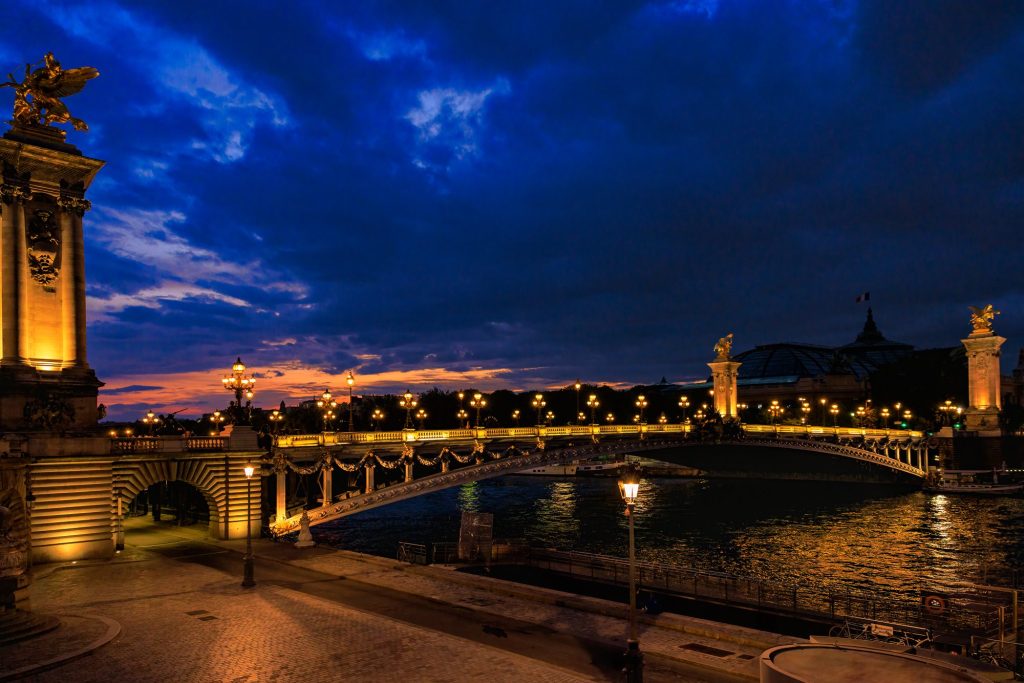
The Pont Alexandre III is a deck arch bridge that spans the Seine in Paris. It connects the Champs-Élysées quarter with those of the Invalides and Eiffel Tower. The bridge is widely regarded as the most ornate, extravagant bridge in the city. It has been classified as a French monument historique since 1975.
The Beaux-Arts style bridge, with its exuberant Art Nouveau lamps, cherubs, nymphs and winged horses at either end, was built between 1896 and 1900. It is named after Tsar Alexander III, who had concluded the Franco-Russian Alliance in 1892. His son Nicholas II laid the foundation stone in October 1896. The style of the bridge reflects that of the Grand Palais, to which it leads on the right bank.
The next bridge upstream on the Seine is Pont de la Concorde and the next bridge downstream is Pont des Invalides, which is the lowest bridge crossing the Seine.
Stacey Kent is an American jazz singer with a glorious voice. She was born in 1965 in New Jersey and is a graduate of Sarah Lawrence College. Her paternal grandfather was a Russian who grew up in France. He later moved to the United States where he taught Kent French. Once she learned French, it was the only language she spoke with her grandfather. Kent travelled to England after college to study music in London, where she met saxophonist Jim Tomlinson, whom she married in 1991.
Kent has also faced serious health challenges. In a 2004 interview with Robert Kaiser of The Washington Post, Kent recounted that she’s been in comas three times caused by brainstem encephalitis:
Each time, baffled doctors were not certain they could bring her back. The last coma was in 1999, and Tomlinson nursed her through it. On doctors’ advice, he brought records to her hospital room. When she awoke he was playing Mildred Bailey, one of the great jazz singers of the ’30s. “There’s just so much emotion in that voice,” Kent says. “It’s a cry - even when she’s singing a happy song.”
Jean-Jacques Goldman is very popular in the French-speaking world. Since the death of Johnny Hallyday in 2017, he has been the highest grossing living French pop rock act. He was born in 1951.
The film follows a French boy and an American girl who meet at the Château de Vaux-le-Vicomte — 50 minutes south of Paris — and begin a romance that leads to a journey to Venice where they hope to seal their love forever with a kiss beneath the Bridge of Sighs at sunset.
Diane Lane portrays an affluent, intelligent and charming teenager living in Paris. The scenes of Paris are glorious. Thelonious Bernard does a great job portraying the street smart French boy Diane Lane falls in love with. And Laurence Olivier adds a lot to the film.
Michel LeGrand (1932-2019) wrote the scores for more than 250 films including The Umbrellas of Cherbourg (1964) starring Catherine Deneuve and Yentl (1983), a creation of Barbra Streisand.
Ever since I was a boy, my ambition has been to live completely surrounded by music. My dream is not to miss out anything. That’s why I’ve never settled on one musical discipline. I love playing, conducting, singing and writing, and in all styles. So I turn my hand to everything – not just a bit of everything. Quite the opposite. I do all these activities at once, seriously, sincerely and with deep commitment.
Michel LeGrand
He recorded more than 100 albums, with Maurice Chevalier, Kiri Te Kanawa, Sarah Vaughan, Lena Horne among others. Others who recorded his music included Frank Sinatra and Sting.
He died on January 26, 2019. He was 86 years old. He was laid to rest at the Père Lachaise Cemetery.
Downie likes to walk and so do I. His book is divided into “Paris People”, “Paris Places” and “Paris Phenomena.” It is the places that interested me the most. For example, Downie describes a long walk along the Seine that I decided to replicate. It transformed my view of Paris because I learned how much of the city revolves around the river. I also learned just how small the city is geographically and how it seems that almost every centimeter of the city has been lovingly cultivated.
The walk begins at France’s gigantic national library — Bibliothèque nationale de France. This is the largest library I have ever seen; it houses more than 15 million books and journals. It is located near the Métro station Bibliothèque François Mitterrand right along the Seine. But not much else is nearby. The location feels desolate, modern and suburban, although the library remains within Paris’s Périphérique or beltway.
However, it was unclear to me from reading the book where the walk ended so I emailed the author who cheerfully responded with the details and even suggested a nice, reasonably priced restaurant for lunch right along the walk. The restaurant is La Fregate and is at the only spot on the walk where you have to go up to the sidewalk from the river.
I watched the city transform from stark, modern suburbs and eventually came upon Notre Dame and the Eiffel Tower and on to its terminus at the Pont Mirabeau. I will never forget Le Pont Mirabeau after reading Guillaume Apollinaire’s poem in high school breathing life and love into the bridge. Seeing Le Pont Mirabeau at the end of this day-long walk was special.
The entire walk was about 10 km or 6.2 miles. The transformations within that short distance speak volumes about Paris.
At Downie’s suggestion, I also visited Buttes-Chaumont park which is even more impressive than Mr. Downie describes. He knows Place des Vosges like the back of his hand so that chapter is exceptional.
On top of the wonderful details that make Paris come to life, Downie’s prose shows a love and mastery of the English language that I appreciate. This gem of a book will teach you so much about Paris and make you want to return again and again or just to go to Paris and remain as Downie has.
LE PONT MIRABEAU
Guillaume Apollinaire

Sous le pont Mirabeau coule la Seine
   Et nos amours
         Faut-il qu’il m’en souvienne
La joie venait toujours après la peine

        Vienne la nuit sonne l’heure
        Les jours s’en vont je demeure

Les mains dans les mains restons face à face
   Tandis que sous
        Le pont de nos bras passe
Des éternels regards l’onde si lasse

        Vienne la nuit sonne l’heure
        Les jours s’en vont je demeure


L’amour s’en va comme cette eau courante
  L’amour s’en va
    Comme la vie est lente
Et comme l’Espérance est violente

          Vienne la nuit sonne l’heure
          Les jours s’en vont je demeure

Passent les jours et passent les semaines
    Ni temps passé
    Ni les amours reviennent
Sous le pont Mirabeau coule la Seine

          Vienne la nuit sonne l’heure
          Les jours s’en vont je demeure