Cahors lies roughly 110 kilometers north of Toulouse, tucked into southwest France along a dramatic bend in the Lot River. The Lot itself is a long, winding waterway—about 480 kilometers in length—that rises in the Cévennes Mountains near Mont Lozère and flows westward through limestone valleys and vineyards before eventually joining the Garonne River near Aiguillon. In Cahors, the river curves almost completely around the old town, shaping both its geography and its history.
Cahors feels both geographically and psychologically distant from the great urban centers of France. I was there with the Alliance Française of Washington, and traveling with a group that shares such a deep appreciation for French history and culture made every discovery more meaningful. Yet one structure, above all others, has stayed with me: the Pont Valentré.
The Pont Valentré: A Masterpiece of Stone

I have seen many of the world’s great bridges. Some are elegant, some monumental, others purely functional. But for me, the quiet power and restrained beauty of the Pont Valentré stands apart. To call it merely “old” is an understatement. It is majestic—a staggering feat of 14th-century engineering that commands the Lot River with calm authority.
Construction of the bridge began in 1308, commissioned by the consuls of Cahors to strengthen the city’s defenses and secure control of this vital river crossing during a period of frequent conflict. Built entirely of local stone, the bridge took nearly 70 years to complete, a testament to both medieval ambition and the sheer difficulty of such a project.
With its three fortified towers, thick arches, and narrow passageway, the bridge was conceived not merely as a crossing, but as a defensive structure—a fortified bulwark designed to protect the city as much as to connect it. What struck me immediately was its absolute integrity. The Pont Valentré does not rely on ornament to impress. Its beauty comes from its perfect proportions, its clarity of purpose, and its sheer defiance of time. Stone laid more than seven hundred years ago still carries weight, meaning, and history—without apology.
Recognized as a UNESCO World Heritage Site, the Pont Valentré is preserved not only for its architectural excellence but as an exceptionally intact example of medieval military engineering integrated into an urban landscape.
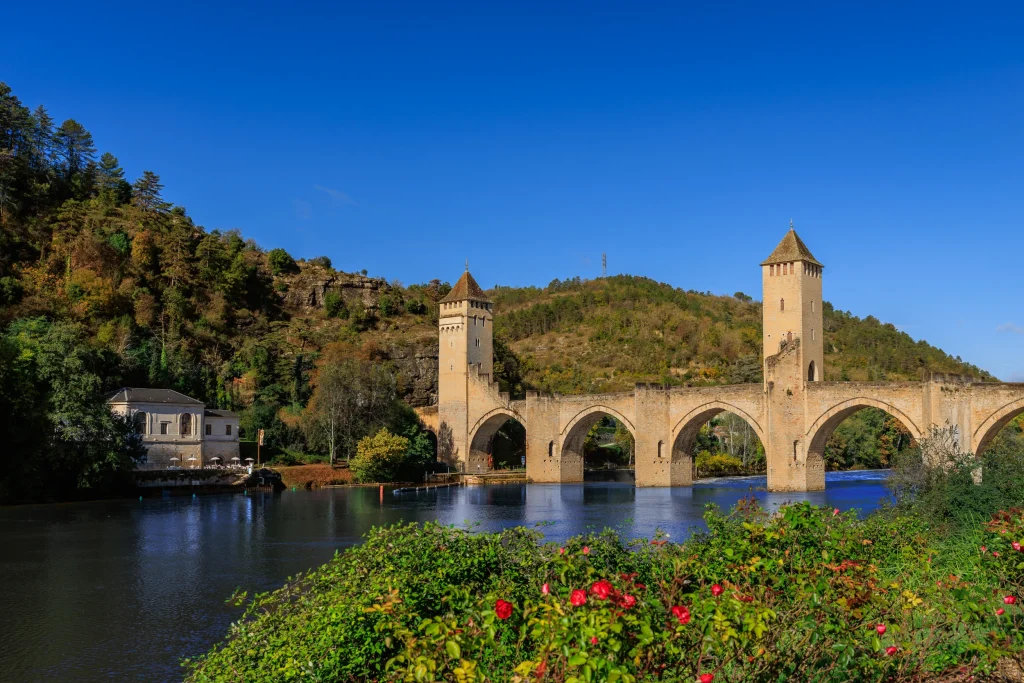
There is, of course, the famous legend associated with the bridge. According to local lore, the builder, frustrated by delays, made a pact with the devil to ensure its completion. When the work was finished, the builder outwitted him by assigning an impossible task—fetching water in a sieve—thus saving his soul. Whether one believes the story or not, the bridge feels almost mythic, as though it belongs as much to folklore as to history. When human ingenuity and endurance reach this level, legend feels almost inevitable.
I found myself comparing it to the Pont Alexandre III in Paris, because both are undeniably beautiful. The Parisian bridge is ornate, celebratory, and dazzling—a triumph of decoration and modern confidence. The Pont Valentré, by contrast, is elemental. It does not decorate the landscape; it belongs to it. It is not merely a monument—it is a survivor.
Beyond the Bridge: Château de Haute-Serre
The day continued with a visit to Château de Haute-Serre, a vineyard renowned for producing some of the region’s most distinguished Malbecs. Though it lies only about 10 kilometers—roughly a 15-minute drive—from Cahors, the estate feels far removed from the town. The road gradually leaves the river behind, rising into open countryside until you arrive at a place that feels notably quieter and more self-contained.
The contrast between the rugged medieval stone of the morning and the meticulously cultivated land of the afternoon was striking. At Haute-Serre, I felt an immediate sense of calm—a peaceful stillness born of space, order, and the slow rhythm of agricultural life rather than urban movement.
The estate unfolds across gently rolling terrain, with vines carefully tended and precisely aligned. Yet what impressed me most was the discipline of the operation itself. The winery was immaculate—spotless in a way that spoke to seriousness, precision, and deep respect for the craft. It was, quite literally, so clean that you felt you could eat off the floor.
We enjoyed an elegant three-course luncheon created especially for the Alliance Française of Washington. We began with a cream of pumpkin soup accented by Lardo di Colonnata, garlic croutons, and walnut oil. This was followed by duck breast served with carrot mousseline, kaffir lime, multicolored carrots, and an orange gastrique. Dessert was a refined praline mille-feuille.

The food was exceptional, the wine a revelation—structured, expressive, and unmistakably rooted in its terroir. Nothing about the experience felt rushed or performative. There was only a quiet confidence, born of tradition, patience, and care.
Final Reflections
Cahors and its surroundings reward those willing to slow down, learn a bit of history, and truly look. The region feels light-years away from Paris—calmer, quieter, and deeply grounded.
From the enduring stone of the Pont Valentré to the hushed order of Château de Haute-Serre, I was struck by a shared sensibility: places built with seriousness, maintained with care, and allowed to exist without spectacle. Whether medieval or modern, these are places that do not ask for attention—they earn it.
The Pont Valentré is remarkable not because it is decorative, but because it has endured—doing exactly what it was engineered to do for centuries. Paired with the excellence of Château de Haute-Serre and the shared pleasure of traveling with such thoughtful companions, Cahors reminded me that when tradition is taken seriously, it remains very much alive.
Some places impress you in the moment.
Others stay with you.
Cahors belongs firmly in the second category.