During World War II, Switzerland maintained extensive and highly profitable economic ties with Nazi Germany, a relationship that has been a subject of significant historical scrutiny.
The Bergier Commission: The Swiss government’s own independent inquiry, the Bergier Commission, conducted the most comprehensive study of Swiss relations with Nazi Germany, documenting extensive economic ties across banking, industry, transport, and insurance. Final Report – synthesis PDF.
Banking and gold: The Swiss National Bank (SNB) and commercial banks purchased large quantities of gold from the German Reichsbank, much of it looted from occupied Europe and victims of Nazi persecution — a pattern detailed in the official U.S. government Eizenstat report and in the SNB’s own historical study. State Dept. summary; SNB report PDF.
Industry and exports: Swiss firms supplied Germany with machinery, precision instruments, and war-relevant goods. Official research shows Swiss exports of war-relevant goods rose from 47 million CHF in 1937 to 425 million CHF in 1943. Bergier economic chapter – PDF. Additional Bergier studies found that munitions exports overwhelmingly favored the Axis. Swissinfo summary.
Prefabricated barracks and espionage. Declassified U.S. intelligence records detail the activities of SS officer Hans Wilhelm Eggen, a close associate of Heinrich Himmler. These documents show that Eggen both arranged multi-million-franc purchases of prefabricated huts from Swiss suppliers and used these transactions as cover for building an SS intelligence network and managing clandestine finances in Switzerland. CIA Reading Room – doc 1; CIA Reading Room – doc 2
Whatever one calls Switzerland’s political stance, the historical record shows that Swiss institutions and companies actively engaged in — and profited from — economic relationships with Nazi Germany across finance and industry. Bergier Commission portal.
During my recent visit to Gdańsk, I stopped at the Museum of the Second World War. Even before stepping inside, the building grabbed my attention. It was designed by Studio Architektoniczne Kwadrat, the winners of an international competition in 2010 for the museum’s architecture.
The structure is bold and unsettling—its sharply angled form slices upward from the earth like a wound. The massively leaning tower seems to rise from underground, symbolizing the rupture of war and the tension between past and present. In many ways, the outer architecture spoke louder to me than the exhibits inside.
Museum of the Second World War in Gdańsk
This was my first visit, and I came genuinely curious: how does Poland tell the story of World War II?
The answer turned out to be complicated. The museum presents a deeply Polish view of the war—understandably so, given Poland was invaded and brutalized by both Nazi Germany and the Soviet Union. The exhibition highlights this trauma and the bravery of the Polish people. But as a resource on broader wartime history or its moral complexities, I found it less impressive.
In particular, I noticed what wasn’t there. Polish antisemitism before, during, and after the war is barely addressed. The role of Polish collaborators or bystanders in the persecution of Jews is downplayed or ignored. Instead, the narrative leans heavily into Polish heroism and victimhood, avoiding harder truths that also belong to the historical record. I don’t raise this to diminish Polish suffering—but because good history demands honesty, even when it’s uncomfortable.
This criticism isn’t mine alone. When the museum opened in 2017, it was widely praised for its inclusive, civilian-focused narrative. Historian Timothy Snyder called it “perhaps the most ambitious museum devoted to the second world war in any country”. But soon after, the Law and Justice Party (PiS)-led government began reshaping its direction. Minister Piotr Gliński dismissed founding director Paweł Machcewicz, and a group of 500 historians and academics signed an open letter condemning the changes as “unacceptable, even barbaric interference,” accusing the government of turning the site into a “propaganda institution.” These developments are also explored in a blog post by Cameron Hewitt for Rick Steves Europe: Poland’s New World War II Museum — Who Gets to Tell the Story?
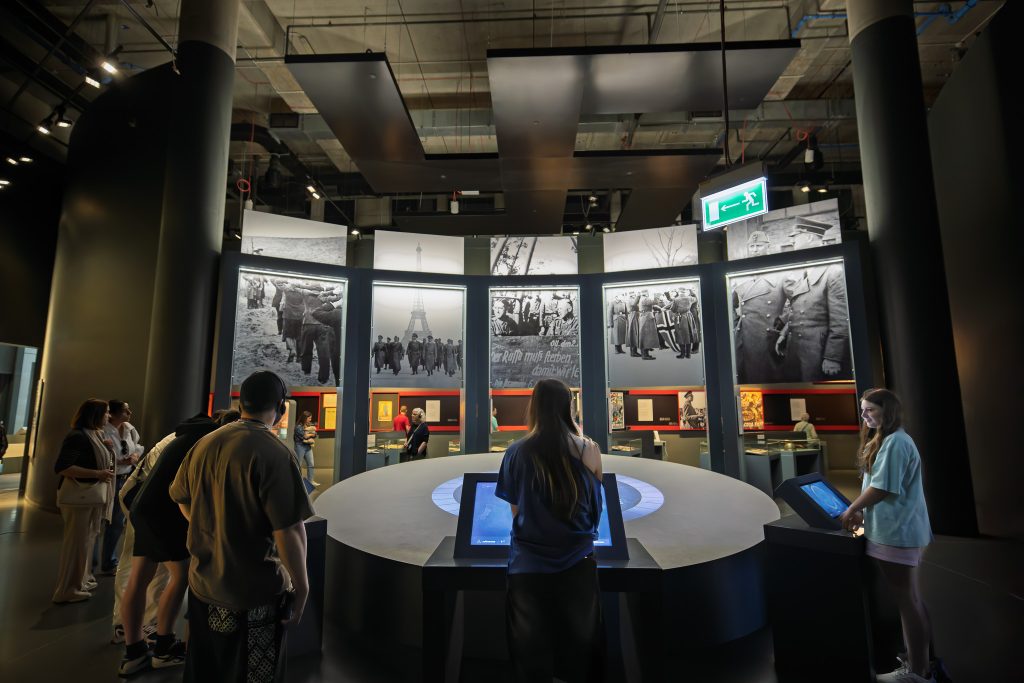
Visitors interact with digital displays beneath stark black-and-white images at the Museum of the Second World War in Gdańsk.
By contrast, the POLIN Museum of the History of Polish Jews in Warsaw offers a more introspective experience. POLIN confronts Polish complicity, antisemitism, and the full arc of Jewish life in Poland—including the violent aftermath of WWII. It trusts visitors with complexity and nuance; here, questions aren’t only raised—they’re interrogated.
I left the Gdańsk museum feeling I understood more about how Poland sees World War II—and less about the war itself. In that sense, the museum is valuable—but not as a comprehensive or balanced historical resource. It’s a window into national memory, shaped by architecture, politics, and selective storytelling.
If you’re visiting Gdańsk, I still recommend walking around the museum. The building alone is worth the stop. But if you’re seeking a fuller understanding of WWII and its legacy in Poland, there are richer, more honest places to begin—like POLIN in Warsaw or the memorials at Auschwitz-Birkenau.
The Museum of the Second World War is a striking architectural shell—but what it chooses not to say may be its most telling feature.
I recently returned from a journey through Poland—a place both beautiful and burdened. As I walked the streets of Warsaw, Kraków, and smaller towns tied to my family’s past, I found myself reckoning not just with personal memory, but with the immense suffering and resilience that have shaped this country.
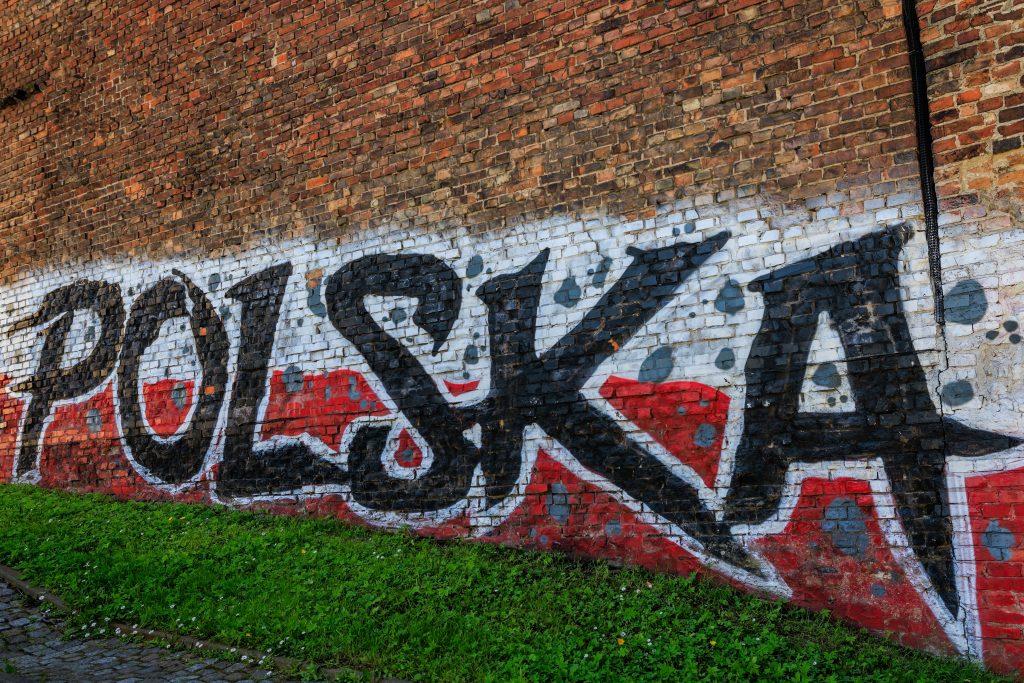
Graffiti spelling “POLSKA” on a brick wall in Gdansk. Pride, resilience, and memory coexist in Poland’s streets—just as they do in its history.
Poland was not only the first victim of World War II—it was also one of the most devastated. In 1939, it was invaded and carved up by two brutal regimes: Nazi Germany from the west, and the Soviet Union from the east. What followed was a six-year onslaught of destruction, repression, and mass murder.
By war’s end, an estimated six million Polish citizens were dead—roughly 17% of the population. Half of them were Jews murdered in the Holocaust. The other half were primarily ethnic Poles who perished in bombings, executions, forced labor, resistance fighting, and Soviet purges (Wikipedia – World War II casualties of Poland).
The physical destruction was staggering. Warsaw, the capital, was deliberately reduced to rubble after the 1944 uprising—85 to 90 percent of the city was destroyed. Nationally, about 30% of Poland’s infrastructure and wealth was lost, and over 40% of its cultural property—including archives, libraries, and religious sites—was looted or obliterated (Polish War Reparations Bureau – Wikipedia summary).
Yet even after the war, Poland was not free. Instead of liberation, it fell under Soviet domination. For nearly five decades, the Polish people lived under Communist rule imposed by Moscow. The state censored speech, imprisoned dissenters, and suppressed any honest reckoning with what the country had endured.
But Poland’s vulnerability didn’t begin in 1939. From the late 18th century until the end of World War I, Poland did not exist as an independent nation. For more than a century, it was partitioned by Russia, Prussia, and Austria—wiped off the map. My father was born in 1916, during that period of nonexistence. Poland would only re-emerge as a sovereign state in 1918, two years after his birth, following the end of the Great War.
Then came the Second World War, bringing unimaginable suffering. My father, born near Częstochowa, survived the HASAG slave labor camp and was later imprisoned at the Gross-Rosen concentration camp, and from there transferred to Flossenbürg and Dachau. He was one of the very few to survive. His parents and most of his extended family were murdered. For my father—as for so many Polish Jews—there was no going home.
Today, Poland is a member of NATO, and there is hope that the alliance provides the kind of protection it lacked in the past. But I find myself wondering: Would NATO and the United States truly defend Poland if attacked by Russia? Or would the West abandon Poland again, as it did in 1939? I don’t know the answer. I hope we never have to find out.
Yet there is another truth I cannot ignore. As a Jew, I deeply value Poland’s efforts to remember the Holocaust—through museums, memorials, and scholarship. I was moved by what I saw. But I also felt that Poland has yet to fully come to terms with the long history of antisemitism that predates Nazi Germany. I say this not in a spirit of accusation, but of reflection. While Germany has publicly and institutionally confronted its role in the Holocaust, Poland has often struggled to acknowledge how deeply antisemitism was woven into the social fabric—even before the war. There were Poles who risked everything to save Jews, and they deserve enduring honor. But there were also Poles who betrayed, exploited, or turned away—and that, too, must be faced.
What struck me most during my visit was how present the past still feels. The scars are visible—in the rebuilt bricks of Warsaw’s Old Town, in the memorials to the ghetto, and in the ruins left untouched as testimony. But so too is the resilience. I saw it in young people reclaiming their history, in museums that confront difficult chapters, and in quiet moments of beauty: the light on cobblestones, the music in cafés, the sound of Polish spoken freely.
Before leaving, I asked a guide whether people in Poland today worry about defending their borders. He hesitated—perhaps reluctant to speak directly. But I sensed that the question lingered beneath the surface. Many Poles today do worry about their security, especially in light of Russia’s war against Ukraine. The country is investing heavily in defense and leans firmly on its NATO membership. Yet there is also a quiet anxiety—born of history—that Poland might again be left to face aggression alone.
Still, life goes on. There’s a tension here: between living with history and not being consumed by it. Poles carry that burden with remarkable dignity.
Poland’s story is not only one of tragedy. It is also a story of survival, rebuilding, and memory. Visiting gave me a deeper appreciation not only for what this country has lived through, but also for the dignity with which it remembers—and the silences it still must break.
Abram Enzel was born in Częstochowa, Poland, on June 18, 1916, to Chaim and Faigle Enzel. Chaim worked as a kosher butcher. They had five children — three boys and two girls — with Abram as the firstborn. In 1939, there were 28,500 Jews living in Częstochowa, about 124 miles (200 km) southeast of Warsaw.
The Germans entered Częstochowa on Sunday, September 3, 1939, and persecution of its Jews began immediately. More than 300 Jews were killed the following day, in what became known as “Bloody Monday.” On December 25, 1939, a second pogrom took place, and the Great Synagogue was set on fire. The family survived both pogroms.
On the morning after Yom Kippur in September 1942, Abram was separated from his family. One brother, Nathan, had previously been taken by the Germans to a concentration camp. The rest of Abram’s family was gassed and cremated three days later in Treblinka.
Abram was sent to work in a munitions plant operated by HASAG (Hugo Schneider Aktiengesellschaft-Metalwarenfabrik, Leipzig), one of the largest German industrial companies using concentration camp prisoners to manufacture armaments. HASAG was the third largest such company after I.G. Farben and the Hermann Göring Werke. It operated four camps in Częstochowa, the largest of which — HASAG-Apparatebau — held 7,000 Jewish prisoners. The wages of these forced laborers were paid directly to the SS. Those unfit for work were killed under the policy of Vernichtung durch Arbeit (“extermination through work”). From July 1944 to early 1945, HASAG moved most of its equipment and Jewish workers to Germany. No HASAG personnel were tried by the Allies at Nuremberg.
In 1944, Abram was transferred from HASAG to Gross-Rosen, then to Flossenbürg, and finally to Dachau. One of his most haunting memories was the transfer from Flossenbürg to Dachau with 500 prisoners. In a 1973 Pittsburgh Press interview, Abram recalled: “They made us march at first. But later they herded us like cattle on some old freight cars.” Only 18 of the 500 survived to reach Dachau — Abram among them.
On April 29, 1945, the 42nd and 45th Infantry Divisions and the 20th Armored Division of the U.S. Army liberated Dachau. The next day, Adolf Hitler committed suicide. Abram weighed just 78 pounds at liberation, compared to a healthy 130 pounds before the war.
By June 1946, 2,167 Jews had returned to Częstochowa, but Abram chose not to. He recovered in Germany, ran a grocery store in Bayreuth, and emigrated to the United States in 1951, settling in Pittsburgh, Pennsylvania.
In Pittsburgh, Abram met Dora Weiss, a survivor from Munkács, Czechoslovakia (now Mukačevo, Ukraine). Her parents were murdered in Auschwitz. They married on June 8, 1952, and had one son, David, born January 21, 1955.
Dora died of cancer on July 30, 1958, at age 35. Abram never remarried. He worked at H.J. Heinz before joining the Concordia Club, where he rose from busboy to maître d’. He considered his 30 years there the happiest of his life.
David moved to Washington, D.C., in 1979. Abram retired in 1981 and soon followed. He died on May 10, 1994, in Washington, the capital of the country that had liberated him.
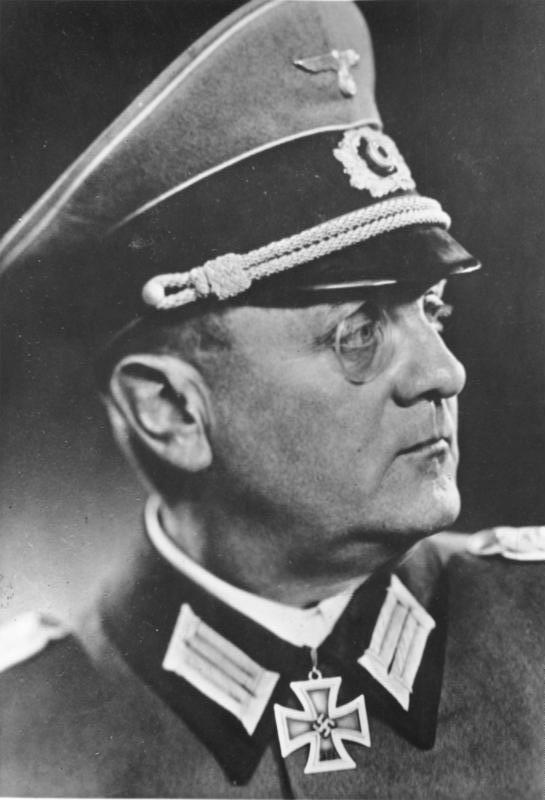
Dietrich v. Choltitz — Bundesarchiv, Bild 183-R63712 / CC-BY-SA 3.0, CC BY-SA 3.0 DE via Wikimedia Commons
At the end of WWII, Adolf Hitler ordered Choltitz to hold Paris, but if that wasn’t possible, to destroy it. Although General Choltitz had been very loyal to Hitler, he could not bring himself to obliterate the City of Light. He ultimately surrendered Paris to French forces on August 25, 1944. He’s been called the “Saviour of Paris” for preventing its destruction.
After his surrender, Choltitz was held for the remainder of the war in London and the United States and was ultimately released from captivity in 1947. He died in Baden-Baden in 1966.
The author of this exceptional book was the distinguished political scientist and biographer Jean Edward Smith. Smith’s work includes highly regarded biographies of Ulysses S. Grant and Dwight D. Eisenhower. He died on September 1, 2019 at the age of 86.