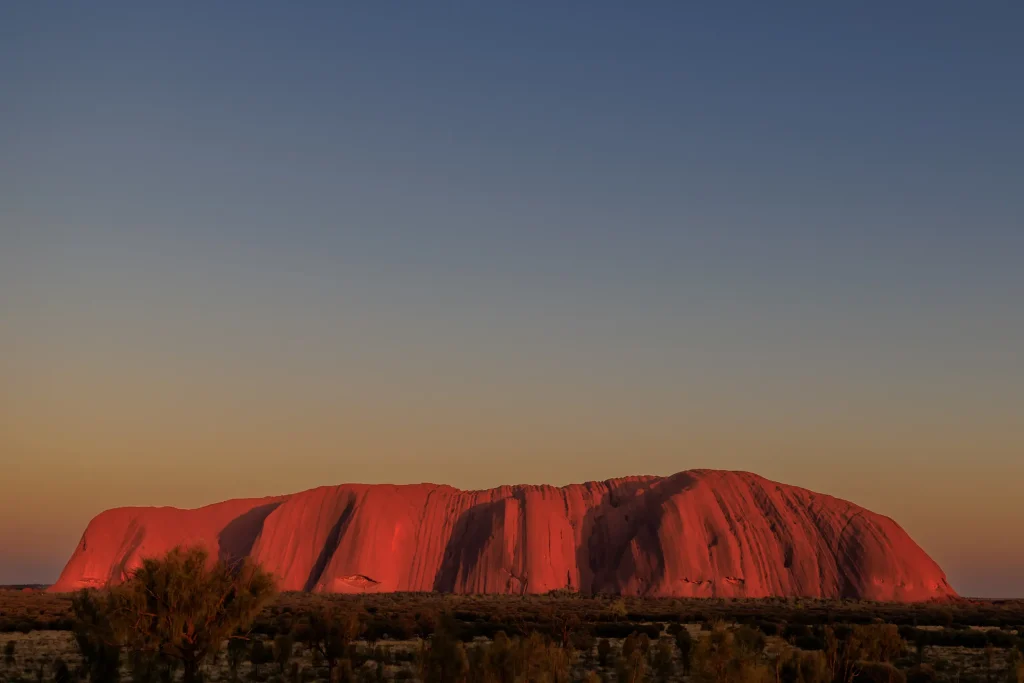
Uluru, also known as Ayers Rock, sits in the center of Australia’s Northern Territory, far from the country’s major cities. It is roughly 1,800 miles from Sydney—a reminder of how vast Australia is, and how remote this landscape remains. The flight from Sydney is about three and a half hours nonstop.
What reinforces that sense of remoteness is the absence of anything resembling a traditional town. Uluru lies within a national park, and there is no permanent settlement at the site itself. Visitors stay nearby in Yulara, a small, purpose-built community created to support tourism. With a population of under a thousand, it consists largely of hotels, restaurants, an airport, and staff housing. Beyond that, the surrounding region remains sparsely populated, apart from Indigenous communities connected to the land. The result is a place that feels deliberately set apart—an outpost rather than a destination that grew organically over time.
People go to Uluru for different reasons. For some, it is a landmark—one of the most recognizable natural sites in the world. For others, it is a place of cultural significance, deeply connected to the traditions of the Anangu people, the traditional custodians of the land. And for many visitors, it is simply a chance to experience a part of Australia that feels entirely different from its coastal cities.
Surprisingly, relatively few Australians have been there. Estimates vary, but it is often said that only a minority—perhaps 20–30%—have made the trip. The reasons are practical. Uluru is remote, travel is time-consuming and expensive, and most Australians live along the coast. Whether that reflects a preference for beaches and a more relaxed coastal lifestyle, or simply geography and convenience, is hard to say. But the distance alone is enough to explain why many have not gone.
What struck me most was not the scale of Uluru, but its presence. At sunrise, the rock changes color gradually, moving through deep reds and softer tones as the light shifts. It is not dramatic in the way of a sudden reveal. It is quieter than that, but no less compelling.
If you go in the Australian summer, be prepared for the heat. During my visit the temperature at Uluru reached a high of 41.6°C (106.9°F) and a low of 24.5°C (76.1°F). For me this was a new record. The humidity was low (around 20%), but it was so hot you could fry an egg on the ground. There are also bush flies—persistent, almost comically so. They don’t bite, but they constantly land on you, drawn to any hint of moisture. Many people wear fly nets over their hats. I simply shooed them away. They were more a distraction than anything else.
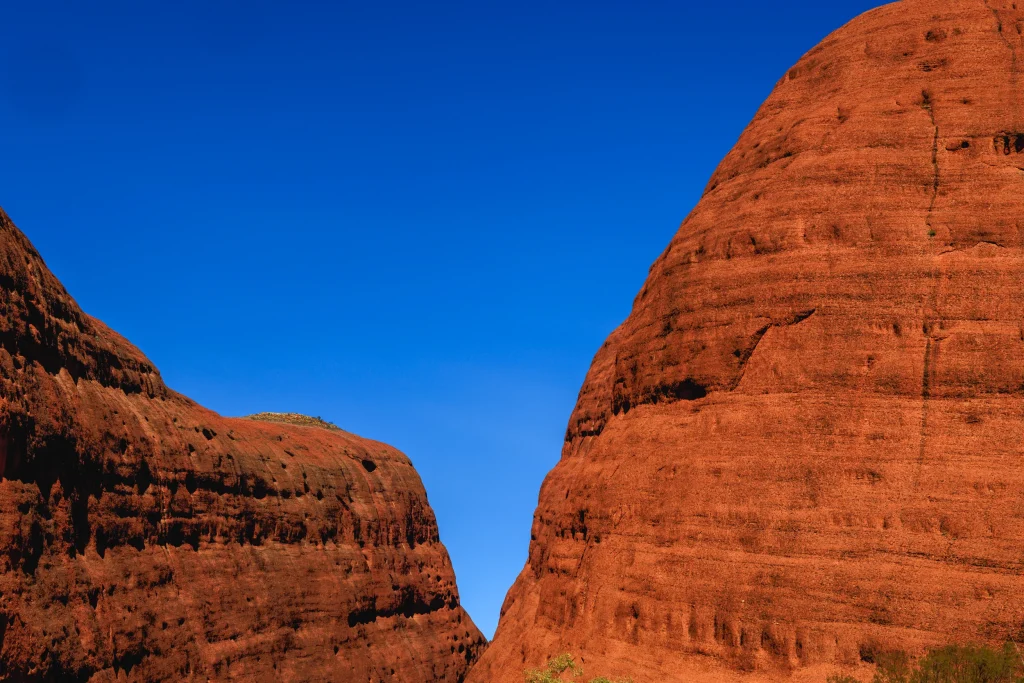
A short distance to the west are Kata Tjuṯa (the Olgas), a series of large domed rock formations that are equally worth visiting. If Uluru is singular and iconic, Kata Tjuṯa feels more complex—less immediately recognizable, but perhaps more varied as a landscape.
One evening, we attended the outdoor dinner experience known as “Sounds of Silence.” Set against the desert, it combines a meal with a view of the setting sun over Uluru. As the light fades, the temperature drops and the sky opens. With little ambient light, the stars become the main event. A single telescope was set up, but it was powerful enough to bring distant objects into clear view. Even without it, the night sky was striking.
The environment is unforgiving, and that too shapes the experience. It is not a place you wander casually; it demands a certain awareness and respect.
We also enjoyed learning through a guided visit with an Indigenous guide. She spoke in her own language, with an Australian guide translating. The cadence of her speech, even before translation, conveyed a sense of connection to the land that is difficult to describe. She wore socks but no shoes in the blazing heat and seemed entirely unfazed—another quiet reminder that this was her environment in a way it could never fully be mine. It underscored that Uluru is not simply a geological formation, but a place with layers of meaning that extend beyond what a visitor can easily grasp.
Uluru is often described as a “must-see,” but that phrase feels inadequate. It is better understood as a place that exists on its own terms—remote, culturally significant, and shaped as much by absence and distance as by what is immediately visible.