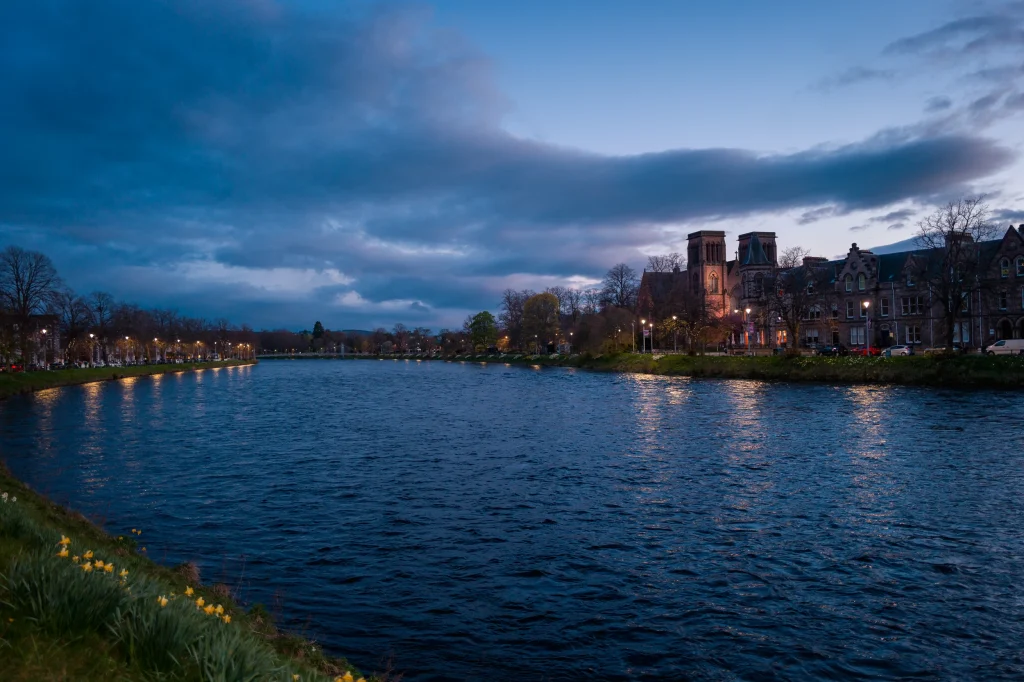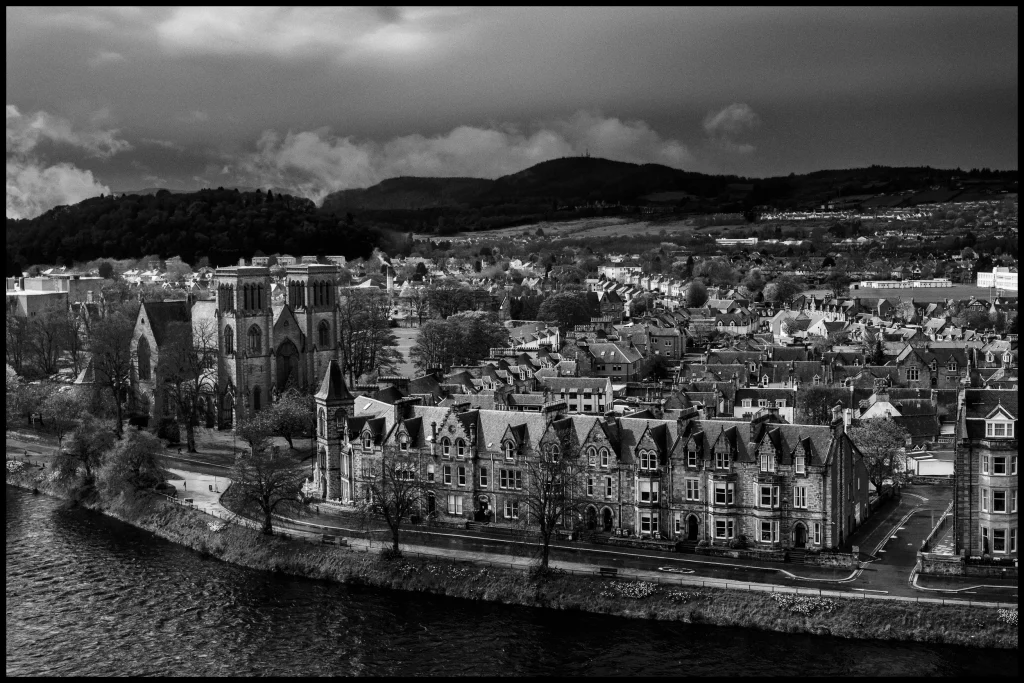
When I arrived in Inverness, I didn’t fully appreciate how far north I had come. The city sits at roughly the same latitude as Sitka, Alaska. Up here, the weather doesn’t simply change—it can shift with astonishing speed. One local told me that four seasons often pass in the span of ten minutes.
I learned that firsthand on a gray, sodden day. Wanting to visit Inverness Castle, I finished my lunch and hoped the downpour would ease. It didn’t. Eventually I pulled up my collar and headed out into the rain anyway.
By the time I climbed the hill and reached the summit, the sky had miraculously opened into brilliant sunshine. Below me, the River Ness wound through the city like a dark ribbon. Beyond the rooftops and church spires, the Highlands stretched toward a gray-green horizon that made me feel both small and fortunate to be standing there.
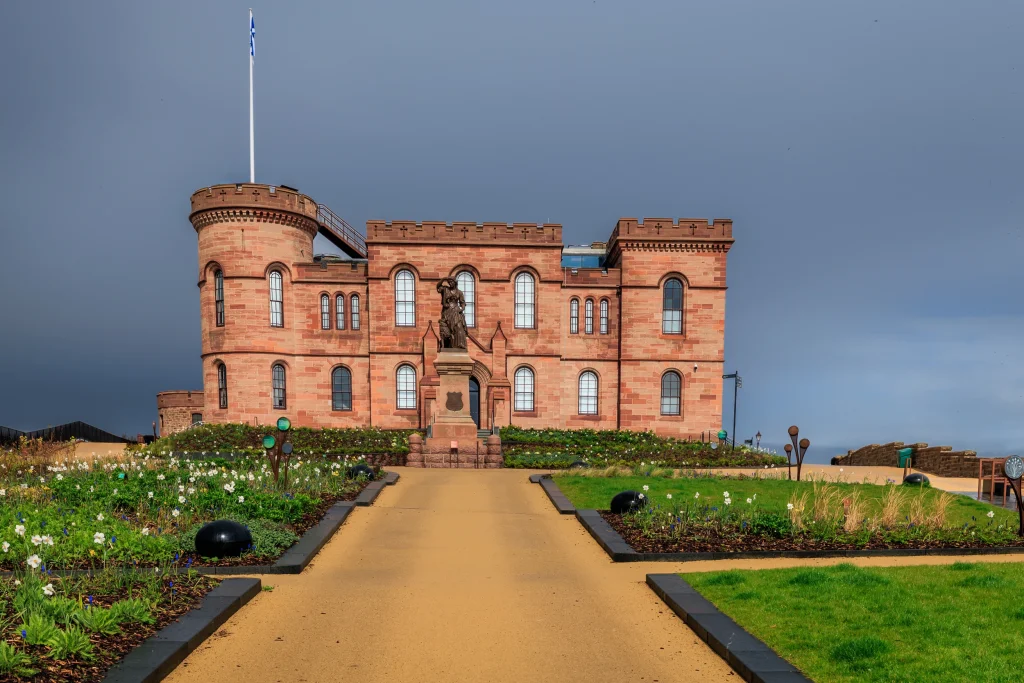
Inside, however, the illusion of a medieval fortress quickly dissolved.
A charming young guide—from Taiwan, as it turned out—explained that despite its imposing red sandstone facade, this “castle” is nothing of the sort. Built in the 1830s and 1840s on the site of earlier fortifications, it was designed as a courthouse and administrative center. For nearly two centuries, it housed the legal machinery of the Highlands. No drawbridges. No dungeons. Mostly paperwork.
Curious, I asked how she handled the famously unpredictable Scottish weather after growing up in Taiwan.
She shrugged, entirely unbothered.
“What brought you all the way to Inverness in the first place?” I asked.
“Love,” she said simply.
That single word stayed with me for the rest of the afternoon.
The former courthouse has recently been reimagined as a visitor center celebrating Highland culture, and tucked away inside I stumbled into something I never expected: three rooms devoted entirely to a Scottish rock band called Runrig.
I had never heard a single note of their music.
Runrig formed on the Isle of Skye in 1973, but they came to embody Highland culture in a way that is difficult to appreciate until you sit down and listen. They performed many of their songs in Scottish Gaelic at a time when the language was widely viewed as fading into history.
What struck me, sitting in that dim room with the music filling the space around me, was how little it resembled mourning. It was defiant, energetic, communal—the sound of people who had decided their culture was worth fighting for rather than merely remembering.
The song that stopped me in my tracks was their rendition of Loch Lomond.
Most people recognize the melody. Fewer know the story commonly associated with it.
The song is often linked to the aftermath of the Jacobite Rising of 1745 and the catastrophic defeat of the Highland clans at Culloden, only a few miles from Inverness. One traditional interpretation imagines a condemned Jacobite prisoner speaking to a companion who will eventually return home to Scotland. The “low road” is not a physical route. According to folklore, it is the path taken by the dead, whose souls would return home before any living traveler could make the journey.
Yet when Runrig performed the song, they did not treat it as a funeral lament. They drove it forward with electric guitars, accordions, and footage of enormous crowds singing in unison. They had taken a centuries-old lament and turned it into the sound of a culture refusing to disappear.
The emotional impact hit hard because I had walked the battlefield of Culloden just that morning.
You approach it across a flat, windswept moor, the kind of landscape that seems designed to offer no shelter and no mercy. Small markers identify where clan regiments made their final stand: Fraser. MacKintosh. Mixed Clans.
The battle itself lasted less than an hour.
I stood at one of those stones and tried to absorb what that meant—not the military history, which I knew in outline, but the human arithmetic of it. Each of those clan names represented not just soldiers but a web of families, language, traditions, and ways of life that the defeat would begin to unravel. Gaelic came under increasing pressure. Highland communities were gradually transformed, and many families were eventually driven from land they had worked for generations.
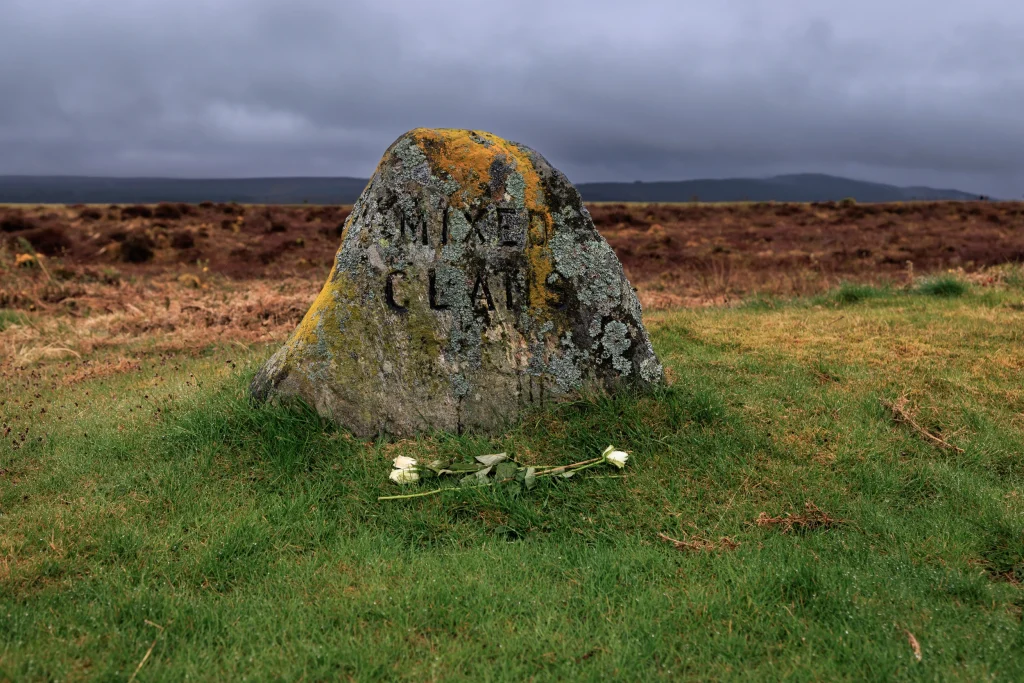
Standing there, it is easy to imagine the Highlands as a place defined primarily by loss.
But Inverness doesn’t feel that way.
Down by the river sits Leakey’s Bookshop, housed in a magnificent former Gaelic church. Towering shelves rise toward vaulted ceilings. A massive wood-burning stove crackles in the center of the room. Staircases wind upward through galleries packed with secondhand books.
It is one of the largest secondhand bookshops in Scotland.

By any purely rational economic measure, a bookstore of this scale seems unlikely in a northern city of only about 66,000 people. Yet on a rainy afternoon the place hummed with life. Readers browsed the shelves. Conversations drifted through the air. The stove glowed warmly against the damp weather outside.
That is what surprised me most about Inverness.
It refuses to carry itself like a place burdened by history.
The architecture along its Victorian streets feels confident rather than nostalgic. The people are warm, direct, and completely matter-of-fact. The guide from Taiwan shrugged off the gray weather and stayed simply because of love.
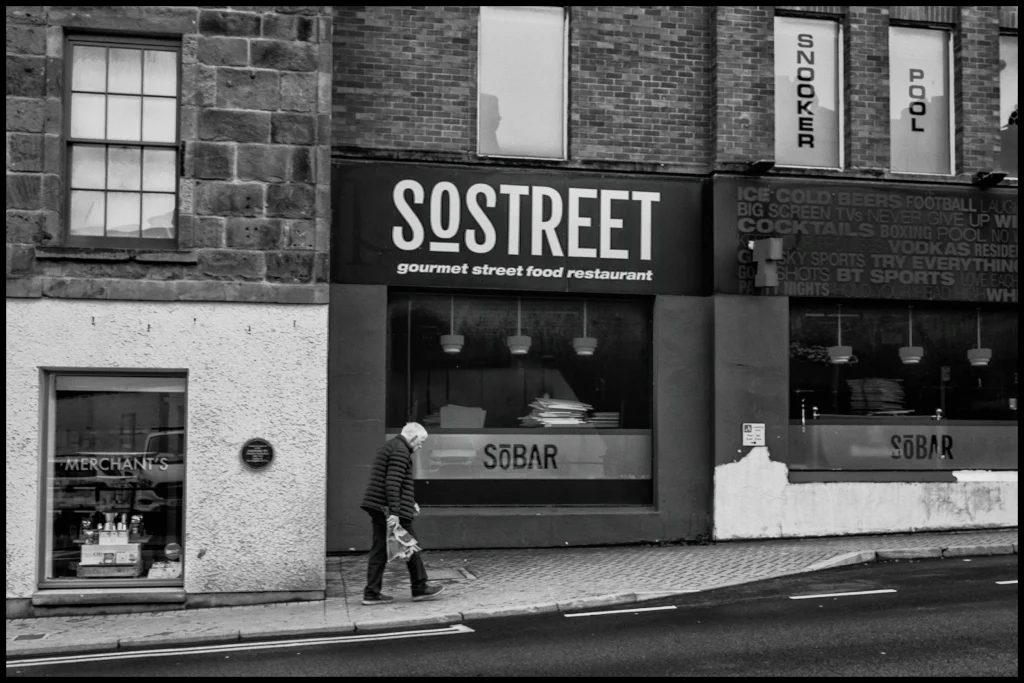
The city on the Ness has acknowledged its past without becoming trapped by it.
The Highlands have survived defeat, forced emigration, harsh weather, and centuries of change. But walking through Inverness, listening to Runrig, and watching the dark waters of the River Ness move quietly toward the sea, what you feel in the air is not the ghost of a tragedy.
It is pride.
Inverness is the gateway to the Highlands, as every travel brochure will tell you. What the brochures miss is that the Highlands still live there—in the music, the bookstores, the warmth of the people, and the quiet confidence of a city that long ago decided to keep going.
As evening settled over Inverness, the River Ness continued its journey toward the Moray Firth, indifferent to battles, politics, and centuries of change.