This towering sculpture of Japanese contemporary artist Yayoi Kusama stands on rue du Pont Neuf, between the Louis Vuitton headquarters and the Samaritaine. Bold, whimsical, and impossible to overlook, it stopped me in my tracks and turned an ordinary walk into a moment I’ll remember.
That stretch of the Pont Neuf was alive with the hum of Paris—buses rumbling past, the scent of fresh pastries drifting from a nearby café, and above it all, Kusama’s unmistakable polka dots adding a splash of surreal joy to the scene.
Yayoi Kusama—often called the princess of polka dots—is one of the world’s most distinctive living artists, known for her playful patterns and immersive installations.
As part of a trip to Greece in 2023, I visited Thessaloniki, the country’s second-largest city, with over one million inhabitants in its metropolitan area, and learned about the tragic fate of its Jews during the Second World War.
On the eve of the war, about 77,000 Jews lived in Greece, with roughly 56,000 in Thessaloniki. The city’s Jewish community was prominent in industry, banking, tourism, and the trades, with many working as laborers, artisans, and port workers.
The Germans invaded Greece on April 6, 1941, and occupied Thessaloniki three days later. The Jewish community council was arrested, apartments were seized, and the Jewish hospital was taken over by the German Army. Jewish newspapers in French and Ladino were shut down, replaced by antisemitic and collaborationist publications. The looting of literary and cultural treasures from libraries and synagogues was carried out by “Operation Rosenberg,” aided by the Wehrmacht. That first winter, some 600 Jews died from hypothermia and disease.
On July 11, 1942, 9,000 Jewish men aged 18–45 were ordered to gather in Liberty Square, where they were humiliated in the summer heat—a day remembered as “Black Saturday.” The Jewish community negotiated their release in exchange for a ransom, funded in part by selling the 500-year-old Jewish cemetery to the Municipality. The cemetery was destroyed, and its tombstones used as building material. About 2,000 men were sent as forced laborers; by October 1942, 250 had died under harsh conditions.
In February 1943, Jews were ordered into a ghetto in the Baron Hirsch quarter. Their property was confiscated, and deportations to Auschwitz and Treblinka began the following month. By August, nearly the entire Jewish population of Thessaloniki—some 54,000 people—had been murdered in the Holocaust.
The “Menorah in flames” sculpture, created in 1997 by Nandor Glid, commemorates these deportations. Glid (1924–1997), a Yugoslav sculptor, is also known for the memorial at the Dachau concentration camp. Installed since 2006 on Eleftherias Square, the site of the 1942 roundup, it was the first Holocaust memorial in a public space in Greece—a sign of changing official attitudes toward Holocaust remembrance. Sadly, it is regularly vandalized.
I also visited the Monastir Synagogue, built between 1925 and 1927 with funding from Jews from Monastir in the Kingdom of Yugoslavia. Architect Ernst Loewy (1878–1943) of Austria-Hungary designed it while working for the Austrian company that built the Thessaloniki–Vienna railway. During the war, the building survived by being requisitioned by the Red Cross. Severely damaged by a 1978 earthquake, it was later restored by the Greek government, with the final historic restoration completed in 2016 and supported by the Federal Republic of Germany.
Today, the synagogue is used primarily during the High Holidays. Daily services are held at a newer synagogue shared with the Rabbinate and the offices of the Jewish Community of Thessaloniki on Tsimiski Street, near the Jewish Museum.
Thessaloniki’s once-thriving Jewish community is gone, but the memorials, the synagogue, and the stories that remain keep its memory alive.
The Blue Angels, formally named the U.S. Navy Flight Demonstration Squadron, are a flight demonstration squadron of the United States Navy. Formed in 1946, the unit is the second oldest formal aerobatic team in the world, following the Patrouille de France which formed in 1931. The name was picked by the original team when they were planning a show in New York in 1946. One of them came across the name of the city’s famous Blue Angel nightclub in the New Yorker Magazine.
The U.S. Navy Blue Angels in tight diamond formation, slicing through the sky with precision during their airshow performance.
The team has six Navy and one Marine Corps demonstration pilots. They fly the Boeing F/A-18E/F Super Hornet and the Lockheed Martin C-130J Super Hercules. Each aircraft is painted in the Blue Angels’ iconic colors: vivid blue and gold. The sleek paint job, high-gloss finish, and striking design aren’t just for aesthetics—they’re also a point of pride and a hallmark of the professionalism the team embodies.
The Blue Angels typically perform aerial displays in at least 60 shows annually at 32 locations throughout the United States and two shows at one location in Canada. The “Blues” still employ many of the same practices and techniques used in the inaugural 1946 season.
One of the most famous formations of the Blue Angels is the “Diamond” (shown above), where four jets fly in tight, symmetrical formation with mere inches separating their wings. An estimated 11 million spectators view the squadron during air shows from March through November each year. Since 1946, the Blue Angels have flown for more than 505 million spectators.
The mission of the Blue Angels is to showcase the pride and professionalism of the United States Navy and Marine Corps by inspiring a culture of excellence and service to the country through flight demonstrations and community outreach.
The Blue Angels execute a high-speed crossover maneuver, their jets streaking in perfect alignment across a brilliant blue sky.
The Blue Angels and the Air Force Thunderbirds do not fly together. Department of Defense policy explains that the use of military aviation demonstration teams is for recruiting purposes; therefore the teams usually do not fly within 150 miles of each other without special permission.
The Blue Angels are a treasured part of American culture. Their air shows are among the most attended aviation events in the country, often drawing hundreds of thousands of spectators.
I saw the Blue Angels perform at the Sun ’n Fun Aerospace Expo in Lakeland, Florida on April 5, 2025. These photos are from that event. Watching the Blue Angels is an awe inspiring experience and a reminder of the skill and courage of those who serve.
Before the Second World War, Częstochowa’s Jewish community was thriving — nearly 40,000 people, about one-third of the city’s population. They played a central role in the city’s commerce, industry, and culture. Today, fewer than 100 remain.
The World Society of Częstochowa Jews and Their Descendants works to preserve this history. One of their recent projects was translating a rare 1936 Jewish newspaper from Częstochowa — a fragile time capsule of life before the German invasion.
Częstochowa, in southern Poland, is perhaps best known for the Pauline Monastery of Jasna Góra, home to the Black Madonna painting and a major pilgrimage site. But for my father, Abram Enzel, the city holds far more personal memories. When Germany invaded Poland in September 1939, Częstochowa’s Jews were forced into a ghetto and later deported to the Treblinka death camp. About 5,200 survived by working in HASAG, a forced labor camp on the city’s outskirts. My father was one of them.
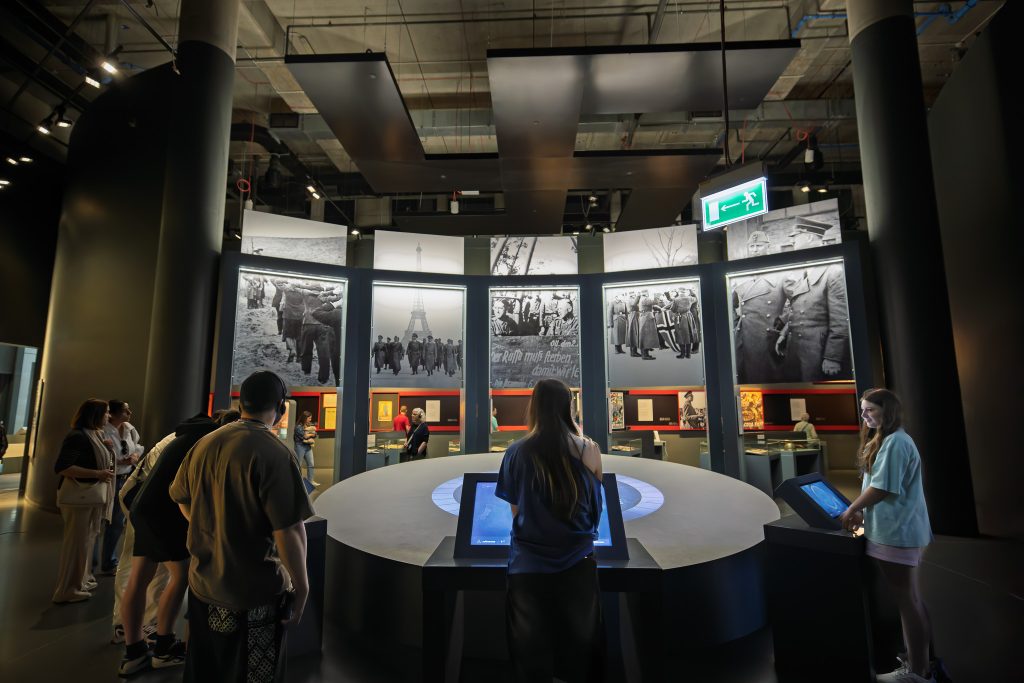
During my recent visit to Gdańsk, I stopped at the Museum of the Second World War. Even before stepping inside, the building grabbed my attention. It was designed by Studio Architektoniczne Kwadrat, the winners of an international competition in 2010 for the museum’s architecture.
The structure is bold and unsettling—its sharply angled form slices upward from the earth like a wound. The massively leaning tower seems to rise from underground, symbolizing the rupture of war and the tension between past and present. In many ways, the outer architecture spoke louder to me than the exhibits inside.
Museum of the Second World War in Gdańsk
This was my first visit, and I came genuinely curious: how does Poland tell the story of World War II?
The answer turned out to be complicated. The museum presents a deeply Polish view of the war—understandably so, given Poland was invaded and brutalized by both Nazi Germany and the Soviet Union. The exhibition highlights this trauma and the bravery of the Polish people. But as a resource on broader wartime history or its moral complexities, I found it less impressive.
In particular, I noticed what wasn’t there. Polish antisemitism before, during, and after the war is barely addressed. The role of Polish collaborators or bystanders in the persecution of Jews is downplayed or ignored. Instead, the narrative leans heavily into Polish heroism and victimhood, avoiding harder truths that also belong to the historical record. I don’t raise this to diminish Polish suffering—but because good history demands honesty, even when it’s uncomfortable.
This criticism isn’t mine alone. When the museum opened in 2017, it was widely praised for its inclusive, civilian-focused narrative. Historian Timothy Snyder called it “perhaps the most ambitious museum devoted to the second world war in any country”. But soon after, the Law and Justice Party (PiS)-led government began reshaping its direction. Minister Piotr Gliński dismissed founding director Paweł Machcewicz, and a group of 500 historians and academics signed an open letter condemning the changes as “unacceptable, even barbaric interference,” accusing the government of turning the site into a “propaganda institution.” These developments are also explored in a blog post by Cameron Hewitt for Rick Steves Europe: Poland’s New World War II Museum — Who Gets to Tell the Story?
Visitors interact with digital displays beneath stark black-and-white images at the Museum of the Second World War in Gdańsk.
By contrast, the POLIN Museum of the History of Polish Jews in Warsaw offers a more introspective experience. POLIN confronts Polish complicity, antisemitism, and the full arc of Jewish life in Poland—including the violent aftermath of WWII. It trusts visitors with complexity and nuance; here, questions aren’t only raised—they’re interrogated.
I left the Gdańsk museum feeling I understood more about how Poland sees World War II—and less about the war itself. In that sense, the museum is valuable—but not as a comprehensive or balanced historical resource. It’s a window into national memory, shaped by architecture, politics, and selective storytelling.
If you’re visiting Gdańsk, I still recommend walking around the museum. The building alone is worth the stop. But if you’re seeking a fuller understanding of WWII and its legacy in Poland, there are richer, more honest places to begin—like POLIN in Warsaw or the memorials at Auschwitz-Birkenau.
The Museum of the Second World War is a striking architectural shell—but what it chooses not to say may be its most telling feature.
The POLIN Museum of the History of Polish Jews in Warsaw is both a monument to a lost civilization and a cultural institution of the highest caliber. Housed in a striking contemporary building on the site of the former Warsaw Ghetto, the museum traces 1,000 years of Jewish life in Polish lands—from early migrations and the Golden Age through the partitions, the Holocaust, and into the present day.
Facing the Monument to the Ghetto Heroes, the POLIN Museum stands on the site of the prewar Jewish neighborhood and wartime ghetto. Together, the museum and monument form a powerful memorial complex. One visits the monument to honor those who died by remembering how they died. One enters the museum to honor them—and those who came before and after—by remembering how they lived.
The building’s striking glass façade and golden interior passage evoke both continuity and fracture on the site of the former Warsaw Ghetto.
One of the museum’s most impressive features is the reconstruction of the wooden synagogue from Gwoździec. This soaring, hand-painted structure, recreated using traditional methods, pays tribute not only to Jewish religious architecture but also to the vibrancy and beauty of a world that once was.
The museum handles Poland’s long Jewish history with beauty, care, and deep respect. Yet I found myself wondering: how deeply does POLIN grapple with the antisemitism that existed in Poland before the German invasion? The subject is present—in interwar exhibits, newspaper clippings, and political histories—but easy to miss, especially amid the museum’s emphasis on Jewish life rather than victimhood. Perhaps this is deliberate. The goal, after all, is education, not alienation. Still, it’s hard to tell the full story of Jewish life in Poland without acknowledging how often Jews were made to feel like outsiders—even before the Holocaust began.
Barbara Kirshenblatt-Gimblett, the museum’s chief curator, once said: “We are creating a museum of life, not a museum of death.” That vision is palpable throughout POLIN’s galleries. The museum honors what was lost while insisting that Jewish history in Poland must also be remembered for what it was: rich, complex, and deeply woven into the national fabric.
At the heart of the POLIN Museum stands a dazzling reconstruction of the wooden synagogue from Gwoździec, a small town once located in the Polish-Lithuanian Commonwealth (now in Ukraine).
So what is the purpose of POLIN today? A Polish guide I met during my travels said the museum is primarily intended for Poles, almost all of whom are not Jewish. There’s truth in that. In a country where 90% of the prewar Jewish population was murdered and few Jews remain, the museum serves not only as remembrance but also as education. It is also, arguably, part of Poland’s broader effort to grapple with its past while promoting cultural tourism. Jewish heritage sites have become cultural and economic assets—a reality that raises uneasy questions about purpose and presentation.
Still, none of that should diminish what POLIN has accomplished. It does not shy away from difficult chapters. It honors what was lost while celebrating what was lived. And for Jewish and non-Jewish visitors alike, it offers a place to learn, reflect, and—perhaps most importantly—feel the weight of presence where so much absence remains.
The Arc de Triomphe du Carrousel (Triumphal Arch of the Carousel) stands in the Place du Carrousel, just west of the Louvre. It was commissioned by Napoleon and built between 1806 and 1808 to commemorate his military victories of 1805 — especially the Battle of Austerlitz — during the War of the Third Coalition.
The arch is 63 feet (19 m) high, 75 feet (23 m) wide, and 24 feet (7.3 m) deep. Its 21-foot (6.4 m) central arch is flanked by two smaller arches, each 14 feet (4.3 m) high and 9 feet (2.7 m) wide. Eight Corinthian columns of marble line its exterior, each topped by a soldier of the Empire.
The far better-known Arc de Triomphe de l’Étoile, at the western end of the Champs-Élysées, was designed in the same year but is about twice the size. It was not completed until 1836.
The monument was designed by Charles Percier and Pierre-François-Léonard Fontaine. Its proportions were based on the Arch of Septimius Severus in Rome, while some decorative elements echo the Arch of Constantine. It originally served as the gateway to the Tuileries Palace, Napoleon’s Imperial residence. When the Tuileries were destroyed during the Paris Commune in 1871, the site opened onto a long westward view toward the Arc de Triomphe.
The frontispiece on the west façade (facing the Tuileries site) reads:
“À la voix du vainqueur d’Austerlitz L’empire d’Allemagne tombe La confédération du Rhin commence Les royaumes de Bavière et de Wurtemberg sont créés Venise est réunie à la couronne de fer L’Italie entière se range sous les lois de son libérateur”
This proclaims the sweeping changes Napoleon made in Europe after his 1805 victory: the dissolution of the Holy Roman Empire, the formation of the Confederation of the Rhine, the creation of new kingdoms in Bavaria and Württemberg, the annexation of Venice, and the consolidation of nearly all Italy under French rule. From Austerlitz in 1805 to Waterloo in 1815, Napoleon’s peak political dominance lasted about a decade — his entire reign as Emperor was just 11 years — yet this monument remains a proud reminder of that era.
Before visiting Paris for the first time, I saw a film called A Little Romance, starring a young Diane Lane as a sharp-witted 13-year-old American girl living in Paris. There’s a charming scene in the film (starting at 21:14) that takes place at the Arc de Triomphe du Carrousel. Although I first saw the film more than 40 years ago, that moment made me want to visit Paris — and it’s stayed with me ever since. In person, the monument and its surroundings surpass what I saw in the film. I make a point to visit every time I’m in Paris.
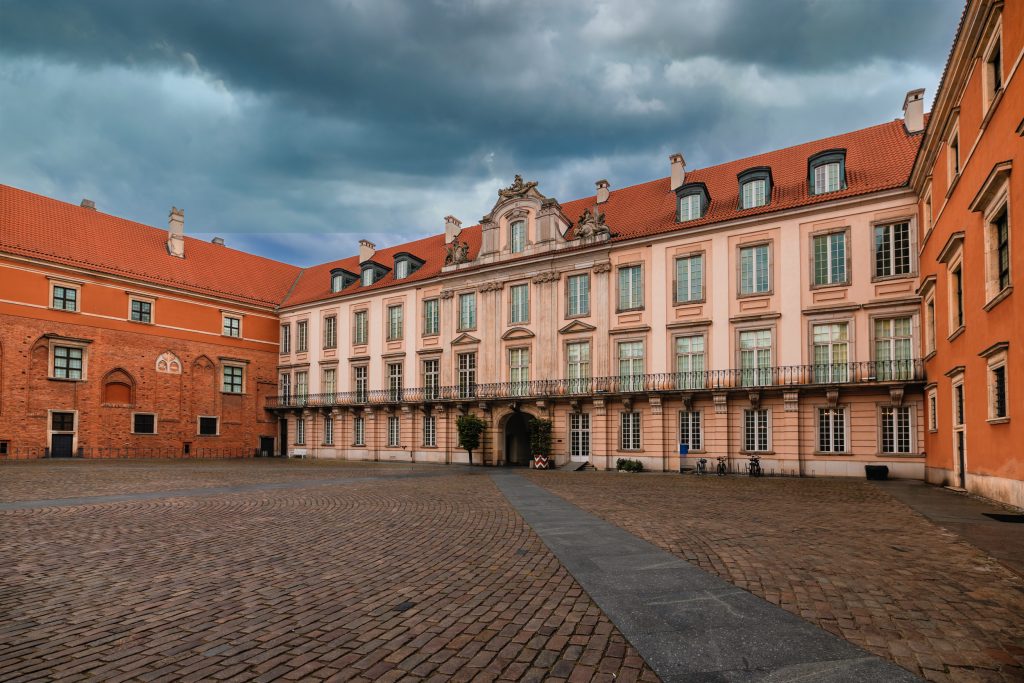
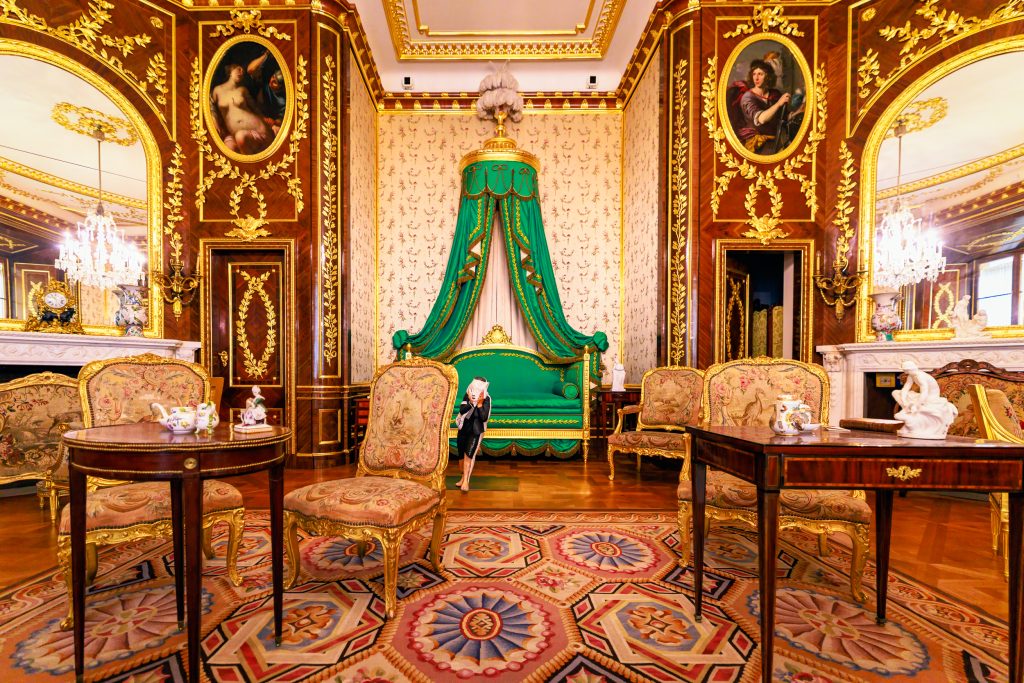
When I visited the Royal Castle in Warsaw, I was struck not only by the grandeur of its interior rooms but by the weight of history they carried. Gilded ceilings, restored frescoes, and polished parquet floors radiated an elegance that felt both authentic and improbable—especially knowing that everything I saw had been painstakingly reconstructed in the 1970s and 1980s, decades after the original interiors were destroyed during World War II.
The Royal Castle in Warsaw rebuilt brick by brick after its wartime destruction—now a national symbol of resilience.
The Royal Castle (Zamek Królewski w Warszawie), which stands at the entrance to Warsaw’s Old Town, has long embodied Poland’s national identity. For centuries, it served as the official royal residence and administrative heart of the Polish–Lithuanian Commonwealth. It was here, in 1791, that lawmakers adopted the Constitution of May 3—the first modern constitution in Europe, and the second in the world after that of the United States.
But by the end of the 18th century, Poland had lost its sovereignty. Through a series of three partitions, Russia, Prussia, and Austria carved up the territory, erasing Poland from the map of Europe for more than a century.
My father was born in 1916 in Kamyk, a village near Częstochowa—home to the revered Black Madonna. At the time, Poland did not exist as an independent country. Kamyk lay within the Russian Partition, a region ruled by the Russian Empire since the late 1700s. By 1916, however, the area was under German military occupation, following advances on the Eastern Front during World War I. Poland would regain its independence just two years later, in 1918, after the collapse of the partitioning empires.
Portraits of Polish monarchs in a room restored from fragments and memory.
In the years following the partitions, foreign rulers redesigned the Castle in neoclassical style. When Poland regained its sovereignty in 1918, the Castle became the official residence of the Polish head of state.
World War II brought devastation. German planes bombed the Castle in 1939, and after the failed Warsaw Uprising in 1944, Nazi forces deliberately destroyed what remained. The Castle lay in ruins.
Under the postwar communist regime, reconstruction was delayed. But in time, rebuilding the Castle became both a political and cultural act of defiance. Polish citizens contributed funds. Historians, architects, and artisans turned to prewar drawings, paintings, and photographs to guide the work. Between 1971 and 1984, the Castle rose again—rebuilt atop its surviving cellars, foundations, the adjacent Copper-Roof Palace, and the Kubicki Arcades.
Today, the Royal Castle is not just a museum; it is a monument to what was lost—and to what was recovered. It houses one of Poland’s most important collections of national and European art. In 1980, UNESCO recognized both the Castle and Warsaw’s Old Town as a World Heritage Site. And in 2024 alone, over 2.14 million people visited—making it one of the most visited art museums in the world.
No detail overlooked: a gilded chamber echoing with royal formality and artistic pride.
I recently returned from a journey through Poland—a place both beautiful and burdened. As I walked the streets of Warsaw, Kraków, and smaller towns tied to my family’s past, I found myself reckoning not just with personal memory, but with the immense suffering and resilience that have shaped this country.
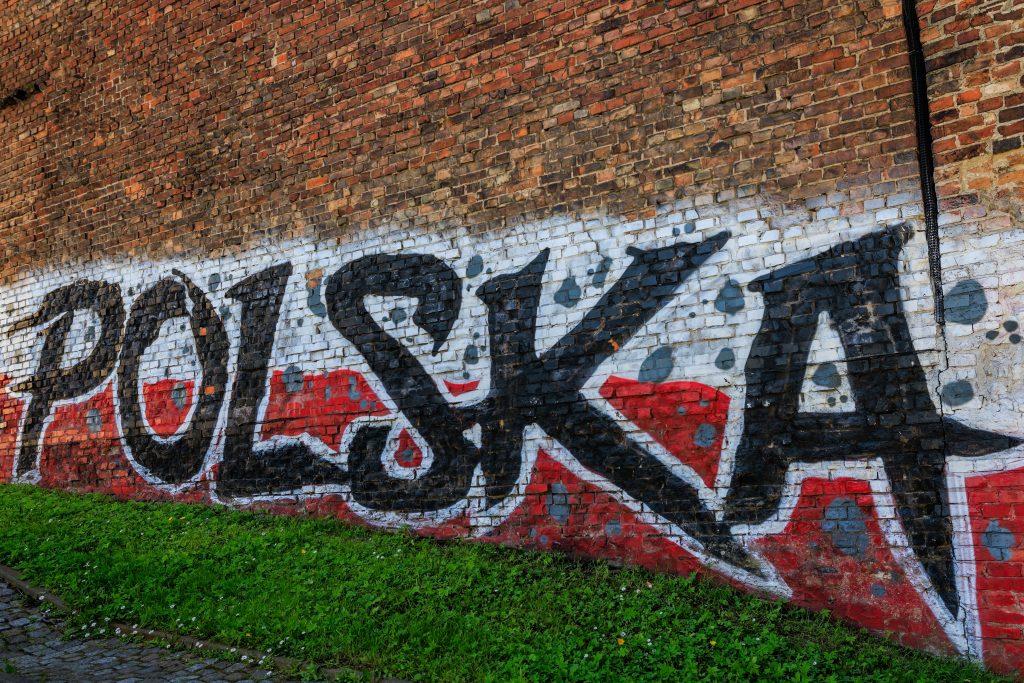
Graffiti spelling “POLSKA” on a brick wall in Gdansk. Pride, resilience, and memory coexist in Poland’s streets—just as they do in its history.
Poland was not only the first victim of World War II—it was also one of the most devastated. In 1939, it was invaded and carved up by two brutal regimes: Nazi Germany from the west, and the Soviet Union from the east. What followed was a six-year onslaught of destruction, repression, and mass murder.
By war’s end, an estimated six million Polish citizens were dead—roughly 17% of the population. Half of them were Jews murdered in the Holocaust. The other half were primarily ethnic Poles who perished in bombings, executions, forced labor, resistance fighting, and Soviet purges (Wikipedia – World War II casualties of Poland).
The physical destruction was staggering. Warsaw, the capital, was deliberately reduced to rubble after the 1944 uprising—85 to 90 percent of the city was destroyed. Nationally, about 30% of Poland’s infrastructure and wealth was lost, and over 40% of its cultural property—including archives, libraries, and religious sites—was looted or obliterated (Polish War Reparations Bureau – Wikipedia summary).
Yet even after the war, Poland was not free. Instead of liberation, it fell under Soviet domination. For nearly five decades, the Polish people lived under Communist rule imposed by Moscow. The state censored speech, imprisoned dissenters, and suppressed any honest reckoning with what the country had endured.
But Poland’s vulnerability didn’t begin in 1939. From the late 18th century until the end of World War I, Poland did not exist as an independent nation. For more than a century, it was partitioned by Russia, Prussia, and Austria—wiped off the map. My father was born in 1916, during that period of nonexistence. Poland would only re-emerge as a sovereign state in 1918, two years after his birth, following the end of the Great War.
Then came the Second World War, bringing unimaginable suffering. My father, born near Częstochowa, survived the HASAG slave labor camp and was later imprisoned at the Gross-Rosen concentration camp, and from there transferred to Flossenbürg and Dachau. He was one of the very few to survive. His parents and most of his extended family were murdered. For my father—as for so many Polish Jews—there was no going home.
Today, Poland is a member of NATO, and there is hope that the alliance provides the kind of protection it lacked in the past. But I find myself wondering: Would NATO and the United States truly defend Poland if attacked by Russia? Or would the West abandon Poland again, as it did in 1939? I don’t know the answer. I hope we never have to find out.
Yet there is another truth I cannot ignore. As a Jew, I deeply value Poland’s efforts to remember the Holocaust—through museums, memorials, and scholarship. I was moved by what I saw. But I also felt that Poland has yet to fully come to terms with the long history of antisemitism that predates Nazi Germany. I say this not in a spirit of accusation, but of reflection. While Germany has publicly and institutionally confronted its role in the Holocaust, Poland has often struggled to acknowledge how deeply antisemitism was woven into the social fabric—even before the war. There were Poles who risked everything to save Jews, and they deserve enduring honor. But there were also Poles who betrayed, exploited, or turned away—and that, too, must be faced.
What struck me most during my visit was how present the past still feels. The scars are visible—in the rebuilt bricks of Warsaw’s Old Town, in the memorials to the ghetto, and in the ruins left untouched as testimony. But so too is the resilience. I saw it in young people reclaiming their history, in museums that confront difficult chapters, and in quiet moments of beauty: the light on cobblestones, the music in cafés, the sound of Polish spoken freely.
Before leaving, I asked a guide whether people in Poland today worry about defending their borders. He hesitated—perhaps reluctant to speak directly. But I sensed that the question lingered beneath the surface. Many Poles today do worry about their security, especially in light of Russia’s war against Ukraine. The country is investing heavily in defense and leans firmly on its NATO membership. Yet there is also a quiet anxiety—born of history—that Poland might again be left to face aggression alone.
Still, life goes on. There’s a tension here: between living with history and not being consumed by it. Poles carry that burden with remarkable dignity.
Poland’s story is not only one of tragedy. It is also a story of survival, rebuilding, and memory. Visiting gave me a deeper appreciation not only for what this country has lived through, but also for the dignity with which it remembers—and the silences it still must break.
In May 2025, I visited Częstochowa, Poland — the city where my father once walked as a young man before World War II. He was born in Kamyk, a small village nearby, into a Jewish family of modest means. His father, like many Jewish men in Kamyk at the time, was a butcher. Before the war, my father would travel to Częstochowa to sell souvenirs of the Black Madonna to pilgrims visiting the Jasna Góra Monastery.
The Black Madonna of Częstochowa, Poland’s most venerated icon, enshrined at Jasna Góra.
Over 80 years later, I walked those same streets with my camera. Much has changed, and much has not.
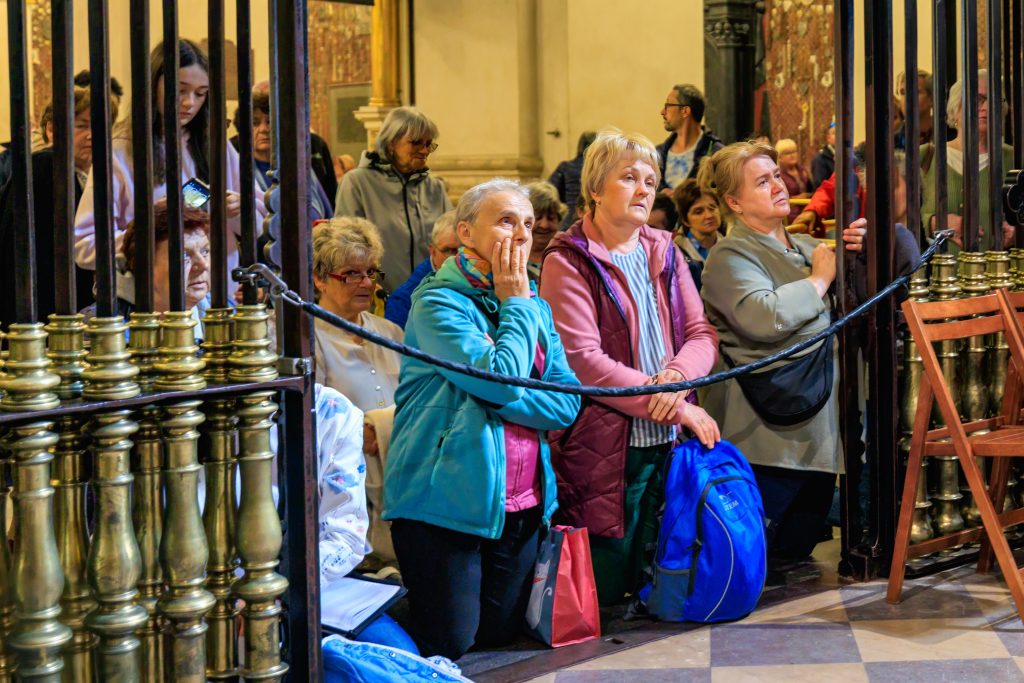
The crowds still come. At Jasna Góra, I watched as worshipers kneeled, prayed, and wiped away tears in front of the Black Madonna — a 14th-century icon believed by many to have miraculous powers.
No photograph can truly capture the intensity of devotion in that room — but I tried.
Pilgrims at Jasna Góra kneel in reverence before the Black Madonna.
But just outside the monastery’s walls, the contrast is striking.
A fenced lot in Częstochowa under stormy skies. The past is never far.
I don’t know exactly where my father stood. But I walked where he walked — on some of the same cobblestones, past buildings he might have passed and beneath the same sky.
This visit was more than just a return to a place. It was a return to memory, to family, and to a world that war tried to erase.