Leica Q3 Review From a Canon Photographer

Emmanuel Nataf writing on PetaPixel discussing his hit rate on the Leica Q3 compared with the Canon R5:

Going back to my “hit rate,” I simply can’t get anywhere near my R5. Part of it is due to the ergonomics of the Q3: a typical Leica without joystick to move the focus and poorly placed dials (the worst one being for exposure, placed on the outer part of the body and hard to reach with your thumb). With the temperatures dropping in the past few weeks, I used the Q3 with gloves and missed countless street shots by pushing the Play button instead of the arrows, definitely killing my shots. You may wonder why I’m not using subject tracking: because switching between subjects rapidly with the Q3’s buttons is completely unreliable.

The second reason for the low hit rate is the autofocus: average in poor lighting conditions and terrible in motion. With the Q3, I’ve had to stop shooting while walking. I have to stop, compose my image and shoot when the right subject comes into the frame — a much less spontaneous experience than what I’m used to.

Lastly, the camera is painfully slow to wake up. It should be on within a few milliseconds, but it takes the Q3 a second or two to start… far too long when trying to capture an instant.


I too own both a Canon R5 and a Leica Q3. The R5 is my main camera. I love it but it is big and heavy compared to the Q3. The Q3 is small, a pleasure to hold and the image quality is great, maybe even a little better than the R5.

  • I agree that the Q3 is slow to start. But I just leave it on and then it starts pretty fast. Sure it drains the battery but the batteries aren’t big or heavy. It’s easy to carry extra batteries.
  • I adjust exposure using the camera dial and find that works well for me. The camera can be adjusted almost infinitely. You just have to experiment and see what works for you.
  • I agree that the R5’s autofocus is better than the Q3 but find that I can shoot on the fly with the Q3. I feel I’ve gotten some nice street photos with the Q3. The eye detection on the Q3 works very well.

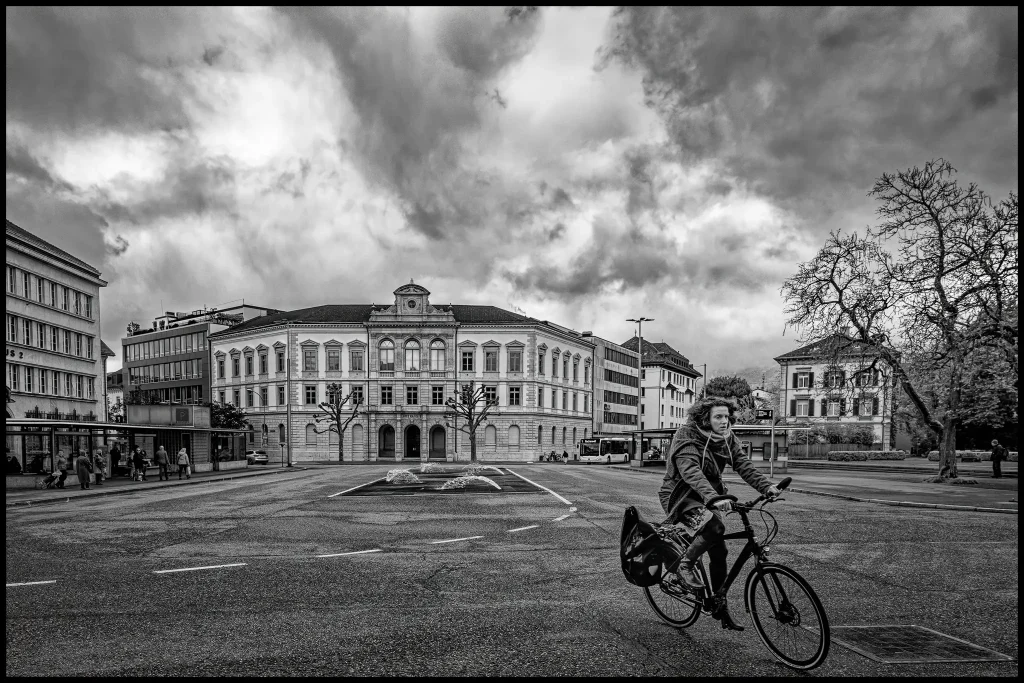
I made the photos in this post with the Q3 while on a trip to Japan in 2023.

In my opinion, when it comes to small, light weight full-frame cameras, Leica has the market all to itself. Would I love to see more competition in this category? Sure. But I don’t see that happening anytime soon.

I am happy to have the Q3 in my bag along with the Canon R5.


Update: April, 2024: On a recent trip to Europe my Q3 malfunctioned. The SD card would not click in the slot. After returning home, I took the camera back to the Leica Store in Washington DC. They returned the camera to Leica Repair in New Jersey. On April 30, 2024 I received the following email message:

4/30
Your equipment has been inspected by our technician. Your repair has been processed and placed in queue. No action is required.

Error description

strong traces of use adjust/replace printed circuit SD card slot faulty

I don’t yet know how long the repair will take. I miss the camera. I really like it. I will continue to update.


Update: May 21, 2024:

Dear Leica Customer,

During the repair of your Leica product, the technician found that a
part required to fully repair your equipment to Leica standards is
currently out of stock.

Our colleagues and worldwide suppliers are working together to resolve
this issue as quickly as possible. However, this will most likely delay
the completion of the repair.

We apologize for the inconvenience and sincerely appreciate your
patience.  If you have any further questions or concerns, please do not
hesitate to contact Customer Care at 201-995-0051 ext. 9930 or email
repair@leicacamerausa.com

Sincerely,

Your Leica Team

Leica Camera USA INC.
Customer Care


I am thinking of buying a Leica M11-P but this experience with the Q3 gives me pause. Still one Leica does not feel like it’s enough for me.


Update: May 24, 2024

I called Leica Repair today to see how long the repair will take. They answered the phone right away and explained the part I need (the SD card holder) must be manufactured and shipped from Germany. The wait will probably be a couple of months. They offered me a Q3 loaner for the duration of the repair, which sounds great to me. They will send me the loaner next week. When my camera is repaired they will notify me. I will then return the loaner and they will then ship my camera to me. I am glad I called.

I added that I’m thinking about buying an M11-P and asked how long repairs generally take. The reply was 60 days – and longer if the camera has to go back to Germany. Analogue repairs take much longer – nine months or longer.

I guess Leica is a small company and this is the price of admission.


Update: May 29, 2024

My Q3 loaner arrived today. Once I held the camera in my hands, I realized just how much I missed it. Luckily, I saved my profile settings on my Mac so I only had to transfer them to an SD card and load them into my loaner.


Update: August 7, 2024

Leica notified me a few days ago that my Q3 has been repaired. Leica sent me a prepaid shipping label and I returned the Q3 loaner. Today, my Q3 arrived well-packaged and working just fine. The entire process took about 100 days. With the loaner, I am happy with Leica service.

SF’s ‘Bay Bridge Lights’ to Go Dark

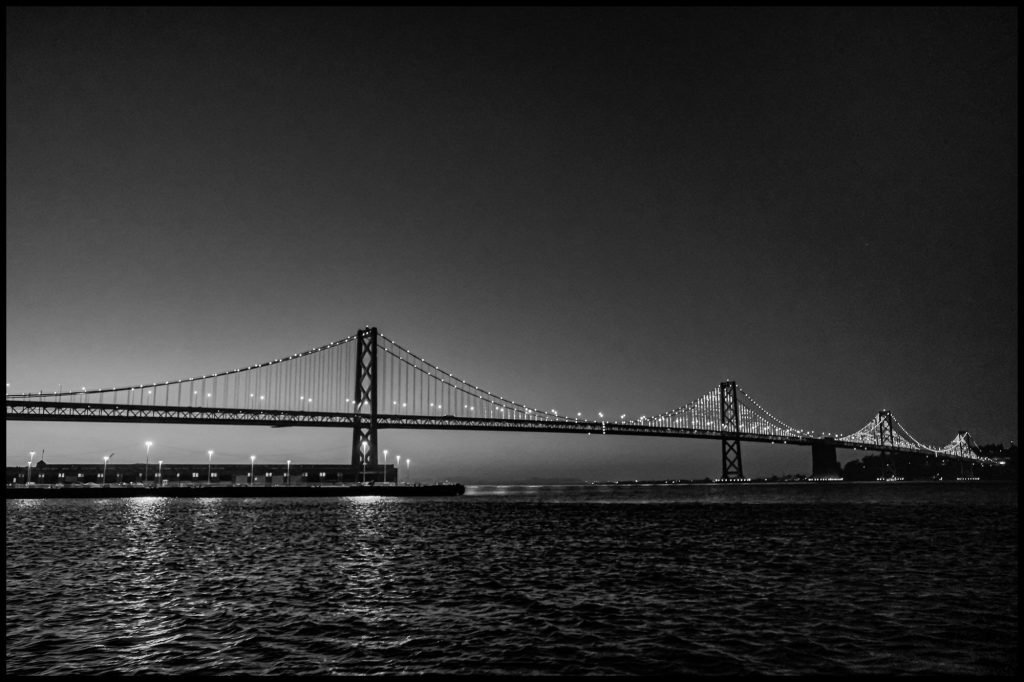
I made this photograph of the San Francisco–Oakland Bay Bridge in 2019. This was only possible because of the beautiful lights on the span. The lights have been on the bridge since 2013 when a public art installation called “The Bay Lights” was activated on the bridge.

The installation was designed by artist Leo Villareal and consists of 25,000 LED lights. This beautiful display stretches 1.8 miles across 300 cables on the western span of the Bay Bridge. Sadly, after ten years the display is worn out and and, according to the San Francisco Chronicle, will go dark on March 5, 2023. However, efforts are underway to raise $11 million to keep “Bay Lights” shining on the Bay Bridge.

I hope they succeed.

Neon Museum, Las Vegas

The Neon Museum in Las Vegas features signs from old casinos and other businesses displayed outdoors on a 2.27 acre campus. The Neon Museum has an outdoor exhibition space known as the Neon Boneyard. Boneyard is traditionally the name for an area where items no longer in use are stored.

Efforts to establish a neon sign museum date to the late 1980s, but stalled due to a lack of resources. On September 18, 1996, the Las Vegas City Council voted to fund such a project, to be known as the Neon Museum. The organization started out by re-installing old signage in downtown Las Vegas, to attract more visitors to the area.

Young Electric Sign Company (YESCO) had manufactured many neon signs in the city, and the company had a storage site for old signs which would eventually become part of the Neon Museum collection. In 2000, as YESCO prepared to close its storage lot, the city provided the museum with land to start its own. Tours of the new site, known as the Neon Boneyard, began in 2001, by appointment only.

The lobby of the former La Concha Motel, located on the Las Vegas Strip, was donated to the museum and moved there in 2006, eventually becoming its visitor center. Construction to convert the lobby began in May 2011, and the museum officially opened to the general public on October 27, 2012, eliminating the appointment system.

Each of the more than 250 signs in the Neon Museum’s collection offers a unique story about the personalities who created it, what inspired it, where and when it was made, and the role it played in Las Vegas’ distinctive history.

The Museum has announced plans for relocation and expansion in downtown Las Vegas’ Art District. The plan is to nearly triple the size of its current location. Currently, only 35 percent of the museum’s collection is visible to the public.

The Neon Museum is located at 770 Las Vegas Blvd. N, Las Vegas NV, 89101. You can buy tickets here.


Sources: The Neon Museum | Wikipedia


Alta, Norway

Alta is located at 70 degrees north, far above the Arctic Circle. Alta is considered the northernmost city in the world with a population surpassing 10,000. The 9.81-square-kilometre (2,420-acre) town has a population (2023) of 15,931. At this latitude, nature is in total control.

Alta is a good place to see the Northern Lights due the region’s relatively stable climate and minimal light pollution, particularly when heading out of town into the surrounding wilderness. The Aurora has been known to be seen here for up to 200 nights a year. 

Alta is a center of transportation in Finnmark county. The town has port facilities along Altafjorden, just alongside Alta Airport in Elvebakken. The airport has direct flights to Oslo and certain other big cities in Norway like Tromsø. The European route E6 highway also runs through the town and the European route E45 has its northern terminus in the town. The main industries present in Alta include a concrete product factory; several wood mills and sawmills; and dairy, horticulture trade, and maritime services.


Resources: Wikipedia – Alta | Alta Tourist Site | Aurora Zone – Alta


One of the Most Famous Paintings Ever Created, on View at the National Gallery of Art

Impression, Sunrise,” which usually lives in Paris at the Musée Marmottan Monet, is in the United States for the first time. It’s the star item in “Paris 1874: The Impressionist Moment,” at the National Gallery of Art in Washington, DC.

“Paris 1874: The Impressionist Moment,” is an important presentation of 130 works including a rare reunion of many of the paintings first featured in that now-legendary Société Anonyme exhibition 150 years ago, which is recognized as the event that gave birth to French Impressionism. On April 15, 1874, the first impressionist exhibition opened in Paris. Hungry for independence, Monet, Renoir, Degas, Morisot, Pissarro, Sisley and Cézanne decided to free themselves from the rules by holding their own exhibition, outside official channels: impressionism was born.

You can see paintings by Paul CézanneClaude MonetBerthe Morisot, and Camille Pissarro and meet their lesser-known contemporaries. See the art norms they were rebelling against and learn what political and social shifts sparked their new approach to art.

The show is on view until January 19, 2025 at the National Gallery of Art. This exhibition is not ticketed. You may need to join a line on busier days. Weekends tend to be most crowded.


Sources: National Gallery of Art | Musée d’Orsay | Wikipedia | The Washington Post | The Wall Street Journal

Blenheim Palace

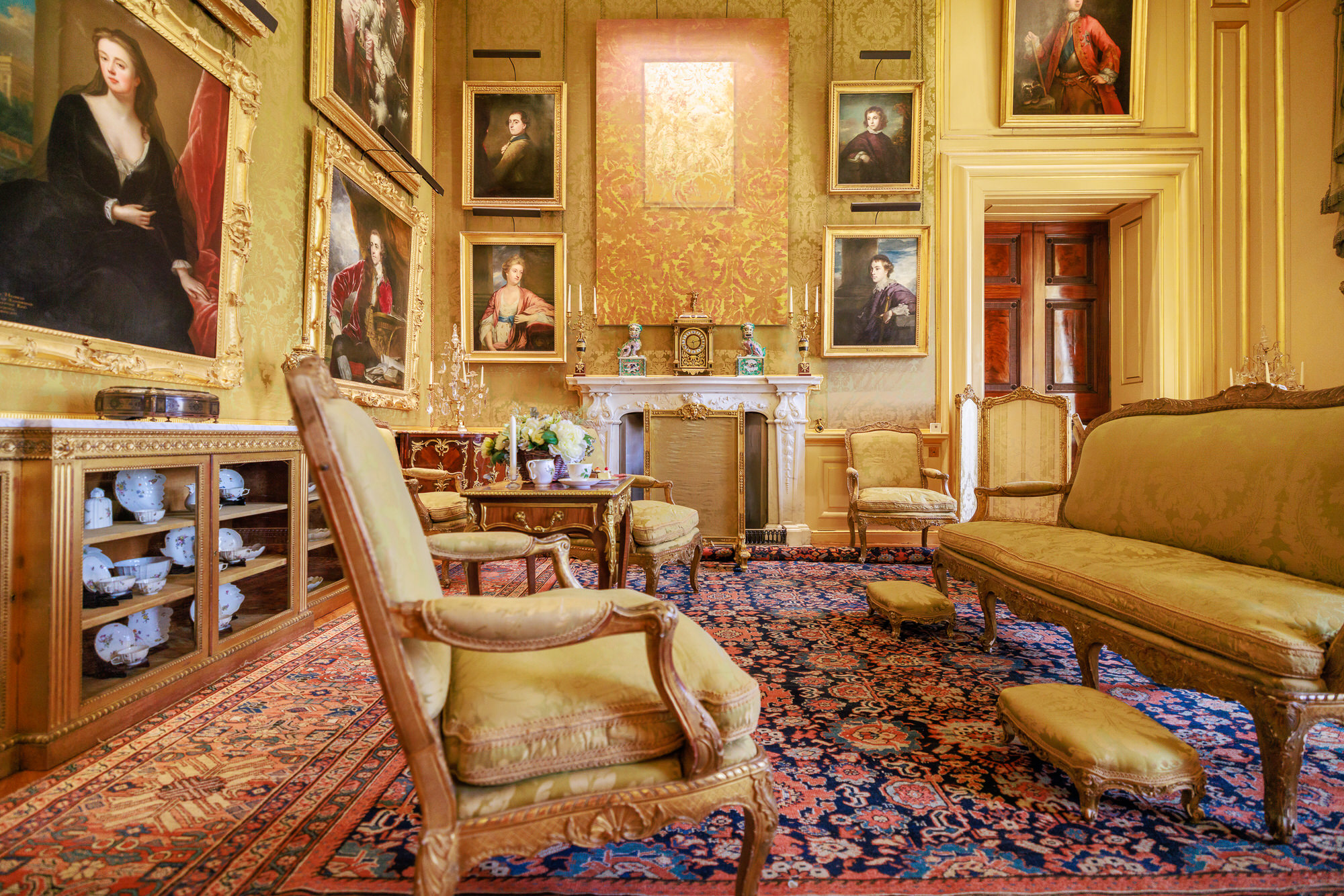
Blenheim Palace is a country house in Woodstock, Oxfordshire, England. It is the seat of the Dukes of Marlborough. Originally called Blenheim Castle, it has been known as Blenheim Palace since the 19th century. It was built between 1705 and 1722, and designated a UNESCO World Heritage Site in 1987. It is among England’s largest houses. The palace is notable as the birthplace and ancestral home of Sir Winston Churchill (1874-1965).

Blenheim Palace was designed by John Vanbrugh (1664-1726). The English nation presented the site to John Churchill, first Duke of Marlborough, in recognition of his victory in 1704 over French and Bavarian troops (the Battle of Blenheim), a victory which decided the future of the Empire and, in doing so, made him a figure of international importance.

Blenheim Palace sits within a large walled landscape park, the structure by Vanbrugh overlaid by the designs of Lancelot “Capability” Brown (1716-1783), an English gardener and landscape architect, who remains the most famous figure in the history of the English landscape garden style.The Park is considered “a naturalistic Versailles”.

The original landscape set out by Vanbrugh, who regulated the course of the River Glyme, was later modified by Lancelot “Capability” Brown who created two lakes, seen as one of the greatest examples of naturalistic landscape design.

Following the palace’s completion, it became the home of the Churchill (later Spencer-Churchill) family for the next 300 years, and various members of the family have changed the interiors, park and gardens. At the end of the 19th century, the palace was saved from ruin by funds gained from the 9th Duke of Marlborough’s marriage to American railroad heiress Consuelo Vanderbilt.

Blenheim Palace sits on an estate that covers about 2,000 acres (approximately 810 hectares) and has 187 rooms. When I visited earlier this year I could not help but think of Blenheim as a “mini-Versailles”. In contrast, the Palace of Versailles has 2,300 rooms and is located on a 2,000-acre estate, about the same size as Blenheim. Versailles is older. Construction started in 1661, compared with the early 18th century for Blenheim.

Comparisons aside, a visit to Blenheim is a great way to spend a day.


Sources:


Folger Shakespeare Library in Washington, DC

Henry Clay Folger (1857-1930) and his wife, Emily Jordan Folger (1858-1936), established the Folger Shakespeare Library as a gift to the American people, after decades of assembling the world’s largest collection of Shakespeare materials. It opened in 1932, two years after the death of Henry Folger. The Folger’s collection features the 82 First Folios of Shakespeare, the 1623 publication that is one of the most sought-after and important books in the history of publishing.

Henry Folger was a first cousin six times removed of Benjamin Franklin and a nephew of J. A. Folger, the founder of Folger Coffee.

After opening, the Folger steadily expanded its holdings to become a world-class research center on the early modern period, while remaining the premier center for Shakespeare studies and resources outside of England. The Folger has the world’s largest collection of the printed works of William Shakespeare, and is a primary repository for rare materials from the early modern period (1500–1750) in Britain and Europe.

The Folger’s public outreach programs, beginning in the library’s early decades with exhibitions, lectures, and publications, have also grown over time.

Emily Folger wrote of Henry Folger’s belief that Shakespeare “is one of our best sources, one of the wells from which we Americans draw our national thought, our faith and our hope.” This belief in the deep connection between Shakespeare and America is the reason the Folger Shakespeare Library is located in the nation’s capital.

The Folgers worked closely with the French-born architect Paul Philippe Cret (1876-1945) to create a marble building which reads like a book, and whose placement testified to the hope that Washington, DC, would become the nation’s civic and cultural capital.

The Folger collection began in 1889 with Henry Folger’s first purchase of a rare book, a copy of the 1685 Fourth Folio of Shakespeare’s plays. By the time the collection was transported to the new library, it amounted to 200,000 items.

In 1938, the library acquired the collection of the late Sir Robert Leicester Harmsworth, comprising more than 8,000 rare books printed in England between 1475 and 1640. Together with later acquisitions, the Harmsworth purchase expanded the Folger’s focus beyond Shakespeare studies to include virtually all aspects of the early modern period in Europe.

From 1948 to 1968, Folger Director Louis B. Wright added substantial materials from the Renaissance in Europe, acquiring 22,000 continental books and 19,000 more English books.

The Folger continues to make new acquisitions of rare material.

In 1930, the library was placed in trust of Amherst College, Henry Folger’s alma mater. The library building is listed on the National Register of Historic Places.

The beautiful Reading Room officially opened in January 1933 and today contains reference works for easy accessibility to readers. Henry Folger wanted the Library’s reading room to feel at once like a private home and the Great Hall of an English college. It features stained-glass windows and a large stone fireplace which has never been used. The large stained-glass window overlooking what is now the Gail Kern Paster Reading Room was designed and created by Nicola D’Ascenzo (1871-1954), an Italian-born American stained glass designer, painter and instructor. The Reading Room also features 16th- and 17th-century French and Flemish tapestries, carved oak paneling and a high trussed roof.

On a hall screen at the east end hang portraits of the Folgers in their academic robes, painted by the British artist Frank O. Salisbury (1874-1962). Above the Salisbury portraits is a bust of Shakespeare based on his memorial in Holy Trinity Church, Stratford-upon-Avon. The ashes of both Folgers are immured behind a memorial plaque.

At the west end of the Reading Room is one of the Folger’s treasures, a large stained-glass window depicting the Seven Ages of Man from Jaques’s speech in As You Like It. Although the window is exposed to exterior sunlight, it is in an interior space and is not visible from outside the building.

The intimate Elizabethan Theatre is the setting for Folger Theatre productions. With its three-tiered wooden balconies, carved oak columns, and half-timbered facade, the Theatre evokes the courtyard of an English Renaissance inn. The theater seats around 260. It has no pit. The first theatrical performance in the Elizabethan Theatre was a 1949 production of Julius Caesar.

A major four-year expansion and renovation led by Kieran Timberlake was completed in 2024.

The Folger Shakespeare Library (201 E. Capitol St. SE) is open 11 a.m.-6 p.m. Tuesday through Sunday, with extended hours to 9 p.m. on Thursdays, Fridays and Saturdays. Free timed entry passes are recommended.


Sources: Official Site | Wikipedia | The Washington Post


Construction of Enhanced Exhibit Space at Lincoln Memorial

This construction project at the Lincoln Memorial will create 15,000 square feet of exhibit space that tells a more complete story of the Lincoln Memorial and provides a look at the structure’s foundations in a cavernous area known as the undercroft. New museum exhibits and multimedia presentations will highlight the construction history of the memorial and discuss how the Lincoln Memorial has become the nation’s foremost backdrop for civil rights demonstrations. The project also includes new restrooms, a larger bookstore, and replacement of the existing elevator as well as the addition of a second elevator.

The undercroft of the Lincoln Memorial is a tall grid of concrete columns surrounded by large expanses of open space. Floor-to-ceiling glass walls will provide a view of the undercroft, and an immersive theater presentation will project images of historic events onto the foundations. Visitors will also learn about the significance of the site as an international icon dedicated to the achievements of Abraham Lincoln and individuals such as Marian Anderson (1897-1993) and Dr. Martin Luther King, Jr. (1929-1968), who have shaped the history of the memorial.

The project will cost $69 million ($26 million from the National Park Service and $43 million in private donations to the National Park Foundation). It is scheduled for completion in July, 2026.

The Lincoln Memorial, including the the 120-ton statue of Abraham Lincoln shown above, remains open during the project. The basement area exhibits, restrooms and elevator will close during construction, however temporary restrooms, bookstore and a handicapped accessible lift will be available for the duration of the work.

And here’s a glimpse from The Washington Post of how the undercroft will be transformed. It looks great.

Sources: National Park Service | The Washington Post.


Solothurn, Switzerland

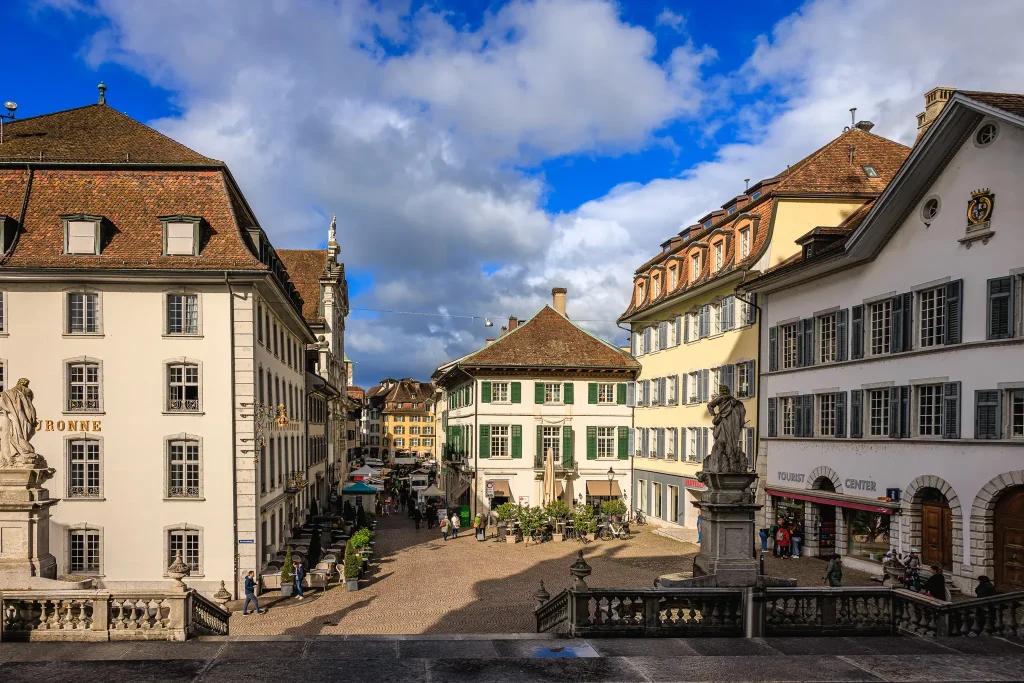
Solothurn (pop. 16,777) is a town, a municipality, and the capital of the canton of Solothurn in Switzerland. It is located in the northwest of Switzerland on the banks of the Aare and on the foot of the Weissenstein Jura mountains.

The town is the only municipality of the district of the same name.

The town got its name from Salodurum, a Roman-era settlement. From 1530 to 1792 it was the seat of the French ambassador to Switzerland. The pedestrian-only old town was built between 1530 and 1792 and shows an impressive array of Baroque architecture, combining Italian Grandezza, French style, and Swiss ideas. The town has eighteen structures listed as heritage sites.

The official language of Solothurn is (the Swiss variety of Standard) German, but the main spoken language is the local variant of the Alemannic Swiss German dialect.

Solothurn is said to be the most beautiful baroque city in Switzerland. The imposing buildings were constructed in various epochs: ranging from the first half of the 12th century, when the clock tower was built, to 1773, when St. Ursus Cathedral was constructed in baroque and neo-classical style.

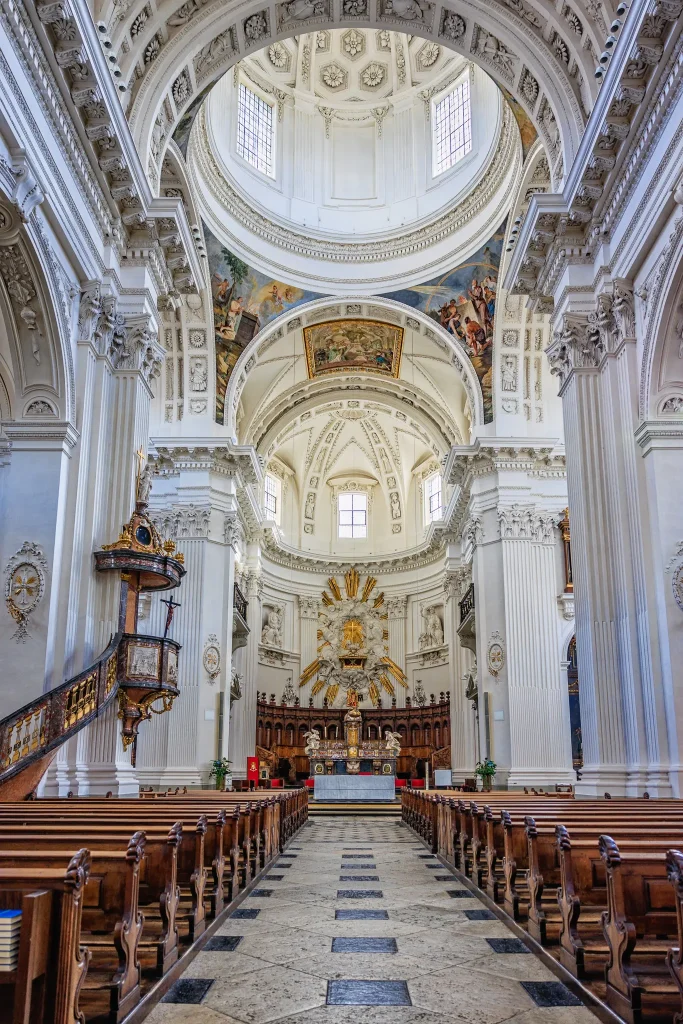
St. Ursus Cathedral is Solothurn’s main attraction. It is the cathedral of the Roman Catholic Diocese of Basel in Solothurn.

St. Ursus Cathedral is considered the most significant Swiss building from the early neoclassical period, and was constructed using light-colored Solothurn marble. The cathedral is also full of Solothurn’s magic number 11: three sets of 11 imposing steps lead up to the cathedral; inside, the cathedral has 11 altars; and the tower is 66 m tall (6 x 11) and has 11 bells.

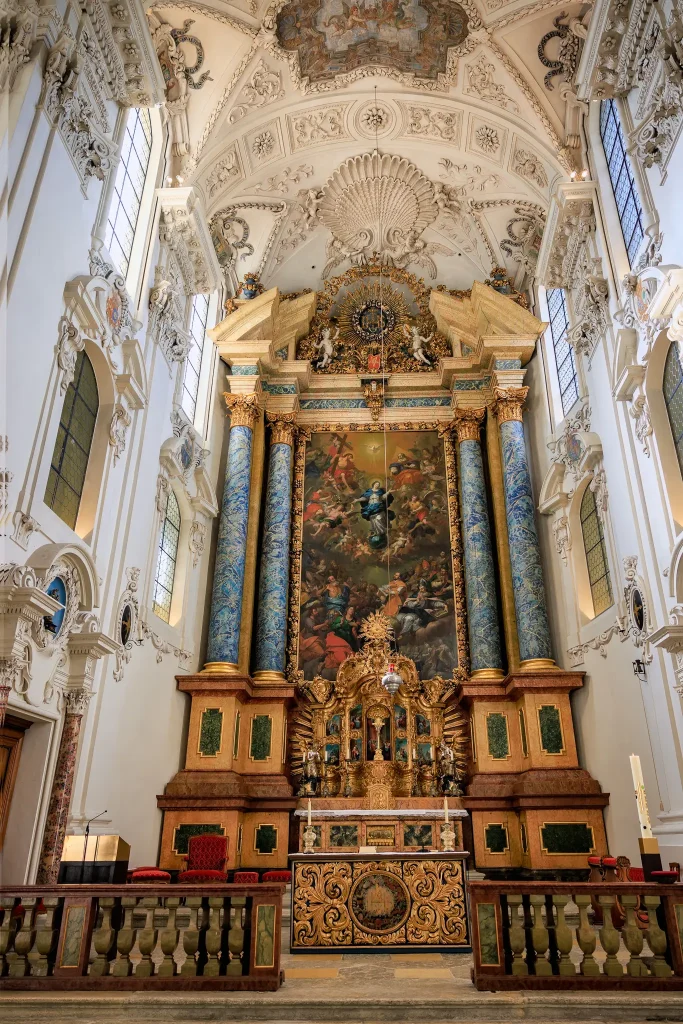
The third complete reconstruction of the cathedral took place from 1762 to 1773 according to a design by Gaetano Matteo Pisoni from Ascona – lasting exactly 11 years. Pisoni’s nephew, Paolo Antonio Pisoni, managed the later years of the construction. Eleven bells from the Kaiser foundry in Solothurn (1764–1768) hang behind large acoustic openings. The high altar by Carlo Luca Pozzi echoes the form of a sarcophagus. The cathedral treasure is stored on the ground floor of the tower.


Sources: Wikipedia | Switzerland Tourism | Solothurn Tourismus


Bikers Honor Fallen Heroes on Memorial Day 2024


On May 26, 2024—Memorial Day weekend in the United States—thousands of bikers rode past the Lincoln Memorial and other monuments in Washington, DC to honor fallen service members and to raise awareness for veterans’ needs.

The tradition began in 1988, when Vietnam War veterans organized the first ride. Nearly every year since, riders have gathered in the capital. In 2020, American Veterans (AMVETS) assumed leadership of the event, renaming it Rolling to Remember and expanding its mission to support all veterans.

Memorial Day is a federal holiday dedicated to those who died while serving in the U.S. armed forces. That sacrifice was deeply present in the minds of the riders, many of whom were Vietnam veterans. The gathering was both solemn and celebratory—moving for participants and spectators alike.


Sources: Rolling to Remember | Wikipedia | Motorcycle ride similar to Rolling Thunder rolls on with a new name and sponsor | Thousands of bikers take to the capital for ‘Rolling to Remember’ | Military Times | Rolling Thunder National