The POLIN Museum of the History of Polish Jews in Warsaw is both a monument to a lost civilization and a cultural institution of the highest caliber. Housed in a striking contemporary building on the site of the former Warsaw Ghetto, the museum traces 1,000 years of Jewish life in Polish lands—from early migrations and the Golden Age through the partitions, the Holocaust, and into the present day.
Facing the Monument to the Ghetto Heroes, the POLIN Museum stands on the site of the prewar Jewish neighborhood and wartime ghetto. Together, the museum and monument form a powerful memorial complex. One visits the monument to honor those who died by remembering how they died. One enters the museum to honor them—and those who came before and after—by remembering how they lived.
The building’s striking glass façade and golden interior passage evoke both continuity and fracture on the site of the former Warsaw Ghetto.
One of the museum’s most impressive features is the reconstruction of the wooden synagogue from Gwoździec. This soaring, hand-painted structure, recreated using traditional methods, pays tribute not only to Jewish religious architecture but also to the vibrancy and beauty of a world that once was.
The museum handles Poland’s long Jewish history with beauty, care, and deep respect. Yet I found myself wondering: how deeply does POLIN grapple with the antisemitism that existed in Poland before the German invasion? The subject is present—in interwar exhibits, newspaper clippings, and political histories—but easy to miss, especially amid the museum’s emphasis on Jewish life rather than victimhood. Perhaps this is deliberate. The goal, after all, is education, not alienation. Still, it’s hard to tell the full story of Jewish life in Poland without acknowledging how often Jews were made to feel like outsiders—even before the Holocaust began.
Barbara Kirshenblatt-Gimblett, the museum’s chief curator, once said: “We are creating a museum of life, not a museum of death.” That vision is palpable throughout POLIN’s galleries. The museum honors what was lost while insisting that Jewish history in Poland must also be remembered for what it was: rich, complex, and deeply woven into the national fabric.
At the heart of the POLIN Museum stands a dazzling reconstruction of the wooden synagogue from Gwoździec, a small town once located in the Polish-Lithuanian Commonwealth (now in Ukraine).
So what is the purpose of POLIN today? A Polish guide I met during my travels said the museum is primarily intended for Poles, almost all of whom are not Jewish. There’s truth in that. In a country where 90% of the prewar Jewish population was murdered and few Jews remain, the museum serves not only as remembrance but also as education. It is also, arguably, part of Poland’s broader effort to grapple with its past while promoting cultural tourism. Jewish heritage sites have become cultural and economic assets—a reality that raises uneasy questions about purpose and presentation.
Still, none of that should diminish what POLIN has accomplished. It does not shy away from difficult chapters. It honors what was lost while celebrating what was lived. And for Jewish and non-Jewish visitors alike, it offers a place to learn, reflect, and—perhaps most importantly—feel the weight of presence where so much absence remains.
The Arc de Triomphe du Carrousel (Triumphal Arch of the Carousel) stands in the Place du Carrousel, just west of the Louvre. It was commissioned by Napoleon and built between 1806 and 1808 to commemorate his military victories of 1805 — especially the Battle of Austerlitz — during the War of the Third Coalition.
The arch is 63 feet (19 m) high, 75 feet (23 m) wide, and 24 feet (7.3 m) deep. Its 21-foot (6.4 m) central arch is flanked by two smaller arches, each 14 feet (4.3 m) high and 9 feet (2.7 m) wide. Eight Corinthian columns of marble line its exterior, each topped by a soldier of the Empire.
The far better-known Arc de Triomphe de l’Étoile, at the western end of the Champs-Élysées, was designed in the same year but is about twice the size. It was not completed until 1836.
The monument was designed by Charles Percier and Pierre-François-Léonard Fontaine. Its proportions were based on the Arch of Septimius Severus in Rome, while some decorative elements echo the Arch of Constantine. It originally served as the gateway to the Tuileries Palace, Napoleon’s Imperial residence. When the Tuileries were destroyed during the Paris Commune in 1871, the site opened onto a long westward view toward the Arc de Triomphe.
The frontispiece on the west façade (facing the Tuileries site) reads:
“À la voix du vainqueur d’Austerlitz L’empire d’Allemagne tombe La confédération du Rhin commence Les royaumes de Bavière et de Wurtemberg sont créés Venise est réunie à la couronne de fer L’Italie entière se range sous les lois de son libérateur”
This proclaims the sweeping changes Napoleon made in Europe after his 1805 victory: the dissolution of the Holy Roman Empire, the formation of the Confederation of the Rhine, the creation of new kingdoms in Bavaria and Württemberg, the annexation of Venice, and the consolidation of nearly all Italy under French rule. From Austerlitz in 1805 to Waterloo in 1815, Napoleon’s peak political dominance lasted about a decade — his entire reign as Emperor was just 11 years — yet this monument remains a proud reminder of that era.
Before visiting Paris for the first time, I saw a film called A Little Romance, starring a young Diane Lane as a sharp-witted 13-year-old American girl living in Paris. There’s a charming scene in the film (starting at 21:14) that takes place at the Arc de Triomphe du Carrousel. Although I first saw the film more than 40 years ago, that moment made me want to visit Paris — and it’s stayed with me ever since. In person, the monument and its surroundings surpass what I saw in the film. I make a point to visit every time I’m in Paris.
When I visited the Royal Castle in Warsaw, I was struck not only by the grandeur of its interior rooms but by the weight of history they carried. Gilded ceilings, restored frescoes, and polished parquet floors radiated an elegance that felt both authentic and improbable—especially knowing that everything I saw had been painstakingly reconstructed in the 1970s and 1980s, decades after the original interiors were destroyed during World War II.
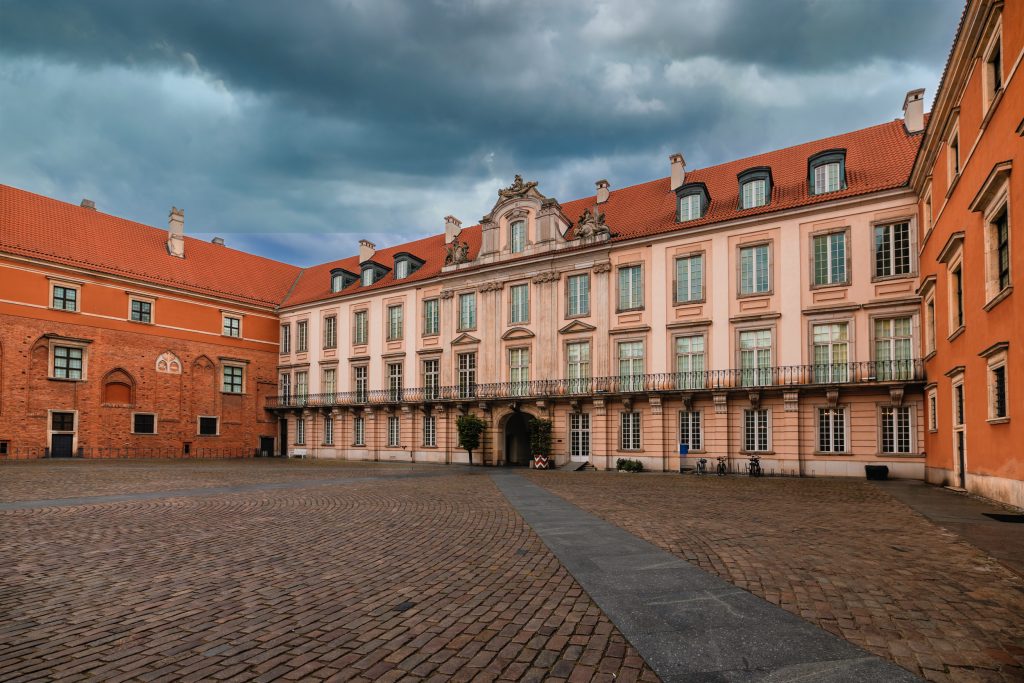
The Royal Castle in Warsaw rebuilt brick by brick after its wartime destruction—now a national symbol of resilience.
The Royal Castle (Zamek Królewski w Warszawie), which stands at the entrance to Warsaw’s Old Town, has long embodied Poland’s national identity. For centuries, it served as the official royal residence and administrative heart of the Polish–Lithuanian Commonwealth. It was here, in 1791, that lawmakers adopted the Constitution of May 3—the first modern constitution in Europe, and the second in the world after that of the United States.
But by the end of the 18th century, Poland had lost its sovereignty. Through a series of three partitions, Russia, Prussia, and Austria carved up the territory, erasing Poland from the map of Europe for more than a century.
My father was born in 1916 in Kamyk, a village near Częstochowa—home to the revered Black Madonna. At the time, Poland did not exist as an independent country. Kamyk lay within the Russian Partition, a region ruled by the Russian Empire since the late 1700s. By 1916, however, the area was under German military occupation, following advances on the Eastern Front during World War I. Poland would regain its independence just two years later, in 1918, after the collapse of the partitioning empires.
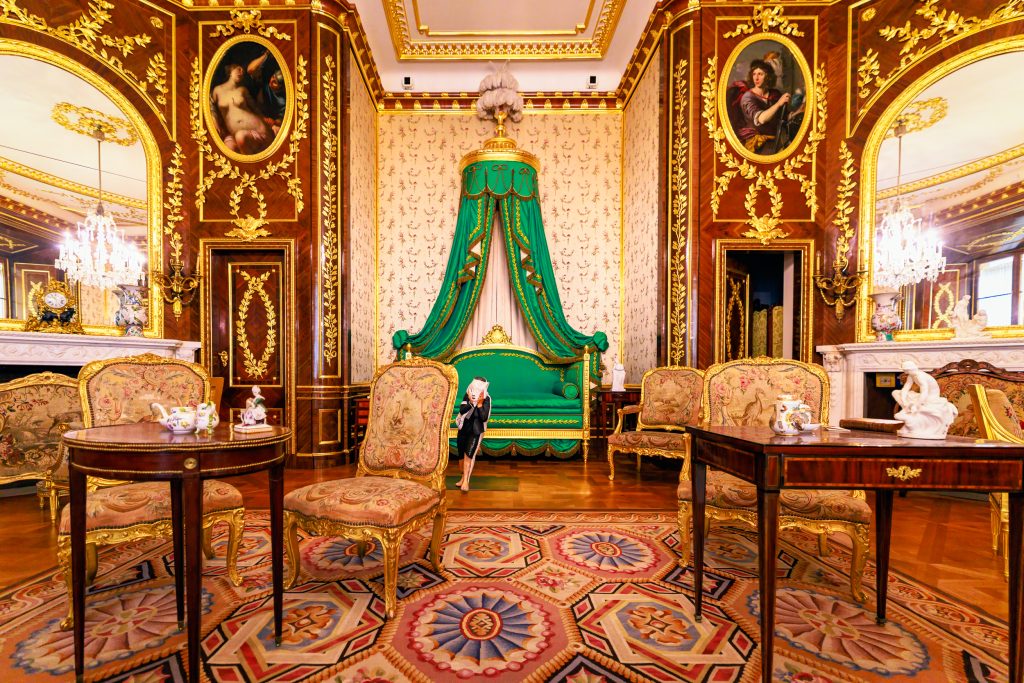
Portraits of Polish monarchs in a room restored from fragments and memory.
In the years following the partitions, foreign rulers redesigned the Castle in neoclassical style. When Poland regained its sovereignty in 1918, the Castle became the official residence of the Polish head of state.
World War II brought devastation. German planes bombed the Castle in 1939, and after the failed Warsaw Uprising in 1944, Nazi forces deliberately destroyed what remained. The Castle lay in ruins.
Under the postwar communist regime, reconstruction was delayed. But in time, rebuilding the Castle became both a political and cultural act of defiance. Polish citizens contributed funds. Historians, architects, and artisans turned to prewar drawings, paintings, and photographs to guide the work. Between 1971 and 1984, the Castle rose again—rebuilt atop its surviving cellars, foundations, the adjacent Copper-Roof Palace, and the Kubicki Arcades.
Today, the Royal Castle is not just a museum; it is a monument to what was lost—and to what was recovered. It houses one of Poland’s most important collections of national and European art. In 1980, UNESCO recognized both the Castle and Warsaw’s Old Town as a World Heritage Site. And in 2024 alone, over 2.14 million people visited—making it one of the most visited art museums in the world.
No detail overlooked: a gilded chamber echoing with royal formality and artistic pride.
I recently returned from a journey through Poland—a place both beautiful and burdened. As I walked the streets of Warsaw, Kraków, and smaller towns tied to my family’s past, I found myself reckoning not just with personal memory, but with the immense suffering and resilience that have shaped this country.
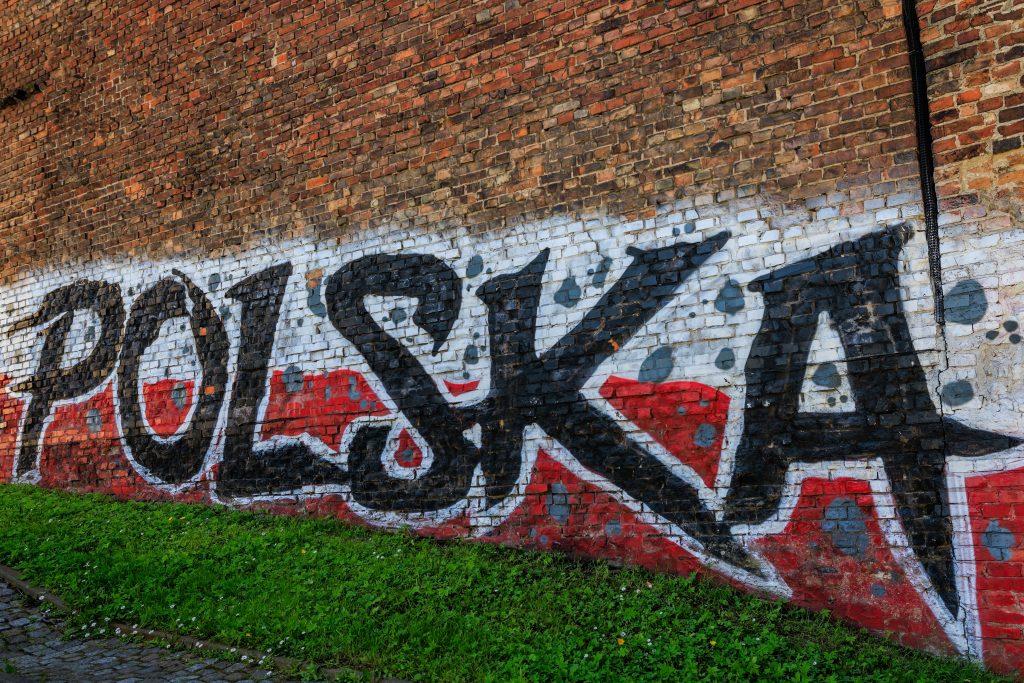
Graffiti spelling “POLSKA” on a brick wall in Gdansk. Pride, resilience, and memory coexist in Poland’s streets—just as they do in its history.
Poland was not only the first victim of World War II—it was also one of the most devastated. In 1939, it was invaded and carved up by two brutal regimes: Nazi Germany from the west, and the Soviet Union from the east. What followed was a six-year onslaught of destruction, repression, and mass murder.
By war’s end, an estimated six million Polish citizens were dead—roughly 17% of the population. Half of them were Jews murdered in the Holocaust. The other half were primarily ethnic Poles who perished in bombings, executions, forced labor, resistance fighting, and Soviet purges (Wikipedia – World War II casualties of Poland).
The physical destruction was staggering. Warsaw, the capital, was deliberately reduced to rubble after the 1944 uprising—85 to 90 percent of the city was destroyed. Nationally, about 30% of Poland’s infrastructure and wealth was lost, and over 40% of its cultural property—including archives, libraries, and religious sites—was looted or obliterated (Polish War Reparations Bureau – Wikipedia summary).
Yet even after the war, Poland was not free. Instead of liberation, it fell under Soviet domination. For nearly five decades, the Polish people lived under Communist rule imposed by Moscow. The state censored speech, imprisoned dissenters, and suppressed any honest reckoning with what the country had endured.
But Poland’s vulnerability didn’t begin in 1939. From the late 18th century until the end of World War I, Poland did not exist as an independent nation. For more than a century, it was partitioned by Russia, Prussia, and Austria—wiped off the map. My father was born in 1916, during that period of nonexistence. Poland would only re-emerge as a sovereign state in 1918, two years after his birth, following the end of the Great War.
Then came the Second World War, bringing unimaginable suffering. My father, born near Częstochowa, survived the HASAG slave labor camp and was later imprisoned at the Gross-Rosen concentration camp, and from there transferred to Flossenbürg and Dachau. He was one of the very few to survive. His parents and most of his extended family were murdered. For my father—as for so many Polish Jews—there was no going home.
Today, Poland is a member of NATO, and there is hope that the alliance provides the kind of protection it lacked in the past. But I find myself wondering: Would NATO and the United States truly defend Poland if attacked by Russia? Or would the West abandon Poland again, as it did in 1939? I don’t know the answer. I hope we never have to find out.
Yet there is another truth I cannot ignore. As a Jew, I deeply value Poland’s efforts to remember the Holocaust—through museums, memorials, and scholarship. I was moved by what I saw. But I also felt that Poland has yet to fully come to terms with the long history of antisemitism that predates Nazi Germany. I say this not in a spirit of accusation, but of reflection. While Germany has publicly and institutionally confronted its role in the Holocaust, Poland has often struggled to acknowledge how deeply antisemitism was woven into the social fabric—even before the war. There were Poles who risked everything to save Jews, and they deserve enduring honor. But there were also Poles who betrayed, exploited, or turned away—and that, too, must be faced.
What struck me most during my visit was how present the past still feels. The scars are visible—in the rebuilt bricks of Warsaw’s Old Town, in the memorials to the ghetto, and in the ruins left untouched as testimony. But so too is the resilience. I saw it in young people reclaiming their history, in museums that confront difficult chapters, and in quiet moments of beauty: the light on cobblestones, the music in cafés, the sound of Polish spoken freely.
Before leaving, I asked a guide whether people in Poland today worry about defending their borders. He hesitated—perhaps reluctant to speak directly. But I sensed that the question lingered beneath the surface. Many Poles today do worry about their security, especially in light of Russia’s war against Ukraine. The country is investing heavily in defense and leans firmly on its NATO membership. Yet there is also a quiet anxiety—born of history—that Poland might again be left to face aggression alone.
Still, life goes on. There’s a tension here: between living with history and not being consumed by it. Poles carry that burden with remarkable dignity.
Poland’s story is not only one of tragedy. It is also a story of survival, rebuilding, and memory. Visiting gave me a deeper appreciation not only for what this country has lived through, but also for the dignity with which it remembers—and the silences it still must break.
In May 2025, I visited Częstochowa, Poland — the city where my father once walked as a young man before World War II. He was born in Kamyk, a small village nearby, into a Jewish family of modest means. His father, like many Jewish men in Kamyk at the time, was a butcher. Before the war, my father would travel to Częstochowa to sell souvenirs of the Black Madonna to pilgrims visiting the Jasna Góra Monastery.
The Black Madonna of Częstochowa, Poland’s most venerated icon, enshrined at Jasna Góra.
Over 80 years later, I walked those same streets with my camera. Much has changed, and much has not.
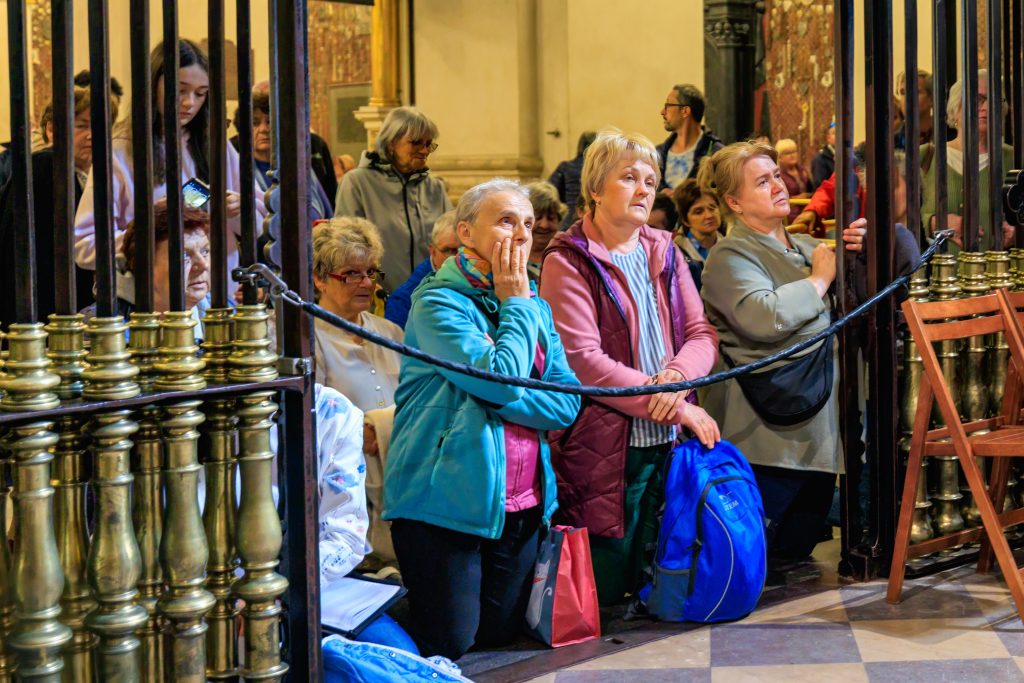
The crowds still come. At Jasna Góra, I watched as worshipers kneeled, prayed, and wiped away tears in front of the Black Madonna — a 14th-century icon believed by many to have miraculous powers.
No photograph can truly capture the intensity of devotion in that room — but I tried.
Pilgrims at Jasna Góra kneel in reverence before the Black Madonna.
But just outside the monastery’s walls, the contrast is striking.
A fenced lot in Częstochowa under stormy skies. The past is never far.
I don’t know exactly where my father stood. But I walked where he walked — on some of the same cobblestones, past buildings he might have passed and beneath the same sky.
This visit was more than just a return to a place. It was a return to memory, to family, and to a world that war tried to erase.
The name Auschwitz is the German version of the Polish town Oświęcim, located about 40 miles (64 km) west of Kraków. After Germany invaded Poland in 1939, the region was annexed into the Third Reich.
The railway tracks leading into Auschwitz II–Birkenau. From 1944, this was the arrival point for hundreds of thousands of deportees, many of whom were sent directly to their deaths upon arrival.
In 1940, Nazi Germany established a concentration camp on the outskirts of Oświęcim, known today as Auschwitz I, or the Main Camp. In 1941, they began building a much larger killing center two miles away in the village of Brzezinka, renamed Birkenau. This site — Auschwitz II — became the heart of the extermination process.
That is the geography and the history. But what I found when I arrived went far beyond what books and maps can convey.
Despite years of studying photographs, listening to survivor testimonies, and watching documentaries, nothing prepared me for Auschwitz II–Birkenau. Not its immense scale, nor the unsettling quiet that hung over the gray May morning in 2025 when I arrived.
In September 1982, I visited Dachau with my father. He had been imprisoned at HASAG, a Nazi forced labor camp in Częstochowa, and was later transferred through a series of camps as the Nazis evacuated prisoners westward in the final stages of the war. In 1944, he was sent from HASAG to Gross-Rosen, then to Flossenbürg, and finally to Dachau.
Gate to the Death Wall – Block 11, Auschwitz I
One of his most harrowing memories was the transfer from Flossenbürg to Dachau. Along with 500 other prisoners, he was first forced to march, then packed into freight cars “like cattle,” as he later described in a 1973 interview with the Pittsburgh Press. Only 18 of the 500 survived the journey. My father was one of them.
During our visit to Dachau in 1982, my father shared this story in German with a group of high school students. Hearing him speak about what he had endured—on the very ground where his imprisonment had ended—moved me deeply. Yet even with that experience, Birkenau struck me in ways I hadn’t expected.
Although Dachau had a gas chamber, historical evidence suggests it was never used for mass executions. It was equipped and capable—part of the same machinery of terror—but not used systematically for mass murder like the crematoria at Auschwitz-Birkenau. Most deaths at Dachau occurred through forced labor, shootings, disease, and medical experiments. Still, standing in that room with my father years ago was sobering. Even unused, the gas chamber embodied the intent of a system built on death.
His brother—my uncle—was deported to Auschwitz and survived. He was among those liberated when the Red Army arrived in January 1945. These are not just historical facts to me; they are the roots of my identity.
So I came to Auschwitz not as a historian, nor just as a photographer, but as a son and a nephew. I didn’t come seeking understanding—I don’t believe Auschwitz can be understood. I came to listen, to stand where memory persists, and to bear witness.
What struck me most wasn’t a particular building or exhibit, but the vastness of Birkenau. It spans roughly 346 acres—more than half a square mile of barracks, chimneys, tracks, and ruins. It felt like a mechanized landscape of erasure, a place where lives were reduced, processed, and obliterated. The train tracks still slice through the camp. Rows of chimneys stretch toward the forest line. The emptiness felt both infinite and suffocating. At one point, I stopped walking and heard only the gravel under my shoes and the wind moving through the wire. It was a silence not of peace, but of reverberation.
Wooden bunks where prisoners slept in overcrowded, in humane conditions.
Auschwitz is one of the most visited Holocaust memorial sites in the world. In recent years, more than two million people a year have come—students, families, descendants of survivors, visitors from every corner of the globe. That fact lingered with me as I walked. I knew I was one of many, yet I felt completely alone.
During my visit, I saw two groups of Israelis. The first were students, draped respectfully in Israeli flags, walking the grounds where their history was nearly erased. The second were soldiers in uniform—quiet, focused, listening intently to their guides. They were not tourists, but heirs to a story that had nearly ended here. Their presence filled me with quiet pride and a sense of defiance. It felt like an answer—a living affirmation of survival and responsibility.
Inside the crematorium at Auschwitz I. Though smaller than the gas chambers later built at Birkenau, this was one of the earliest sites of industrialized murder. Its walls remain stained by fire and time.
I also visited the crematorium at Auschwitz I—preserved as part of the museum—and later, the ruins of the much larger gas chambers and crematoria at Birkenau. These were the industrial centers of death.
The crematorium at Auschwitz I surprised me with its scale. It was smaller and more intimate than I had expected—but no less chilling. It was an early site of killing, later eclipsed by the vast machinery of death at Birkenau. There, the system of extermination became larger, more efficient, and partially hidden underground. Seeing the shattered remains of those later structures brought the full scope of the killing into terrifying clarity.
At Birkenau, the ruins sit in quiet collapse, half-swallowed by the earth. It’s one thing to know what happened there. It’s another to stand where it happened. The deliberate effort to erase these places—and the lives taken within them—was itself part of the crime.
A view of the barracks at Auschwitz II-Birkenau, seen through barbed wire.
I’m grateful to the many Poles who have preserved this site with care. I recognize that Auschwitz was built and operated by Germans, and that the responsibility for the Holocaust rests with them. But it would be dishonest to say I felt only gratitude. My visit stirred unease. Poland’s relationship with its Jewish past is complicated—marked by courage and complicity, remembrance and denial. Antisemitism did not begin or end with the camps. That truth is hard to ignore.
Still, I didn’t come to accuse. I came with questions. I came because I needed to be in the place where history and memory hang so heavily that even the air feels changed.
I left without answers. But I left with something else: a deeper connection to the voices that once filled this place, and a stronger sense of responsibility to keep their stories alive.
Memory alone is not enough. But without memory, nothing remains.
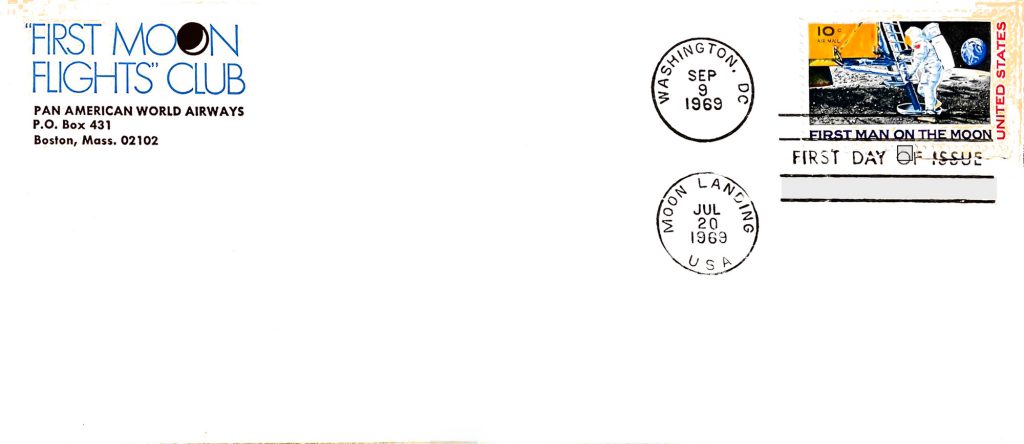
The Club originated from a waiting list that is said to have started in 1964, when Gerhard Pistor, an Austrian journalist, went to a Viennese travel agency requesting a flight to the Moon. The agency forwarded his request to Pan Am, which accepted the reservation two weeks later and replied that the first flight was expected to depart in 2000.
On July 20, 1969, Neil Armstrong became the first human to step foot on the moon.
“First Man on the Moon” stamp depicting Neil Armstrong stepping from the Apollo 11 lunar module Eagle.
On September 9, 1969, the United States Postal Service issued a 10 cent postage stamp showing an astronaut walking on the surface of the moon. It was called the “First Man on the Moon” postage stamp. According to the National Postal Museum, the stamp was made from the same master die that the astronauts took with them to the moon. Additionally, it was the largest stamp the United States had issued up to that point.
Pan Am sent members of the “First Moon Flights” Club “First Day of Issue” envelopes. I was excited to get mine and have kept it all this time. I now doubt I will make it to the moon. But it was an exciting thought.
Unfortunately, Pan Am did not survive. It went bankrupt in 1991.
The residence of the United States Ambassador to Paris is at 41 rue du Faubourg Saint-Honoré in the 8th arrondissement. It is known as the Hôtel de Pontalba. It was built by Louis Visconti for the New Orleans–born Baroness Micaela Almonester de Pontalba between 1842 and 1855. Edmond James de Rothschild acquired the building in 1876.
During the German occupation of France, the mansion, then owned by Baron Maurice de Rothschild, was requisitioned as an officers’ club for the Luftwaffe. After the war, it was rented out to the British Royal Air Force Club, and then to the United States.
In 1948, the American government purchased the building, primarily for the United States Information Service. These offices were moved to the Hôtel Talleyrand as restoration was completed in 1971 during the tenure of Ambassador Arthur K. Watson. The building then became the official residence of the ambassador. This magnificent structure has only been the Ambassador’s residence for a little more than fifty years.
I recently learned that, Maisie Hitchcock, a guide on a Rick Steves tour of Switzerland I took in 2018 died peacefully of ovarian cancer on August 9, 2023 in the company of her family.
Maisie is the third from the left.
Maisie was a kind, gentle guide who did an excellent job showing us the highlights of Switzerland. Although she was English, she lived in Berlin and spoke fluent German.
Maisie enjoyed people and knew how to relate to each person as an individual. Maisie’s father, Robyn Hitchcock, is an English singer-songwriter and guitarist. He wrote a loving memory of his daughter on Instagram.
During that 2018 trip, my suitcase broke and I asked Maisie where I could buy a new bag. Maisie helpfully sent me to Manor in Lugano where I bought a bag that I continue to use on my travels.
May Maisie’s memory be a blessing for many years to come.
Travel with Rick Steves is a weekly, one-hour podcast featuring guest experts and listener calls about travel, cultures, and people around the world. In my view, it’s the best travel podcast available.
Rick Steves is well-traveled, articulate, and endlessly curious. While his guidebooks and organized tours focus mainly on Europe, the podcast ranges far beyond, covering destinations and cultures across the globe.
Guests often include professional guides and authors who contribute to his tours and books. The conversations are timely, informative, and inspiring. Notable guests have included writers such as Paul Theroux and the late David McCullough (1933–2022).
I found McCullough’s interview especially moving. He began his explorations in my hometown of Pittsburgh, Pennsylvania, and went on to write extensively about American history—from The Johnstown Flood to his Pulitzer Prize–winning works. Listening to him talk with Steves was a reminder of how travel and curiosity can begin close to home and expand outward to the wider world.
That’s the caliber of guest Rick Steves brings to his listeners—week after week.