At the 2021 Washington Open, I was lucky enough to watch Rafael Nadal practice—just weeks before he suffered an injury that forced him to withdraw from the tournament.
Nadal’s career is legendary: 22 Grand Slam men’s singles titles, including a record 14 French Opens; 92 ATP-level singles titles, among them 36 Masters 1000 crowns and an Olympic gold medal—with 63 total titles won on clay. After a final appearance for Spain in the 2024 Davis Cup Finals, Nadal officially retired on November 19, 2024.
Watching him then, I didn’t realize I was glimpsing the end of an era—not just a great player, but one of tennis’s most profound champions.
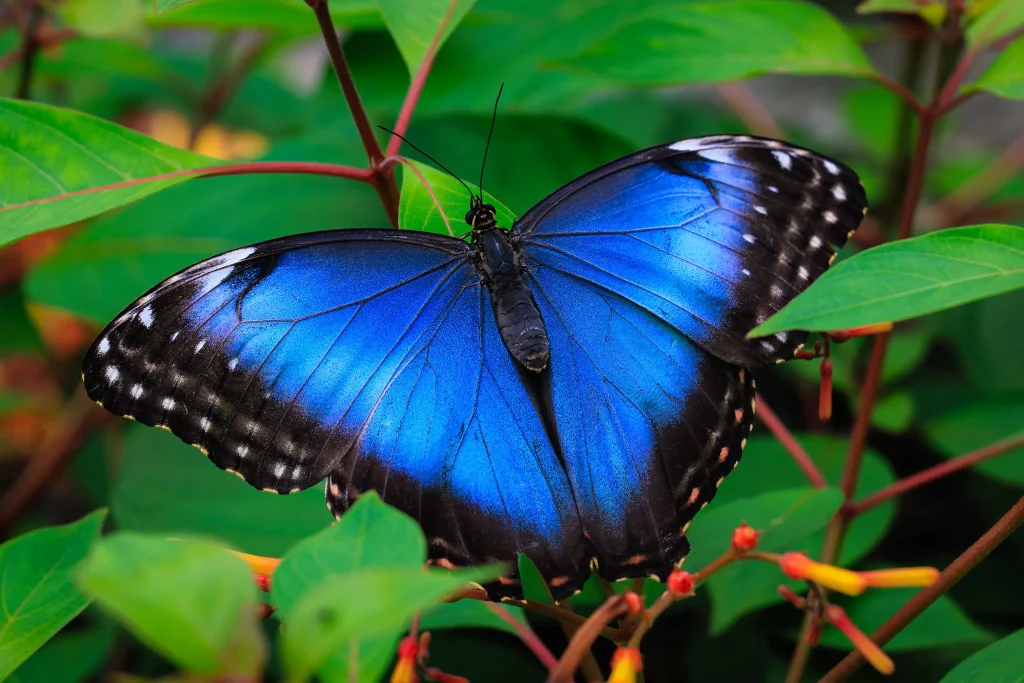
Menelaus blue morpho (Morpho menelaus) at the Butterfly Experience.
Brookside Gardens in Montgomery County, Maryland is an award-winning 50-acre public display garden within Wheaton Regional Park. Included in the gardens are several distinct areas: Aquatic Garden, Azalea Garden, Butterfly Garden, Children’s Garden, Rose Garden, Japanese Style Garden, Trial Garden, Rain Garden, and the Woodland Walk. The Formal Gardens areas include a Perennial Garden, Yew Garden, the Maple Terrace, and Fragrance Garden. Brookside Gardens also features two conservatories for year-round enjoyment. Admission to the gardens is free.
The Butterfly Experience at Brookside Gardens is a seasonal exhibit with a modest fee. Visitors get an intimate, up-close look at hundreds of brilliant live butterflies from North America, Central America, South America, Africa, and Asia as they flutter among colorful flowers throughout Brookside Gardens’ South Conservatory. The exhibit started on April 10, 2025, and runs through September 21, 2025. The Experience is located inside a conservatory glasshouse, which is usually ten degrees warmer than the outside temperature and more humid.
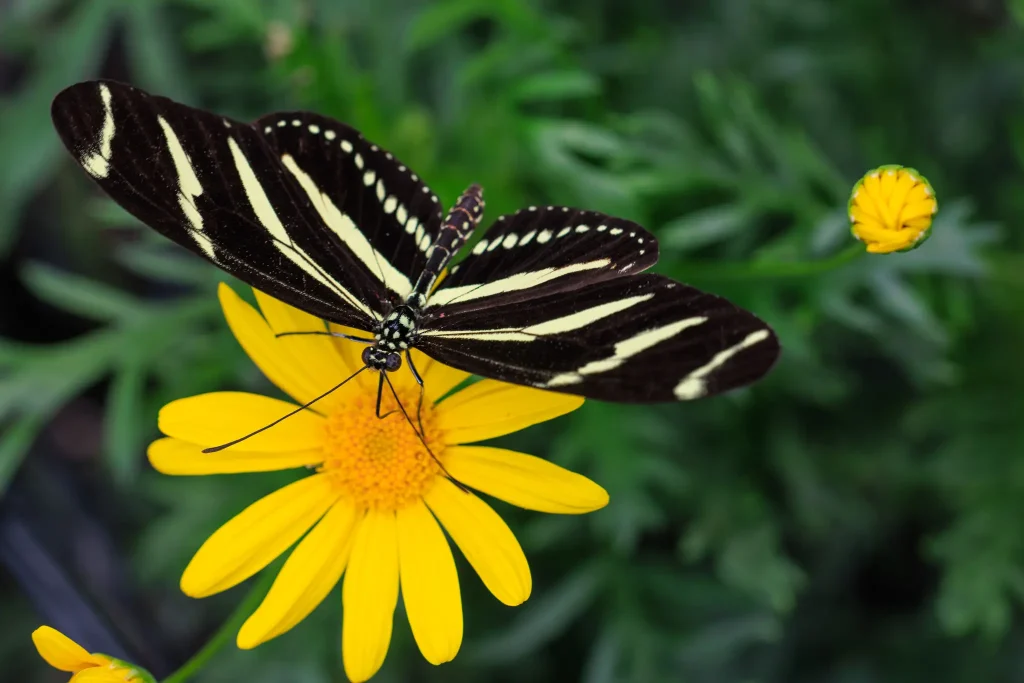
Zebra Longwing Butterfly (Heliconius charithonia)
The exhibit, which had been offered annually beginning in 1997, was last held in 2019 when it was suspended due to the Covid pandemic. This was my first time seeing the exhibit. I’m glad it’s back. It’s quite an undertaking. Every week during the exhibition, Brookside receives between 200 and 300 butterflies from around the world.
The butterflies are beautiful and challenging to photograph, I made these images with a Macro lens but a telephoto lens would probably have been easier. In any event, seeing these wonderful creatures is a treat.
The Blue Angels, formally named the U.S. Navy Flight Demonstration Squadron, are a flight demonstration squadron of the United States Navy. Formed in 1946, the unit is the second oldest formal aerobatic team in the world, following the Patrouille de France which formed in 1931. The name was picked by the original team when they were planning a show in New York in 1946. One of them came across the name of the city’s famous Blue Angel nightclub in the New Yorker Magazine.
The U.S. Navy Blue Angels in tight diamond formation, slicing through the sky with precision during their airshow performance.
The team has six Navy and one Marine Corps demonstration pilots. They fly the Boeing F/A-18E/F Super Hornet and the Lockheed Martin C-130J Super Hercules. Each aircraft is painted in the Blue Angels’ iconic colors: vivid blue and gold. The sleek paint job, high-gloss finish, and striking design aren’t just for aesthetics—they’re also a point of pride and a hallmark of the professionalism the team embodies.
The Blue Angels typically perform aerial displays in at least 60 shows annually at 32 locations throughout the United States and two shows at one location in Canada. The “Blues” still employ many of the same practices and techniques used in the inaugural 1946 season.
One of the most famous formations of the Blue Angels is the “Diamond” (shown above), where four jets fly in tight, symmetrical formation with mere inches separating their wings. An estimated 11 million spectators view the squadron during air shows from March through November each year. Since 1946, the Blue Angels have flown for more than 505 million spectators.
The mission of the Blue Angels is to showcase the pride and professionalism of the United States Navy and Marine Corps by inspiring a culture of excellence and service to the country through flight demonstrations and community outreach.
The Blue Angels execute a high-speed crossover maneuver, their jets streaking in perfect alignment across a brilliant blue sky.
The Blue Angels and the Air Force Thunderbirds do not fly together. Department of Defense policy explains that the use of military aviation demonstration teams is for recruiting purposes; therefore the teams usually do not fly within 150 miles of each other without special permission.
The Blue Angels are a treasured part of American culture. Their air shows are among the most attended aviation events in the country, often drawing hundreds of thousands of spectators.
I saw the Blue Angels perform at the Sun ’n Fun Aerospace Expo in Lakeland, Florida on April 5, 2025. These photos are from that event. Watching the Blue Angels is an awe inspiring experience and a reminder of the skill and courage of those who serve.
The POLIN Museum of the History of Polish Jews in Warsaw is both a monument to a lost civilization and a cultural institution of the highest caliber. Housed in a striking contemporary building on the site of the former Warsaw Ghetto, the museum traces 1,000 years of Jewish life in Polish lands—from early migrations and the Golden Age through the partitions, the Holocaust, and into the present day.
Facing the Monument to the Ghetto Heroes, the POLIN Museum stands on the site of the prewar Jewish neighborhood and wartime ghetto. Together, the museum and monument form a powerful memorial complex. One visits the monument to honor those who died by remembering how they died. One enters the museum to honor them—and those who came before and after—by remembering how they lived.
The building’s striking glass façade and golden interior passage evoke both continuity and fracture on the site of the former Warsaw Ghetto.
One of the museum’s most impressive features is the reconstruction of the wooden synagogue from Gwoździec. This soaring, hand-painted structure, recreated using traditional methods, pays tribute not only to Jewish religious architecture but also to the vibrancy and beauty of a world that once was.
The museum handles Poland’s long Jewish history with beauty, care, and deep respect. Yet I found myself wondering: how deeply does POLIN grapple with the antisemitism that existed in Poland before the German invasion? The subject is present—in interwar exhibits, newspaper clippings, and political histories—but easy to miss, especially amid the museum’s emphasis on Jewish life rather than victimhood. Perhaps this is deliberate. The goal, after all, is education, not alienation. Still, it’s hard to tell the full story of Jewish life in Poland without acknowledging how often Jews were made to feel like outsiders—even before the Holocaust began.
Barbara Kirshenblatt-Gimblett, the museum’s chief curator, once said: “We are creating a museum of life, not a museum of death.” That vision is palpable throughout POLIN’s galleries. The museum honors what was lost while insisting that Jewish history in Poland must also be remembered for what it was: rich, complex, and deeply woven into the national fabric.
At the heart of the POLIN Museum stands a dazzling reconstruction of the wooden synagogue from Gwoździec, a small town once located in the Polish-Lithuanian Commonwealth (now in Ukraine).
So what is the purpose of POLIN today? A Polish guide I met during my travels said the museum is primarily intended for Poles, almost all of whom are not Jewish. There’s truth in that. In a country where 90% of the prewar Jewish population was murdered and few Jews remain, the museum serves not only as remembrance but also as education. It is also, arguably, part of Poland’s broader effort to grapple with its past while promoting cultural tourism. Jewish heritage sites have become cultural and economic assets—a reality that raises uneasy questions about purpose and presentation.
Still, none of that should diminish what POLIN has accomplished. It does not shy away from difficult chapters. It honors what was lost while celebrating what was lived. And for Jewish and non-Jewish visitors alike, it offers a place to learn, reflect, and—perhaps most importantly—feel the weight of presence where so much absence remains.
When I visited the Royal Castle in Warsaw, I was struck not only by the grandeur of its interior rooms but by the weight of history they carried. Gilded ceilings, restored frescoes, and polished parquet floors radiated an elegance that felt both authentic and improbable—especially knowing that everything I saw had been painstakingly reconstructed in the 1970s and 1980s, decades after the original interiors were destroyed during World War II.
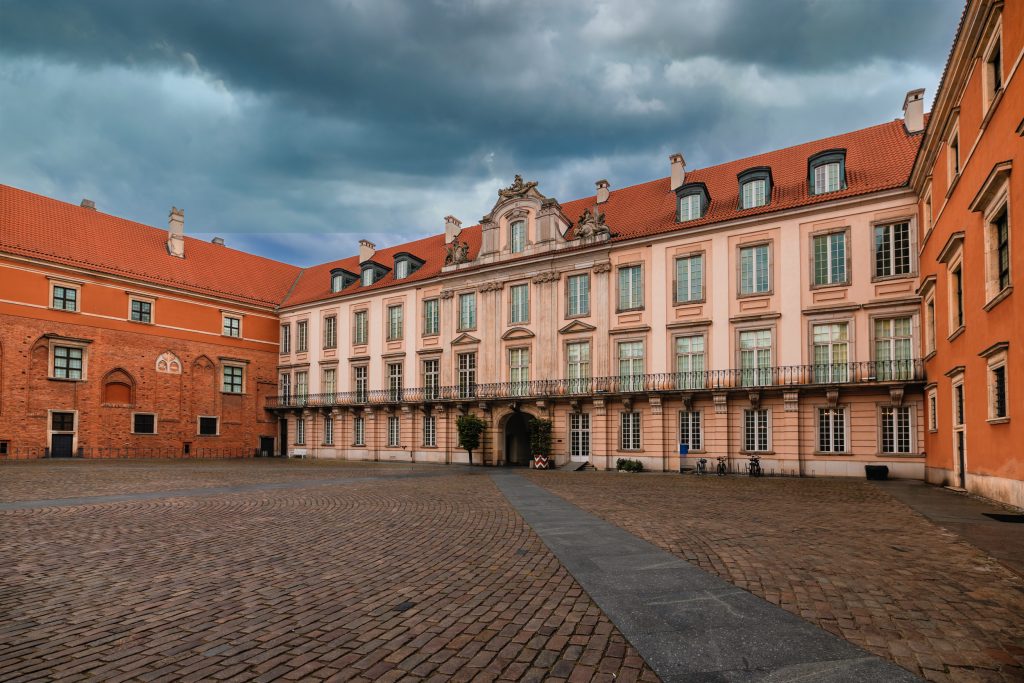
The Royal Castle in Warsaw rebuilt brick by brick after its wartime destruction—now a national symbol of resilience.
The Royal Castle (Zamek Królewski w Warszawie), which stands at the entrance to Warsaw’s Old Town, has long embodied Poland’s national identity. For centuries, it served as the official royal residence and administrative heart of the Polish–Lithuanian Commonwealth. It was here, in 1791, that lawmakers adopted the Constitution of May 3—the first modern constitution in Europe, and the second in the world after that of the United States.
But by the end of the 18th century, Poland had lost its sovereignty. Through a series of three partitions, Russia, Prussia, and Austria carved up the territory, erasing Poland from the map of Europe for more than a century.
My father was born in 1916 in Kamyk, a village near Częstochowa—home to the revered Black Madonna. At the time, Poland did not exist as an independent country. Kamyk lay within the Russian Partition, a region ruled by the Russian Empire since the late 1700s. By 1916, however, the area was under German military occupation, following advances on the Eastern Front during World War I. Poland would regain its independence just two years later, in 1918, after the collapse of the partitioning empires.
Portraits of Polish monarchs in a room restored from fragments and memory.
In the years following the partitions, foreign rulers redesigned the Castle in neoclassical style. When Poland regained its sovereignty in 1918, the Castle became the official residence of the Polish head of state.
World War II brought devastation. German planes bombed the Castle in 1939, and after the failed Warsaw Uprising in 1944, Nazi forces deliberately destroyed what remained. The Castle lay in ruins.
Under the postwar communist regime, reconstruction was delayed. But in time, rebuilding the Castle became both a political and cultural act of defiance. Polish citizens contributed funds. Historians, architects, and artisans turned to prewar drawings, paintings, and photographs to guide the work. Between 1971 and 1984, the Castle rose again—rebuilt atop its surviving cellars, foundations, the adjacent Copper-Roof Palace, and the Kubicki Arcades.
Today, the Royal Castle is not just a museum; it is a monument to what was lost—and to what was recovered. It houses one of Poland’s most important collections of national and European art. In 1980, UNESCO recognized both the Castle and Warsaw’s Old Town as a World Heritage Site. And in 2024 alone, over 2.14 million people visited—making it one of the most visited art museums in the world.
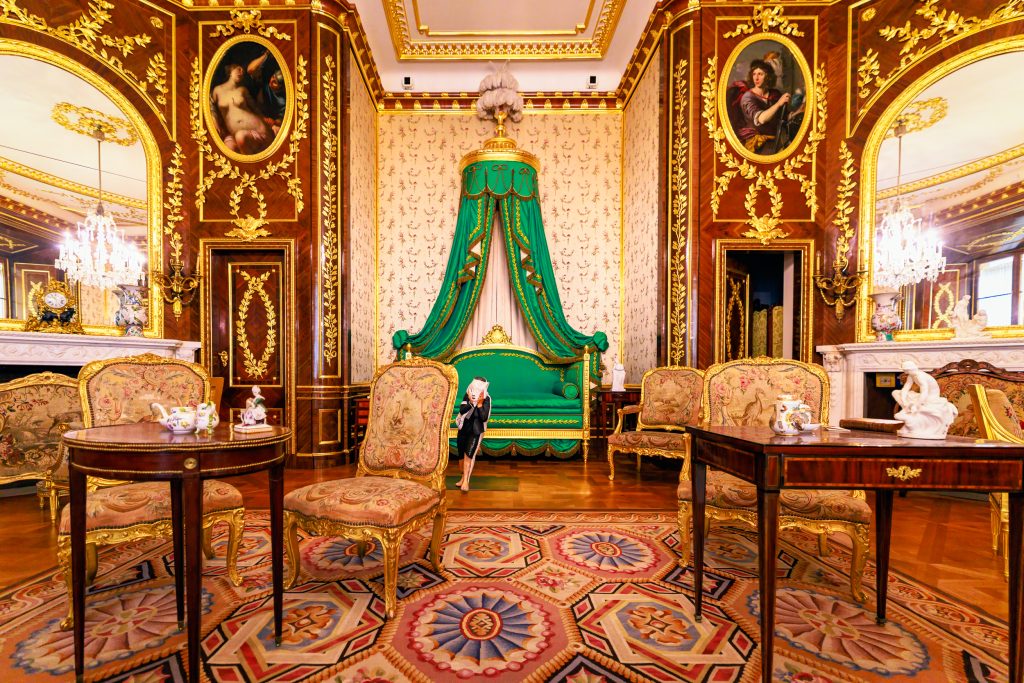
No detail overlooked: a gilded chamber echoing with royal formality and artistic pride.
I recently returned from a journey through Poland—a place both beautiful and burdened. As I walked the streets of Warsaw, Kraków, and smaller towns tied to my family’s past, I found myself reckoning not just with personal memory, but with the immense suffering and resilience that have shaped this country.
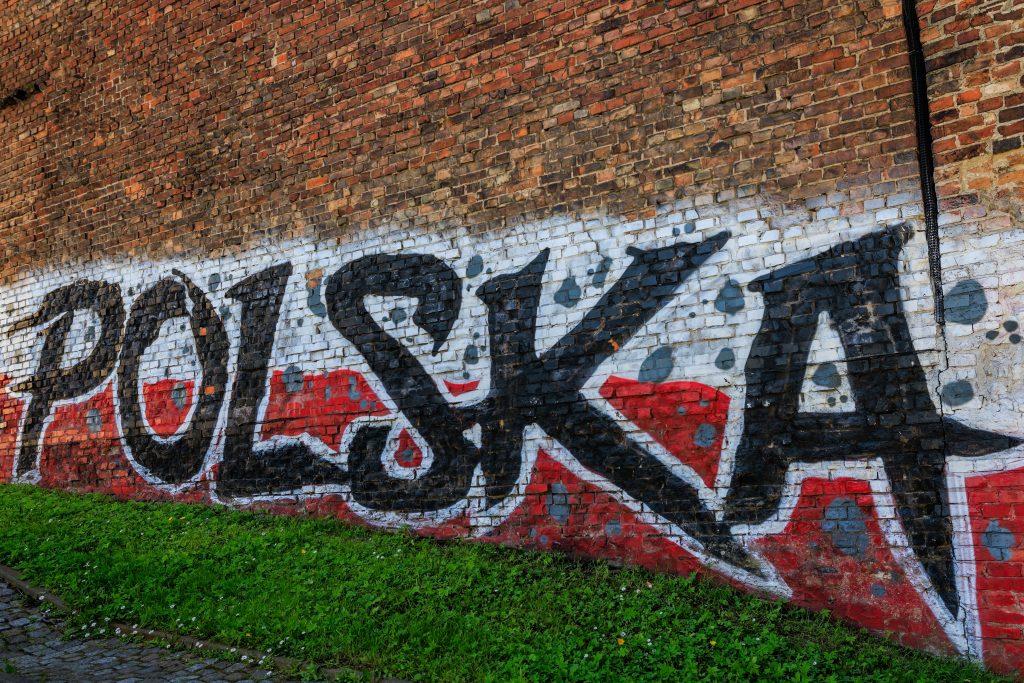
Graffiti spelling “POLSKA” on a brick wall in Gdansk. Pride, resilience, and memory coexist in Poland’s streets—just as they do in its history.
Poland was not only the first victim of World War II—it was also one of the most devastated. In 1939, it was invaded and carved up by two brutal regimes: Nazi Germany from the west, and the Soviet Union from the east. What followed was a six-year onslaught of destruction, repression, and mass murder.
By war’s end, an estimated six million Polish citizens were dead—roughly 17% of the population. Half of them were Jews murdered in the Holocaust. The other half were primarily ethnic Poles who perished in bombings, executions, forced labor, resistance fighting, and Soviet purges (Wikipedia – World War II casualties of Poland).
The physical destruction was staggering. Warsaw, the capital, was deliberately reduced to rubble after the 1944 uprising—85 to 90 percent of the city was destroyed. Nationally, about 30% of Poland’s infrastructure and wealth was lost, and over 40% of its cultural property—including archives, libraries, and religious sites—was looted or obliterated (Polish War Reparations Bureau – Wikipedia summary).
Yet even after the war, Poland was not free. Instead of liberation, it fell under Soviet domination. For nearly five decades, the Polish people lived under Communist rule imposed by Moscow. The state censored speech, imprisoned dissenters, and suppressed any honest reckoning with what the country had endured.
But Poland’s vulnerability didn’t begin in 1939. From the late 18th century until the end of World War I, Poland did not exist as an independent nation. For more than a century, it was partitioned by Russia, Prussia, and Austria—wiped off the map. My father was born in 1916, during that period of nonexistence. Poland would only re-emerge as a sovereign state in 1918, two years after his birth, following the end of the Great War.
Then came the Second World War, bringing unimaginable suffering. My father, born near Częstochowa, survived the HASAG slave labor camp and was later imprisoned at the Gross-Rosen concentration camp, and from there transferred to Flossenbürg and Dachau. He was one of the very few to survive. His parents and most of his extended family were murdered. For my father—as for so many Polish Jews—there was no going home.
Today, Poland is a member of NATO, and there is hope that the alliance provides the kind of protection it lacked in the past. But I find myself wondering: Would NATO and the United States truly defend Poland if attacked by Russia? Or would the West abandon Poland again, as it did in 1939? I don’t know the answer. I hope we never have to find out.
Yet there is another truth I cannot ignore. As a Jew, I deeply value Poland’s efforts to remember the Holocaust—through museums, memorials, and scholarship. I was moved by what I saw. But I also felt that Poland has yet to fully come to terms with the long history of antisemitism that predates Nazi Germany. I say this not in a spirit of accusation, but of reflection. While Germany has publicly and institutionally confronted its role in the Holocaust, Poland has often struggled to acknowledge how deeply antisemitism was woven into the social fabric—even before the war. There were Poles who risked everything to save Jews, and they deserve enduring honor. But there were also Poles who betrayed, exploited, or turned away—and that, too, must be faced.
What struck me most during my visit was how present the past still feels. The scars are visible—in the rebuilt bricks of Warsaw’s Old Town, in the memorials to the ghetto, and in the ruins left untouched as testimony. But so too is the resilience. I saw it in young people reclaiming their history, in museums that confront difficult chapters, and in quiet moments of beauty: the light on cobblestones, the music in cafés, the sound of Polish spoken freely.
Before leaving, I asked a guide whether people in Poland today worry about defending their borders. He hesitated—perhaps reluctant to speak directly. But I sensed that the question lingered beneath the surface. Many Poles today do worry about their security, especially in light of Russia’s war against Ukraine. The country is investing heavily in defense and leans firmly on its NATO membership. Yet there is also a quiet anxiety—born of history—that Poland might again be left to face aggression alone.
Still, life goes on. There’s a tension here: between living with history and not being consumed by it. Poles carry that burden with remarkable dignity.
Poland’s story is not only one of tragedy. It is also a story of survival, rebuilding, and memory. Visiting gave me a deeper appreciation not only for what this country has lived through, but also for the dignity with which it remembers—and the silences it still must break.
In May 2025, I visited Częstochowa, Poland — the city where my father once walked as a young man before World War II. He was born in Kamyk, a small village nearby, into a Jewish family of modest means. His father, like many Jewish men in Kamyk at the time, was a butcher. Before the war, my father would travel to Częstochowa to sell souvenirs of the Black Madonna to pilgrims visiting the Jasna Góra Monastery.
The Black Madonna of Częstochowa, Poland’s most venerated icon, enshrined at Jasna Góra.
Over 80 years later, I walked those same streets with my camera. Much has changed, and much has not.
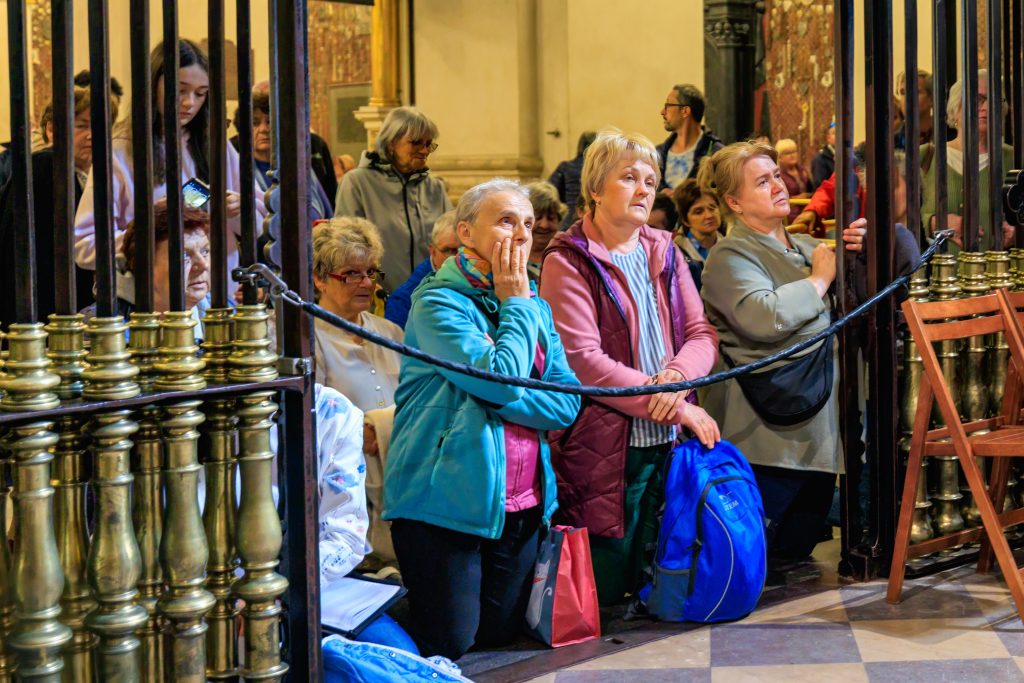
The crowds still come. At Jasna Góra, I watched as worshipers kneeled, prayed, and wiped away tears in front of the Black Madonna — a 14th-century icon believed by many to have miraculous powers.
No photograph can truly capture the intensity of devotion in that room — but I tried.
Pilgrims at Jasna Góra kneel in reverence before the Black Madonna.
But just outside the monastery’s walls, the contrast is striking.
A fenced lot in Częstochowa under stormy skies. The past is never far.
I don’t know exactly where my father stood. But I walked where he walked — on some of the same cobblestones, past buildings he might have passed and beneath the same sky.
This visit was more than just a return to a place. It was a return to memory, to family, and to a world that war tried to erase.
The name Auschwitz is the German version of the Polish town Oświęcim, located about 40 miles (64 km) west of Kraków. After Germany invaded Poland in 1939, the region was annexed into the Third Reich.
The railway tracks leading into Auschwitz II–Birkenau. From 1944, this was the arrival point for hundreds of thousands of deportees, many of whom were sent directly to their deaths upon arrival.
In 1940, Nazi Germany established a concentration camp on the outskirts of Oświęcim, known today as Auschwitz I, or the Main Camp. In 1941, they began building a much larger killing center two miles away in the village of Brzezinka, renamed Birkenau. This site — Auschwitz II — became the heart of the extermination process.
That is the geography and the history. But what I found when I arrived went far beyond what books and maps can convey.
Despite years of studying photographs, listening to survivor testimonies, and watching documentaries, nothing prepared me for Auschwitz II–Birkenau. Not its immense scale, nor the unsettling quiet that hung over the gray May morning in 2025 when I arrived.
In September 1982, I visited Dachau with my father. He had been imprisoned at HASAG, a Nazi forced labor camp in Częstochowa, and was later transferred through a series of camps as the Nazis evacuated prisoners westward in the final stages of the war. In 1944, he was sent from HASAG to Gross-Rosen, then to Flossenbürg, and finally to Dachau.
Gate to the Death Wall – Block 11, Auschwitz I
One of his most harrowing memories was the transfer from Flossenbürg to Dachau. Along with 500 other prisoners, he was first forced to march, then packed into freight cars “like cattle,” as he later described in a 1973 interview with the Pittsburgh Press. Only 18 of the 500 survived the journey. My father was one of them.
During our visit to Dachau in 1982, my father shared this story in German with a group of high school students. Hearing him speak about what he had endured—on the very ground where his imprisonment had ended—moved me deeply. Yet even with that experience, Birkenau struck me in ways I hadn’t expected.
Although Dachau had a gas chamber, historical evidence suggests it was never used for mass executions. It was equipped and capable—part of the same machinery of terror—but not used systematically for mass murder like the crematoria at Auschwitz-Birkenau. Most deaths at Dachau occurred through forced labor, shootings, disease, and medical experiments. Still, standing in that room with my father years ago was sobering. Even unused, the gas chamber embodied the intent of a system built on death.
His brother—my uncle—was deported to Auschwitz and survived. He was among those liberated when the Red Army arrived in January 1945. These are not just historical facts to me; they are the roots of my identity.
So I came to Auschwitz not as a historian, nor just as a photographer, but as a son and a nephew. I didn’t come seeking understanding—I don’t believe Auschwitz can be understood. I came to listen, to stand where memory persists, and to bear witness.
What struck me most wasn’t a particular building or exhibit, but the vastness of Birkenau. It spans roughly 346 acres—more than half a square mile of barracks, chimneys, tracks, and ruins. It felt like a mechanized landscape of erasure, a place where lives were reduced, processed, and obliterated. The train tracks still slice through the camp. Rows of chimneys stretch toward the forest line. The emptiness felt both infinite and suffocating. At one point, I stopped walking and heard only the gravel under my shoes and the wind moving through the wire. It was a silence not of peace, but of reverberation.
Wooden bunks where prisoners slept in overcrowded, in humane conditions.
Auschwitz is one of the most visited Holocaust memorial sites in the world. In recent years, more than two million people a year have come—students, families, descendants of survivors, visitors from every corner of the globe. That fact lingered with me as I walked. I knew I was one of many, yet I felt completely alone.
During my visit, I saw two groups of Israelis. The first were students, draped respectfully in Israeli flags, walking the grounds where their history was nearly erased. The second were soldiers in uniform—quiet, focused, listening intently to their guides. They were not tourists, but heirs to a story that had nearly ended here. Their presence filled me with quiet pride and a sense of defiance. It felt like an answer—a living affirmation of survival and responsibility.
Inside the crematorium at Auschwitz I. Though smaller than the gas chambers later built at Birkenau, this was one of the earliest sites of industrialized murder. Its walls remain stained by fire and time.
I also visited the crematorium at Auschwitz I—preserved as part of the museum—and later, the ruins of the much larger gas chambers and crematoria at Birkenau. These were the industrial centers of death.
The crematorium at Auschwitz I surprised me with its scale. It was smaller and more intimate than I had expected—but no less chilling. It was an early site of killing, later eclipsed by the vast machinery of death at Birkenau. There, the system of extermination became larger, more efficient, and partially hidden underground. Seeing the shattered remains of those later structures brought the full scope of the killing into terrifying clarity.
At Birkenau, the ruins sit in quiet collapse, half-swallowed by the earth. It’s one thing to know what happened there. It’s another to stand where it happened. The deliberate effort to erase these places—and the lives taken within them—was itself part of the crime.
A view of the barracks at Auschwitz II-Birkenau, seen through barbed wire.
I’m grateful to the many Poles who have preserved this site with care. I recognize that Auschwitz was built and operated by Germans, and that the responsibility for the Holocaust rests with them. But it would be dishonest to say I felt only gratitude. My visit stirred unease. Poland’s relationship with its Jewish past is complicated—marked by courage and complicity, remembrance and denial. Antisemitism did not begin or end with the camps. That truth is hard to ignore.
Still, I didn’t come to accuse. I came with questions. I came because I needed to be in the place where history and memory hang so heavily that even the air feels changed.
I left without answers. But I left with something else: a deeper connection to the voices that once filled this place, and a stronger sense of responsibility to keep their stories alive.
Memory alone is not enough. But without memory, nothing remains.
In 1874, about forty Jewish men, primarily of German origin, met to form an association “to promote social and literary entertainment among its members,” according to its charter. The first president was Josiah Cohen, a respected teacher, lawyer, and judge. Jacob Eiseman served as president in 1884, the year the club was chartered. Most of its early members — and nearly all of its early officers — belonged to Rodef Shalom Congregation.
The Concordia Club — a ballroom where I first learned to dance, restored to its former grace.
Social clubs like the Concordia sprang up across the United States at a time when Jews were routinely denied membership in prominent social and business clubs. In Pittsburgh, for example, the Duquesne Club did not begin admitting Jewish members until 1968. The Concordia Club was sometimes referred to as the “Jewish Duquesne Club.”
The Club’s first home was a rented house on Stockton Avenue in Allegheny City (now Pittsburgh’s North Side). In the late 1870s, a dance hall was added to the building. The Club purchased the property in 1890, later replacing it with a new clubhouse on the same site, built at a cost of about $75,000. Membership at the time numbered 175.
The Duquesne Club — a doorway into more than a century of tradition.
Move to Oakland
Over the next two decades, the Club grew into a leading social institution for the Jewish community, even as the community shifted eastward toward neighborhoods such as Squirrel Hill. By 1913, more than 95 percent of members lived in Squirrel Hill. That year, the Club moved to a new home on O’Hara Street in the Schenley Farms district of Oakland. Designed by prominent Pittsburgh architect Charles Bickel, the clubhouse was dedicated on Christmas Day, 1913, with a gala banquet. It featured a banquet hall, ballroom, library, lounges, sleeping quarters, billiard rooms, and bowling alleys.
When the building opened, it was considered one of the city’s most opulent, with elegant china, crystal, linens, and lavish floral arrangements. A 1915 Jewish Criterion article described it as “entirely complete with billiard rooms, banquet hall, rest and lounging parlors, reading quarters and sleeping accommodations.” In 1967, the Club added elaborate dark oak paneling salvaged from the Fort Pitt Hotel after its demolition.
The Concordia Club hosted themed dances, vaudeville shows, musical revues, amateur theater productions, and holiday celebrations. It was also the venue for countless private events, remaining a central gathering place for Pittsburgh’s Jewish community. At its peak, membership approached 300. My father worked at the Club for many years, and as an awkward teenager I took ballroom dance classes in its elegant ballroom — shown above in its restored state.
Sale to Pitt and Renovation
After 135 years, facing declining membership and financial strain, the Club sold the building to the University of Pittsburgh. It closed on December 14, 2009.
Pitt undertook a $5.8 million restoration and renovation, completed in April 2011. The project preserved much of the historic character while creating nearly 35,000 square feet of space to ease shortages in student meeting, event, and office facilities at the William Pitt Union.
Upgrades included a new roof, modernized heating and cooling, improved lighting, and reconfigured interiors. The first floor now houses the oak-paneled lounge and a dining/meeting room. Upstairs, the 450-person ballroom — with its balcony, arched windows, and small stage — was restored, including gold leaf trim, reopened balcony access, and refurbished chandeliers by their original Pittsburgh maker. The basement is used for student organization storage, and the building also houses the Math Assistance Center, the Freshman Studies Program, and the Writing Center.
Pitt’s renovation was remarkably respectful of the Club’s history. The building’s signature oak paneling and elegant ballroom continue to be enjoyed — now by the university community that dominates the Oakland neighborhood.
“My earliest memories of the Concordia Club are of me as a little girl going to family dinners and parties, excited to know that upon entering the foyer I would be greeted with the warmth and safety of a place where the best of memories would be made.”
In a beautifully written piece about Flickr, Ferdy Christant reminds us why photography matters — not for the numbers, the likes, or the attention, but for the joy it brings.
His words hit a nerve:
“For amateurs and enthusiasts, . . . first and foremost . . . enjoy your hobby. Enjoy photography itself as well as your topics, be they a landscape, a model or a freaky insect. Or even a Snowy Owl. This is your hobby and you should learn to enjoy it even if not a single other human being notices. Start with this. Your joy and self-worth should not depend on others.
I’m serious. Look at people having other hobbies. Reading, hiking, tennis, wood crafts, brewing beer, collecting stamps, watching movies or playing Tetris… none of these people spend hours per day seeking validation as to whether their hobby is worthwhile or has meaning. It has meaning because it is your time and you enjoy doing it. None of them determine meaning based on others as if they are monitoring a stock market of self-worth.”
I needed to hear that.
Like many photographers, I sometimes slip into caring too much about reactions — checking stats, wondering if a photo is “good enough,” comparing myself to others. But the truth is, my favorite images are usually the ones that meant something to me when I made them — not the ones that performed well.
Photography has brought me joy, calm, connection, and surprise. That’s more than enough.