Between 1933 and 1938, Nazi Germany staged massive rallies in Nuremberg. The former Nazi Party Rally Grounds remain the largest surviving complex of National Socialist architecture in today’s Germany. Designed by Hitler’s architect Albert Speer, the vast structures still convey the immense power of Nazi propaganda. Speer was later convicted of war crimes and crimes against humanity at the International Military Tribunal in Nuremberg. He served 20 years in prison and died in London in 1981.
The Zeppelinfeld (Zeppelin Field), shown above, is one of the most striking remains. Its massive grandstand, 360 meters wide, was modeled on the Pergamon Altar of ancient Greece, with square piers inspired by Franco-American architect Paul Philippe Cret. After Germany’s defeat in 1945, American forces famously blew the swastika from its top. The name “Zeppelinfeld” refers to the landing of Count Zeppelin’s airship (LZ6) here in 1909.
I visited in April 2024, on a cold and windy day, with my cousin from Nuremberg who graciously served as my guide. The site felt stark, desolate, and impossibly vast—its scale resisting any attempt to capture it in photographs. Only a handful of visitors were there, but the immensity of the place chilled me. I tried to imagine the grounds filled with uniformed followers of Adolf Hitler, roaring in unison. The thought sent a shiver down my spine.
How could this have happened in Germany—a country with such a deep tradition of culture, learning, and science? Could it happen again? Is it already happening? The pull of the far right has not disappeared; it is rising once more.
What happened here was not inevitable. It can happen again.
The Peabody Room is a special collection dedicated to Georgetown neighborhood history and is part of The People’s Archive, the D.C. Public Library’s local history center focused on Washington, D.C. and African American history and culture. Among its resources is a house history file covering many Georgetown home
Peabody Room, Georgetown Library
Peabody Room, Georgetown Library
This local branch dates back to 1875, when the first library in Georgetown was funded by George Peabody (1795–1869), an American financier and philanthropist.
Peabody was born into a poor family in Massachusetts. He began in the dry goods trade and later moved into banking. In 1837, he relocated to London—then the capital of world finance—where he became the most noted American banker and helped to establish the young nation’s international credit.
Having no son of his own, Peabody took on Junius Spencer Morgan as a partner in 1854. Their joint business would evolve into the global financial services firm J.P. Morgan & Co. after Peabody’s 1864 retirement.### George Peabody’s Legacy
Peabody is often considered the father of modern philanthropy. His charitable initiatives included:
For his generosity, he was awarded the Congressional Gold Medal and named a Freeman of the City of London.
Fire and Renewal
In 2007, a large fire broke out at the Georgetown Library, severely damaging much of the building and causing the roof to collapse. The blaze irreparably damaged parts of the library’s holdings and artwork, including items in the Peabody collection.
Repairs and a major renovation were completed in 2010, restoring the library and ensuring the Peabody Room’s continued role as a steward of Georgetown’s history.
As a lover of France and its language, walking into the Comédie-Française feels like stepping into the heart of French culture. Founded in 1680 by decree of Louis XIV, it is the world’s oldest active theater company and the only state theater in France with its own permanent troupe of actors.
Its main stage, the Salle Richelieu, stands within the Palais-Royal complex in the 1st arrondissement. The setting is both grand and intimate — a space steeped in history yet alive with contemporary energy.
Often called La Maison de Molière, the theater honors the playwright most closely tied to its legacy. Though Molière died before the company was formally created, the Comédiens-Français still perform his plays and pay tribute to him each January 15.
The Comédie-Française is often associated with the classical repertoire, but creation has always been central to its mission. In 2023, I saw a modern staging of Médée d’après Euripide that showed just how vital and daring the troupe remains.
If you speak French, it’s worth buying a ticket. Sitting in that gilded hall, you’re not just a spectator — you’re part of a living tradition more than three centuries old.
The George Peabody Library in Baltimore is one of the most beautiful libraries I’ve ever stepped into. Walking through its doors feels like entering a cathedral of books — the kind of place that instantly slows you down and makes you look up.
It wasn’t always part of Johns Hopkins University. The library began as the library of the Peabody Institute of the City of Baltimore, founded in 1857 when Massachusetts-born philanthropist George Peabody dedicated the institute to the people of Baltimore in gratitude for their “kindness and hospitality.” Today, it’s part of the Special Collections Department of the Sheridan Libraries at Johns Hopkins, still serving the public as Peabody intended.
The building, which opened in 1878, was designed by Baltimore architect Edmund G. Lind, working with the Peabody Institute’s first provost, Dr. Nathaniel H. Morison. The moment you enter the stack room, your eyes are drawn upward to five tiers of intricate cast-iron balconies, all leading to a skylight 61 feet above. The ironwork, crafted by the Bartlett-Robbins Company, has the kind of fine detail you don’t see much anymore.
The library holds 300,000 volumes, mostly from the 19th century, covering everything from religion and British art to American history, literature, the history of science, and tales of exploration and travel. It’s easy to imagine 19th-century scholars hunched over these very books.
Between 2002 and 2004, the library underwent a $1 million restoration, and it still feels lovingly cared for. Best of all, it’s free and open to the public. If you find yourself in Baltimore, make time for it. It’s not just a place to see books — it’s a place to feel them, to stand in the quiet and be surrounded by the beauty of knowledge made visible.
Visitors can upload a photograph of a Holocaust victim or survivor, and the site’s facial recognition technology will compare it to its vast archives, returning the ten most likely matches.
Patt’s motivation is deeply personal: all four of his grandparents were Holocaust survivors from Poland. His initial goal was to help his grandmother recover photographs of her family members who were murdered during the Holocaust. When the war began, she was nine years old and fled her hometown of Zamość with her father and siblings. Her mother — Patt’s great-grandmother — remained behind and was shot and killed during the Nazi invasion. Later, her brother was killed when he attempted to return to rescue her. The rest of the family survived and eventually emigrated to New York City after the war.
The Vietnam Veterans Memorial in Washington, D.C., honors U.S. service members who served in the Vietnam War. Its black granite walls bear the names of more than 58,000 men and women who gave their lives during the conflict. Completed in 1982, the Memorial Wall was later joined by the Three Soldiers statue in 1984 and the Vietnam Women’s Memorial in 1993.
Set within Constitution Gardens, just northeast of the Lincoln Memorial, the site is maintained by the National Park Service and draws more than five million visitors each year. The Wall’s striking, minimalist design was created by American architect Maya Lin, born in Ohio in 1959. In 2007, it was ranked tenth on the American Institute of Architects’ “List of America’s Favorite Architecture.” As a national memorial, it is listed on the National Register of Historic Places.
I began photographing the Wall in 2002. At the time, I knew I wanted to take on a long-term photo project but had no clear idea what it would be. One day, I visited the memorial, took a few photographs, and later posted them in an online forum. Soon after, I returned to make more images and shared those as well. A kind stranger replied: “It looks like you’ve found your project.” That simple comment stayed with me.
Over the years, I’ve returned again and again—sometimes during the thunder of motorcycles from Rolling Thunder, other times in the stillness of Veterans Day dawn. More than two decades later, this remains my longest-running body of work. I’ve witnessed the Wall as a place of quiet remembrance and healing—for veterans, families, friends, and strangers alike.
The photographs here reflect that journey, capturing both intimate moments of reflection and the collective gatherings that honor those who served and sacrificed.
I wanted to create a memorial that everyone would be able to respond to, regardless of whether one thought our country should or should not have participated in the war.”
Maya Lin, Designer of the Vietnam Veterans Memorial
The Musée Nissim de Camondo is a historic house museum of French decorative arts, located in the Hôtel Camondo at 63 rue de Monceau, on the edge of Parc Monceau in Paris’s 8th arrondissement.
The home was built in 1911 by Ottoman-born Jewish banker and art collector Count Moïse de Camondo, inspired by the Petit Trianon at Versailles. It was designed to house his remarkable collection of decorative arts and fine furniture.
Tragedy shaped its fate. In 1917, the Count’s only son, Nissim, was killed in World War I. Shattered by the loss, the Count withdrew from society and dedicated himself entirely to perfecting his collection. When he died in 1935, he left the house and all it contained to the Musée des Arts Décoratifs, stipulating that it become a museum in Nissim’s memory.
Just nine years later, the Count’s last surviving heir, his daughter Béatrice, was deported to Auschwitz along with her family during the Nazi occupation of France. None survived. The Camondo family line ended, leaving the house as its sole surviving legacy.
The Washington Monument honors George Washington (1732–1799), the nation’s first president, and stands at the heart of the U.S. capital. Designed by Robert Mills and completed under the direction of Lt. Col. Thomas Lincoln Casey and the U.S. Army Corps of Engineers, it is built in the form of an Egyptian obelisk, evoking the timelessness of ancient civilizations. When it was completed in 1884, at 555 feet, 5 1/8 inches (169 meters), it was the tallest structure in the world, holding that title until the Eiffel Tower surpassed it in 1889.
The geometric layout of Washington, D.C., designed by Pierre L’Enfant, reserved a prominent site for a monument to Washington at the intersection of lines radiating south from the White House and west from the Capitol. In 1833, the Washington National Monument Society formed to fund and build a memorial “unparalleled in the world.” After a decade of fundraising and design competitions, the Society selected Robert Mills’ ambitious 1845 plan: a 600-foot obelisk surrounded by thirty 100-foot columns.
Construction began on July 4, 1848, with a cornerstone-laying ceremony attended by President James K. Polk, Dolley Madison, Eliza Hamilton, George Washington Parke Custis, and future presidents Buchanan, Lincoln, and Johnson. By 1854, the monument had reached 156 feet before work stalled due to political infighting and lack of funds.
In 1876, Congress assumed responsibility for completing the monument. Casey’s first priority was strengthening the foundation, which took four years. Matching the original stone proved difficult—three different quarries ultimately supplied stone, resulting in the color variations visible today. The final height was set at 555 feet, ten times the base width, and Mills’ elaborate colonnade was abandoned in favor of a simple, clean obelisk form.
The monument was dedicated on February 21, 1885, one day before Washington’s birthday. Inscriptions on the aluminum cap commemorate key dates and individuals involved, with the east face bearing the Latin phrase Laus Deo (“Praise be to God”). The public first accessed the monument in 1886 via an iron staircase; a public elevator was added in 1888. Today, 193 commemorative stones from states, cities, civic groups, and foreign nations line the interior walls, including a marble slab from the Parthenon inscribed in Greek.
Modern History and Restoration
The steam elevator was replaced by an electric model in 1901. The National Park Service assumed jurisdiction in 1933. Major restorations occurred in 1934, 1964, 1998–2001, 2011–2014 (after earthquake damage), and 2016–2019 (elevator modernization).
The Washington Monument is open daily from 9:00 a.m. to 5:00 p.m., except on December 25 and July 4, and one day each month for maintenance. Timed reservations are required, available online or in person at the Washington Monument Lodge on 15th Street. The nearest Metro stations are Federal Triangle and Smithsonian.
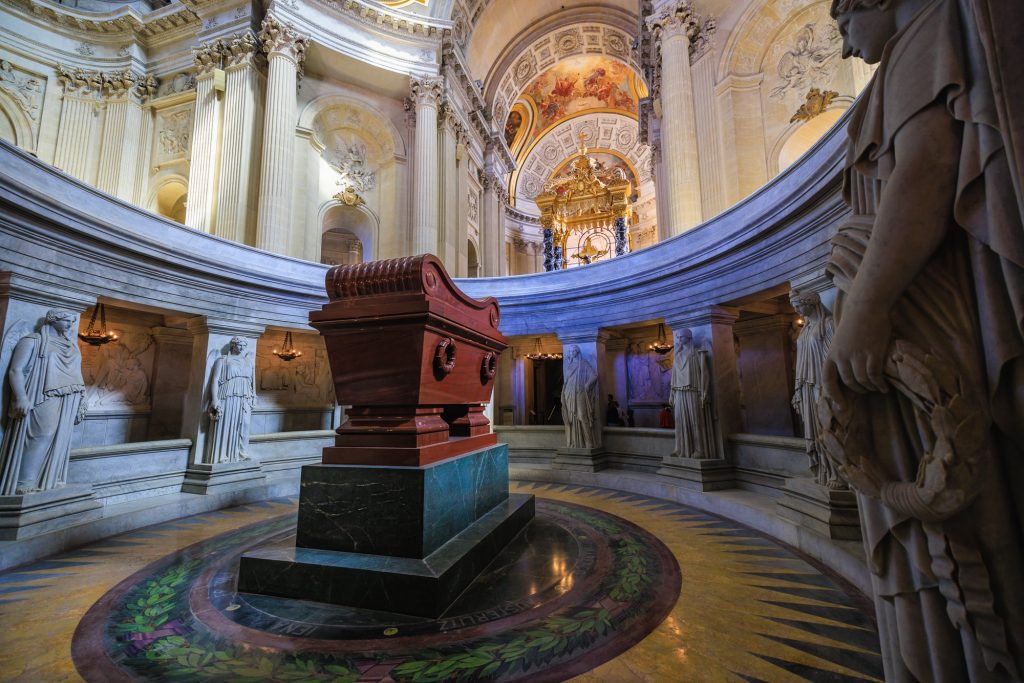
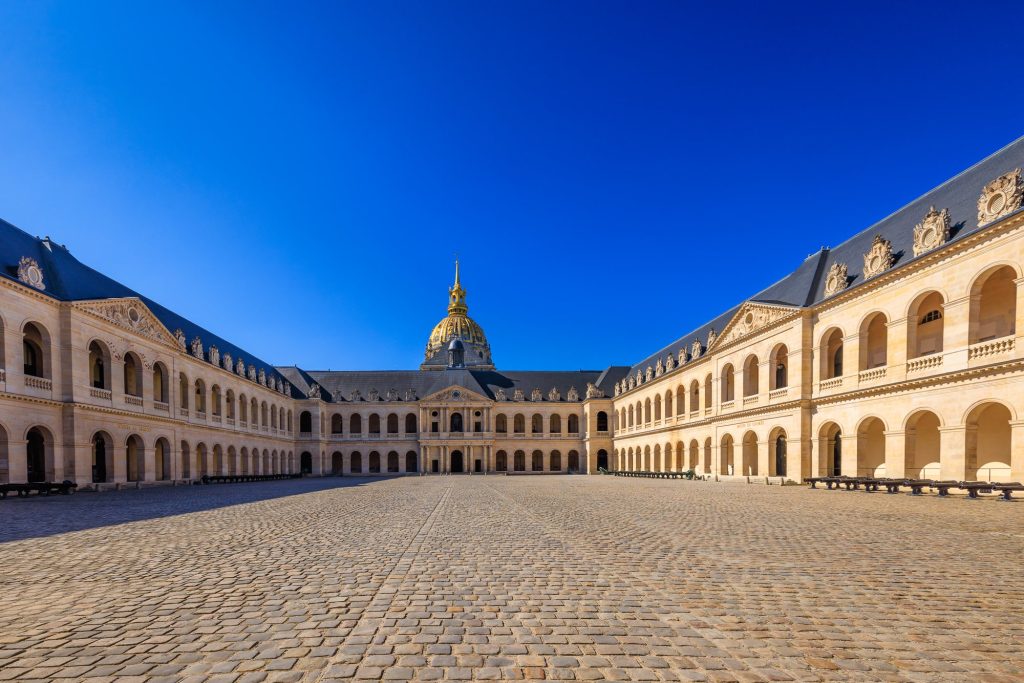
Built in the late 17th century under King Louis XIV, Les Invalides was originally designed as a home and hospital for war veterans. Today, it stands as one of Paris’s most iconic sites—part military museum, part monument, and the final resting place of Napoleon Bonaparte.
Located in the 7th arrondissement, Les Invalides houses the Musée de l’Armée (Army Museum), which showcases centuries of French military history, from medieval armor to World War II artifacts. The golden dome of the Dôme des Invalides is visible from across Paris, glinting in the sunlight and dominating the skyline.
The site has played a role in pivotal moments of French history. It was stormed during the French Revolution in 1789, when rioters seized weapons stored inside. In 1840, Napoleon’s remains were brought here from Saint Helena and interred beneath the grand dome—a solemn resting place fit for an emperor. In 1906, the courtyard of Les Invalides was the setting for the formal rehabilitation ceremony of Alfred Dreyfus, marking the end of one of France’s most infamous miscarriages of justice.
As part of a trip to Greece in 2023, I visited Thessaloniki, the country’s second-largest city, with over one million inhabitants in its metropolitan area, and learned about the tragic fate of its Jews during the Second World War.
On the eve of the war, about 77,000 Jews lived in Greece, with roughly 56,000 in Thessaloniki. The city’s Jewish community was prominent in industry, banking, tourism, and the trades, with many working as laborers, artisans, and port workers.
The Germans invaded Greece on April 6, 1941, and occupied Thessaloniki three days later. The Jewish community council was arrested, apartments were seized, and the Jewish hospital was taken over by the German Army. Jewish newspapers in French and Ladino were shut down, replaced by antisemitic and collaborationist publications. The looting of literary and cultural treasures from libraries and synagogues was carried out by “Operation Rosenberg,” aided by the Wehrmacht. That first winter, some 600 Jews died from hypothermia and disease.
On July 11, 1942, 9,000 Jewish men aged 18–45 were ordered to gather in Liberty Square, where they were humiliated in the summer heat—a day remembered as “Black Saturday.” The Jewish community negotiated their release in exchange for a ransom, funded in part by selling the 500-year-old Jewish cemetery to the Municipality. The cemetery was destroyed, and its tombstones used as building material. About 2,000 men were sent as forced laborers; by October 1942, 250 had died under harsh conditions.
In February 1943, Jews were ordered into a ghetto in the Baron Hirsch quarter. Their property was confiscated, and deportations to Auschwitz and Treblinka began the following month. By August, nearly the entire Jewish population of Thessaloniki—some 54,000 people—had been murdered in the Holocaust.
The “Menorah in flames” sculpture, created in 1997 by Nandor Glid, commemorates these deportations. Glid (1924–1997), a Yugoslav sculptor, is also known for the memorial at the Dachau concentration camp. Installed since 2006 on Eleftherias Square, the site of the 1942 roundup, it was the first Holocaust memorial in a public space in Greece—a sign of changing official attitudes toward Holocaust remembrance. Sadly, it is regularly vandalized.
I also visited the Monastir Synagogue, built between 1925 and 1927 with funding from Jews from Monastir in the Kingdom of Yugoslavia. Architect Ernst Loewy (1878–1943) of Austria-Hungary designed it while working for the Austrian company that built the Thessaloniki–Vienna railway. During the war, the building survived by being requisitioned by the Red Cross. Severely damaged by a 1978 earthquake, it was later restored by the Greek government, with the final historic restoration completed in 2016 and supported by the Federal Republic of Germany.
Today, the synagogue is used primarily during the High Holidays. Daily services are held at a newer synagogue shared with the Rabbinate and the offices of the Jewish Community of Thessaloniki on Tsimiski Street, near the Jewish Museum.
Thessaloniki’s once-thriving Jewish community is gone, but the memorials, the synagogue, and the stories that remain keep its memory alive.