Robert Clary, a French-born survivor of Nazi concentration camps who later played a feisty prisoner of war in the unlikely 1960s sitcom Hogan’s Heroes, died on November 16, 2022, at his home in Beverly Hills, California. He was 96.
Clary was the last surviving original cast member of the series, which also starred Bob Crane, Richard Dawson, Larry Hovis, and Ivan Dixon as the Allied prisoners. Their captors were portrayed by Werner Klemperer and John Banner, both European Jews who had fled Nazi persecution before the war.
For decades, Clary said nothing publicly about his wartime experience. That changed in 1980, when he decided to speak out after seeing Holocaust deniers attempt to diminish or erase the truth of Nazi crimes. His silence broke with painful clarity: twelve members of his immediate family — his parents and ten siblings — had been murdered. Clary himself was deported to Buchenwald, where he was liberated on April 11, 1945. He was the only member of his family to survive.
Beyond his acting career, Clary committed himself to Holocaust remembrance. Beginning in 1980, he spoke at high schools and community groups, participated in survivor gatherings in Jerusalem, volunteered with the Museum of Tolerance, and became deeply involved with the USC Shoah Foundation. He was among the first 100 survivors interviewed for their archive and later conducted 75 interviews himself, ensuring that others’ stories would be preserved.
Hogan’s Heroes aired on CBS from 1965 to 1971, running for six seasons and 168 episodes. It remains the longest-running American sitcom set against the backdrop of World War II.
Unrealistic as it was, I loved the show. It made me laugh then, and it still makes me laugh today. The series is available on Amazon Prime.
The Frauenkirche (“Church of Our Lady”) stands on the eastern side of the main market in Nuremberg, Germany. An example of brick Gothic architecture, it was built between 1352 and 1362 on the initiative of Charles IV (1316–1378), Holy Roman Emperor.
The church’s origins are bound up with tragedy. In 1349, during the Black Death, a violent pogrom led to the expulsion of Nuremberg’s Jewish community. Charles IV ordered the city’s synagogue demolished, and the Frauenkirche was built on its ruins as part of the newly created Hauptmarkt.
Yet within a few years, the city authorities, short of money, sought to attract Jews back. In 1351, Charles IV allowed their return under specific conditions, and by 1382 the Jewish community numbered more than 500, concentrated in the Judengasse (today’s Judenstrasse). More background can be found at the Jewish Virtual Library.
Centuries later, between the two world wars, Nuremberg became a stronghold of the Nazi Party. Julius Streicher (1885–1946) founded one of the first local branches there in 1922 and published the antisemitic weekly Der Stürmer. The city also hosted massive Nazi rallies, and its Jews lived under daily harassment and threat.
The Frauenkirche itself was nearly destroyed during the bombing of Nuremberg (see photo above) in World War II, leaving only its nave walls and façade. Restoration was completed in 1953, and today the church once again dominates the Hauptmarkt as both a historic monument and a reminder of the city’s layered past.
The Pegnitz is a river in Franconia, in the German state of Bavaria. Its source is in the town of Pegnitz (population ~15,000), about 27 km south of Bayreuth. The river runs for about 113 km (70 mi) before meeting the Rednitz in Fürth to form the Regnitz. Along its course, it flows through Nuremberg (population ~545,000), the largest city in Franconia, the second-largest in Bavaria, and the 14th-largest in Germany.
Nuremberg is famous for its castle and extensive city walls, with their many towers—among the most impressive fortifications in Europe.
Nuremberg in the Nazi Era
From 1933 to 1945, Nuremberg held special significance for the Nazi regime. The city was chosen as the site of massive Nazi Party rallies, staged in 1927, 1929, and annually from 1933 to 1938. These events were designed as propaganda spectacles.
At the 1935 rally, Hitler convened the Reichstag in Nuremberg to pass the Nuremberg Laws, which stripped Jews and other so-called “non-Aryans” of German citizenship.
After the collapse of Nazi Germany, Nuremberg again became a focal point of world history. Between 1945 and 1946, the surviving top Nazi leaders were tried for war crimes and crimes against humanity at the International Military Tribunal. The proceedings took place in Courtroom 600 of the Nuremberg Palace of Justice. (The cross visible today in the courtroom was added later by the postwar German government and was not present during the trials.)
Visitors can upload a photograph of a Holocaust victim or survivor, and the site’s facial recognition technology will compare it to its vast archives, returning the ten most likely matches.
Patt’s motivation is deeply personal: all four of his grandparents were Holocaust survivors from Poland. His initial goal was to help his grandmother recover photographs of her family members who were murdered during the Holocaust. When the war began, she was nine years old and fled her hometown of Zamość with her father and siblings. Her mother — Patt’s great-grandmother — remained behind and was shot and killed during the Nazi invasion. Later, her brother was killed when he attempted to return to rescue her. The rest of the family survived and eventually emigrated to New York City after the war.
The Musée Nissim de Camondo is a historic house museum of French decorative arts, located in the Hôtel Camondo at 63 rue de Monceau, on the edge of Parc Monceau in Paris’s 8th arrondissement.
The home was built in 1911 by Ottoman-born Jewish banker and art collector Count Moïse de Camondo, inspired by the Petit Trianon at Versailles. It was designed to house his remarkable collection of decorative arts and fine furniture.
Tragedy shaped its fate. In 1917, the Count’s only son, Nissim, was killed in World War I. Shattered by the loss, the Count withdrew from society and dedicated himself entirely to perfecting his collection. When he died in 1935, he left the house and all it contained to the Musée des Arts Décoratifs, stipulating that it become a museum in Nissim’s memory.
Just nine years later, the Count’s last surviving heir, his daughter Béatrice, was deported to Auschwitz along with her family during the Nazi occupation of France. None survived. The Camondo family line ended, leaving the house as its sole surviving legacy.
As part of a trip to Greece in 2023, I visited Thessaloniki, the country’s second-largest city, with over one million inhabitants in its metropolitan area, and learned about the tragic fate of its Jews during the Second World War.
On the eve of the war, about 77,000 Jews lived in Greece, with roughly 56,000 in Thessaloniki. The city’s Jewish community was prominent in industry, banking, tourism, and the trades, with many working as laborers, artisans, and port workers.
The Germans invaded Greece on April 6, 1941, and occupied Thessaloniki three days later. The Jewish community council was arrested, apartments were seized, and the Jewish hospital was taken over by the German Army. Jewish newspapers in French and Ladino were shut down, replaced by antisemitic and collaborationist publications. The looting of literary and cultural treasures from libraries and synagogues was carried out by “Operation Rosenberg,” aided by the Wehrmacht. That first winter, some 600 Jews died from hypothermia and disease.
On July 11, 1942, 9,000 Jewish men aged 18–45 were ordered to gather in Liberty Square, where they were humiliated in the summer heat—a day remembered as “Black Saturday.” The Jewish community negotiated their release in exchange for a ransom, funded in part by selling the 500-year-old Jewish cemetery to the Municipality. The cemetery was destroyed, and its tombstones used as building material. About 2,000 men were sent as forced laborers; by October 1942, 250 had died under harsh conditions.
In February 1943, Jews were ordered into a ghetto in the Baron Hirsch quarter. Their property was confiscated, and deportations to Auschwitz and Treblinka began the following month. By August, nearly the entire Jewish population of Thessaloniki—some 54,000 people—had been murdered in the Holocaust.
The “Menorah in flames” sculpture, created in 1997 by Nandor Glid, commemorates these deportations. Glid (1924–1997), a Yugoslav sculptor, is also known for the memorial at the Dachau concentration camp. Installed since 2006 on Eleftherias Square, the site of the 1942 roundup, it was the first Holocaust memorial in a public space in Greece—a sign of changing official attitudes toward Holocaust remembrance. Sadly, it is regularly vandalized.
I also visited the Monastir Synagogue, built between 1925 and 1927 with funding from Jews from Monastir in the Kingdom of Yugoslavia. Architect Ernst Loewy (1878–1943) of Austria-Hungary designed it while working for the Austrian company that built the Thessaloniki–Vienna railway. During the war, the building survived by being requisitioned by the Red Cross. Severely damaged by a 1978 earthquake, it was later restored by the Greek government, with the final historic restoration completed in 2016 and supported by the Federal Republic of Germany.
Today, the synagogue is used primarily during the High Holidays. Daily services are held at a newer synagogue shared with the Rabbinate and the offices of the Jewish Community of Thessaloniki on Tsimiski Street, near the Jewish Museum.
Thessaloniki’s once-thriving Jewish community is gone, but the memorials, the synagogue, and the stories that remain keep its memory alive.
Before the Second World War, Częstochowa’s Jewish community was thriving — nearly 40,000 people, about one-third of the city’s population. They played a central role in the city’s commerce, industry, and culture. Today, fewer than 100 remain.
The World Society of Częstochowa Jews and Their Descendants works to preserve this history. One of their recent projects was translating a rare 1936 Jewish newspaper from Częstochowa — a fragile time capsule of life before the German invasion.
Częstochowa, in southern Poland, is perhaps best known for the Pauline Monastery of Jasna Góra, home to the Black Madonna painting and a major pilgrimage site. But for my father, Abram Enzel, the city holds far more personal memories. When Germany invaded Poland in September 1939, Częstochowa’s Jews were forced into a ghetto and later deported to the Treblinka death camp. About 5,200 survived by working in HASAG, a forced labor camp on the city’s outskirts. My father was one of them.
The POLIN Museum of the History of Polish Jews in Warsaw is both a monument to a lost civilization and a cultural institution of the highest caliber. Housed in a striking contemporary building on the site of the former Warsaw Ghetto, the museum traces 1,000 years of Jewish life in Polish lands—from early migrations and the Golden Age through the partitions, the Holocaust, and into the present day.
Facing the Monument to the Ghetto Heroes, the POLIN Museum stands on the site of the prewar Jewish neighborhood and wartime ghetto. Together, the museum and monument form a powerful memorial complex. One visits the monument to honor those who died by remembering how they died. One enters the museum to honor them—and those who came before and after—by remembering how they lived.
The building’s striking glass façade and golden interior passage evoke both continuity and fracture on the site of the former Warsaw Ghetto.
One of the museum’s most impressive features is the reconstruction of the wooden synagogue from Gwoździec. This soaring, hand-painted structure, recreated using traditional methods, pays tribute not only to Jewish religious architecture but also to the vibrancy and beauty of a world that once was.
The museum handles Poland’s long Jewish history with beauty, care, and deep respect. Yet I found myself wondering: how deeply does POLIN grapple with the antisemitism that existed in Poland before the German invasion? The subject is present—in interwar exhibits, newspaper clippings, and political histories—but easy to miss, especially amid the museum’s emphasis on Jewish life rather than victimhood. Perhaps this is deliberate. The goal, after all, is education, not alienation. Still, it’s hard to tell the full story of Jewish life in Poland without acknowledging how often Jews were made to feel like outsiders—even before the Holocaust began.
Barbara Kirshenblatt-Gimblett, the museum’s chief curator, once said: “We are creating a museum of life, not a museum of death.” That vision is palpable throughout POLIN’s galleries. The museum honors what was lost while insisting that Jewish history in Poland must also be remembered for what it was: rich, complex, and deeply woven into the national fabric.
At the heart of the POLIN Museum stands a dazzling reconstruction of the wooden synagogue from Gwoździec, a small town once located in the Polish-Lithuanian Commonwealth (now in Ukraine).
So what is the purpose of POLIN today? A Polish guide I met during my travels said the museum is primarily intended for Poles, almost all of whom are not Jewish. There’s truth in that. In a country where 90% of the prewar Jewish population was murdered and few Jews remain, the museum serves not only as remembrance but also as education. It is also, arguably, part of Poland’s broader effort to grapple with its past while promoting cultural tourism. Jewish heritage sites have become cultural and economic assets—a reality that raises uneasy questions about purpose and presentation.
Still, none of that should diminish what POLIN has accomplished. It does not shy away from difficult chapters. It honors what was lost while celebrating what was lived. And for Jewish and non-Jewish visitors alike, it offers a place to learn, reflect, and—perhaps most importantly—feel the weight of presence where so much absence remains.
I recently returned from a journey through Poland—a place both beautiful and burdened. As I walked the streets of Warsaw, Kraków, and smaller towns tied to my family’s past, I found myself reckoning not just with personal memory, but with the immense suffering and resilience that have shaped this country.
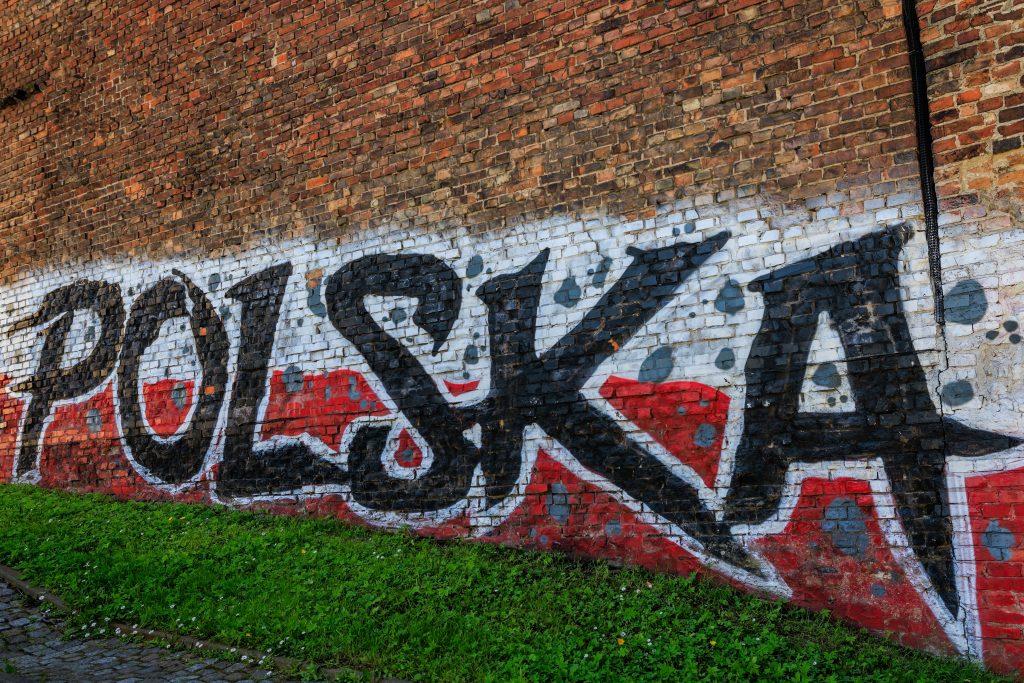
Graffiti spelling “POLSKA” on a brick wall in Gdansk. Pride, resilience, and memory coexist in Poland’s streets—just as they do in its history.
Poland was not only the first victim of World War II—it was also one of the most devastated. In 1939, it was invaded and carved up by two brutal regimes: Nazi Germany from the west, and the Soviet Union from the east. What followed was a six-year onslaught of destruction, repression, and mass murder.
By war’s end, an estimated six million Polish citizens were dead—roughly 17% of the population. Half of them were Jews murdered in the Holocaust. The other half were primarily ethnic Poles who perished in bombings, executions, forced labor, resistance fighting, and Soviet purges (Wikipedia – World War II casualties of Poland).
The physical destruction was staggering. Warsaw, the capital, was deliberately reduced to rubble after the 1944 uprising—85 to 90 percent of the city was destroyed. Nationally, about 30% of Poland’s infrastructure and wealth was lost, and over 40% of its cultural property—including archives, libraries, and religious sites—was looted or obliterated (Polish War Reparations Bureau – Wikipedia summary).
Yet even after the war, Poland was not free. Instead of liberation, it fell under Soviet domination. For nearly five decades, the Polish people lived under Communist rule imposed by Moscow. The state censored speech, imprisoned dissenters, and suppressed any honest reckoning with what the country had endured.
But Poland’s vulnerability didn’t begin in 1939. From the late 18th century until the end of World War I, Poland did not exist as an independent nation. For more than a century, it was partitioned by Russia, Prussia, and Austria—wiped off the map. My father was born in 1916, during that period of nonexistence. Poland would only re-emerge as a sovereign state in 1918, two years after his birth, following the end of the Great War.
Then came the Second World War, bringing unimaginable suffering. My father, born near Częstochowa, survived the HASAG slave labor camp and was later imprisoned at the Gross-Rosen concentration camp, and from there transferred to Flossenbürg and Dachau. He was one of the very few to survive. His parents and most of his extended family were murdered. For my father—as for so many Polish Jews—there was no going home.
Today, Poland is a member of NATO, and there is hope that the alliance provides the kind of protection it lacked in the past. But I find myself wondering: Would NATO and the United States truly defend Poland if attacked by Russia? Or would the West abandon Poland again, as it did in 1939? I don’t know the answer. I hope we never have to find out.
Yet there is another truth I cannot ignore. As a Jew, I deeply value Poland’s efforts to remember the Holocaust—through museums, memorials, and scholarship. I was moved by what I saw. But I also felt that Poland has yet to fully come to terms with the long history of antisemitism that predates Nazi Germany. I say this not in a spirit of accusation, but of reflection. While Germany has publicly and institutionally confronted its role in the Holocaust, Poland has often struggled to acknowledge how deeply antisemitism was woven into the social fabric—even before the war. There were Poles who risked everything to save Jews, and they deserve enduring honor. But there were also Poles who betrayed, exploited, or turned away—and that, too, must be faced.
What struck me most during my visit was how present the past still feels. The scars are visible—in the rebuilt bricks of Warsaw’s Old Town, in the memorials to the ghetto, and in the ruins left untouched as testimony. But so too is the resilience. I saw it in young people reclaiming their history, in museums that confront difficult chapters, and in quiet moments of beauty: the light on cobblestones, the music in cafés, the sound of Polish spoken freely.
Before leaving, I asked a guide whether people in Poland today worry about defending their borders. He hesitated—perhaps reluctant to speak directly. But I sensed that the question lingered beneath the surface. Many Poles today do worry about their security, especially in light of Russia’s war against Ukraine. The country is investing heavily in defense and leans firmly on its NATO membership. Yet there is also a quiet anxiety—born of history—that Poland might again be left to face aggression alone.
Still, life goes on. There’s a tension here: between living with history and not being consumed by it. Poles carry that burden with remarkable dignity.
Poland’s story is not only one of tragedy. It is also a story of survival, rebuilding, and memory. Visiting gave me a deeper appreciation not only for what this country has lived through, but also for the dignity with which it remembers—and the silences it still must break.
In May 2025, I visited Częstochowa, Poland — the city where my father once walked as a young man before World War II. He was born in Kamyk, a small village nearby, into a Jewish family of modest means. His father, like many Jewish men in Kamyk at the time, was a butcher. Before the war, my father would travel to Częstochowa to sell souvenirs of the Black Madonna to pilgrims visiting the Jasna Góra Monastery.
The Black Madonna of Częstochowa, Poland’s most venerated icon, enshrined at Jasna Góra.
Over 80 years later, I walked those same streets with my camera. Much has changed, and much has not.
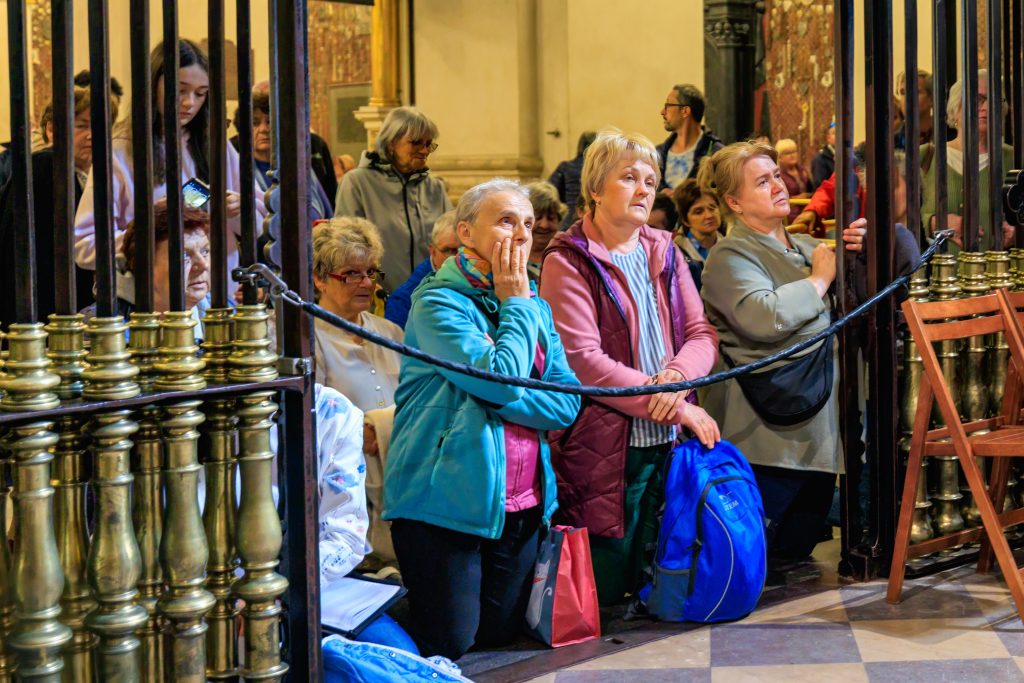
The crowds still come. At Jasna Góra, I watched as worshipers kneeled, prayed, and wiped away tears in front of the Black Madonna — a 14th-century icon believed by many to have miraculous powers.
No photograph can truly capture the intensity of devotion in that room — but I tried.
Pilgrims at Jasna Góra kneel in reverence before the Black Madonna.
But just outside the monastery’s walls, the contrast is striking.
A fenced lot in Częstochowa under stormy skies. The past is never far.
I don’t know exactly where my father stood. But I walked where he walked — on some of the same cobblestones, past buildings he might have passed and beneath the same sky.
This visit was more than just a return to a place. It was a return to memory, to family, and to a world that war tried to erase.