Lake Needwood is a 75-acre reservoir in Derwood, Maryland, created in 1965 by damming Rock Creek to help with flood control and soil erosion. Nestled just east of Rockville, in Montgomery County, the lake is also the starting point of the Rock Creek Trail, which winds its way down to the Potomac River in Washington, D.C. Today, it’s a favorite spot for walking, biking, and running.
I often walk at Lake Needwood. It’s a calming refuge in a busy suburban county, and I enjoy it in every season — especially in the fall, when the trees blaze with color and the light turns golden.
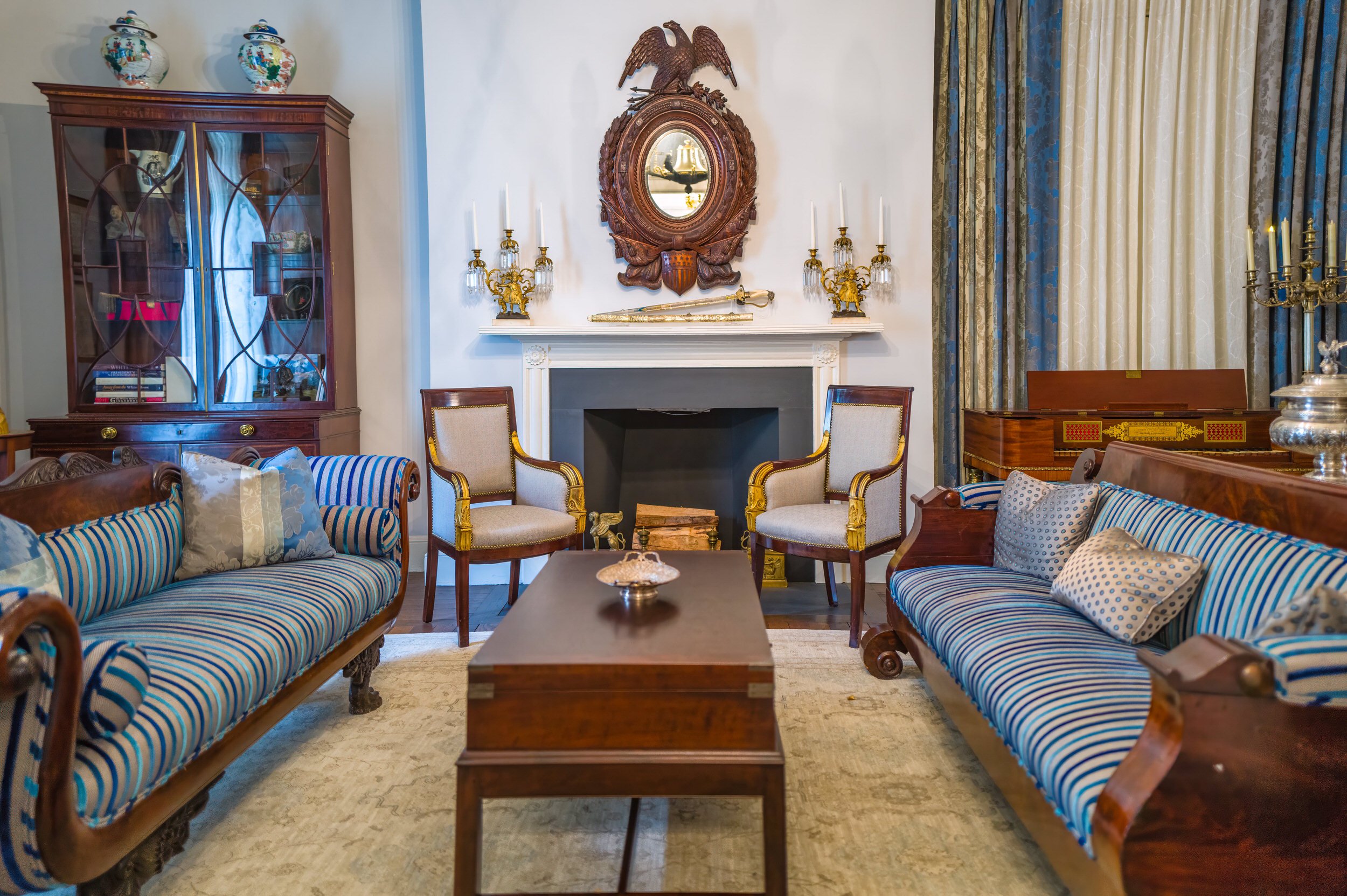
Decatur House is one of Washington’s most historic homes, standing just steps from the White House at the corner of Lafayette Square. Built in 1818 by the great neoclassical architect Benjamin Henry Latrobe, it is one of only three of his houses still standing in the United States.
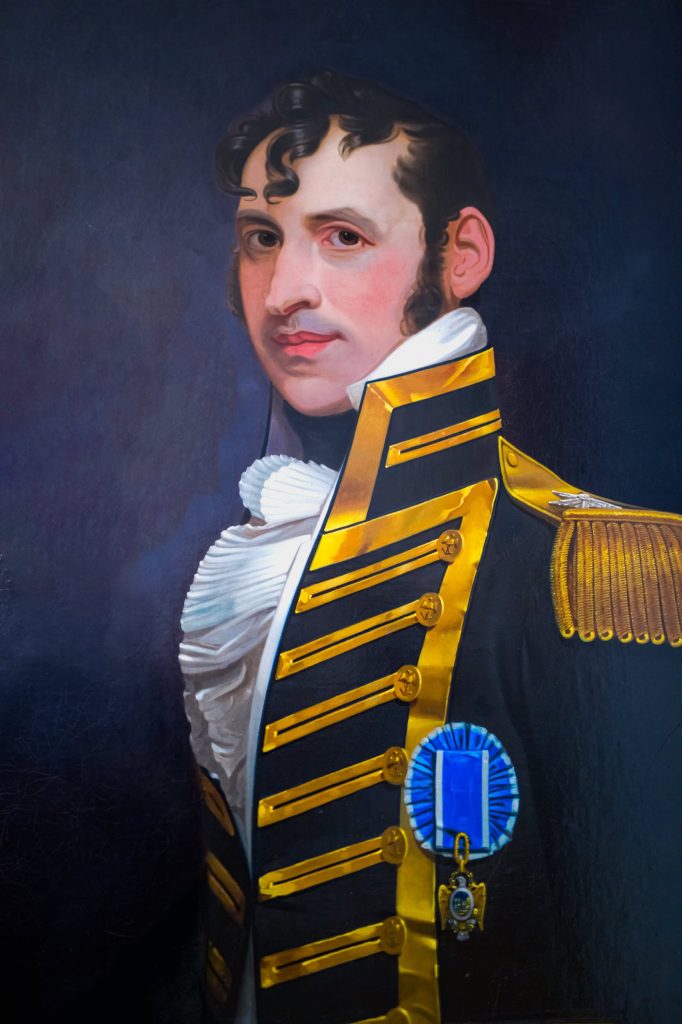
The home was commissioned by Stephen Decatur Jr., a celebrated naval officer who became the nation’s first post–Revolutionary War hero. Decatur supervised the construction of U.S. naval vessels, commanded them in battle, and won fame for his victories against pirates and foreign adversaries. His promising career ended abruptly in 1820, when he was killed in a duel with fellow officer James Barron. Decatur’s death at just 41 shocked the young republic.
In 1836, later owners added an outbuilding behind the house, which included slave quarters — a reminder that the grandeur of Lafayette Square coexisted with the realities of enslavement.
Today, Decatur House is both a museum and the home of the National Center for White House History, operated by the White House Historical Association, the nonprofit founded by First Lady Jacqueline Kennedy in 1961 to preserve and share the history of America’s Executive Mansion. The association offers free public tours of Decatur House every Monday (excluding federal holidays and the Monday after Thanksgiving). The house and courtyard can also be rented for private events, including weddings. A small shop offers books, gifts, and keepsakes that make excellent mementos of a visit to the nation’s capital.
Standing in its elegant rooms, it’s easy to sense the layers of history — from Decatur’s tragic end to the continuing work of preserving White House history. Decatur House remains both a monument to a naval hero and a reminder of the complexities of America’s past.
Between 1933 and 1938, Nazi Germany staged massive rallies in Nuremberg. The former Nazi Party Rally Grounds remain the largest surviving complex of National Socialist architecture in today’s Germany. Designed by Hitler’s architect Albert Speer, the vast structures still convey the immense power of Nazi propaganda. Speer was later convicted of war crimes and crimes against humanity at the International Military Tribunal in Nuremberg. He served 20 years in prison and died in London in 1981.
The Zeppelinfeld (Zeppelin Field), shown above, is one of the most striking remains. Its massive grandstand, 360 meters wide, was modeled on the Pergamon Altar of ancient Greece, with square piers inspired by Franco-American architect Paul Philippe Cret. After Germany’s defeat in 1945, American forces famously blew the swastika from its top. The name “Zeppelinfeld” refers to the landing of Count Zeppelin’s airship (LZ6) here in 1909.
I visited in April 2024, on a cold and windy day, with my cousin from Nuremberg who graciously served as my guide. The site felt stark, desolate, and impossibly vast—its scale resisting any attempt to capture it in photographs. Only a handful of visitors were there, but the immensity of the place chilled me. I tried to imagine the grounds filled with uniformed followers of Adolf Hitler, roaring in unison. The thought sent a shiver down my spine.
How could this have happened in Germany—a country with such a deep tradition of culture, learning, and science? Could it happen again? Is it already happening? The pull of the far right has not disappeared; it is rising once more.
What happened here was not inevitable. It can happen again.
The Peabody Room is a special collection dedicated to Georgetown neighborhood history and is part of The People’s Archive, the D.C. Public Library’s local history center focused on Washington, D.C. and African American history and culture. Among its resources is a house history file covering many Georgetown home
Peabody Room, Georgetown Library
Peabody Room, Georgetown Library
This local branch dates back to 1875, when the first library in Georgetown was funded by George Peabody (1795–1869), an American financier and philanthropist.
Peabody was born into a poor family in Massachusetts. He began in the dry goods trade and later moved into banking. In 1837, he relocated to London—then the capital of world finance—where he became the most noted American banker and helped to establish the young nation’s international credit.
Having no son of his own, Peabody took on Junius Spencer Morgan as a partner in 1854. Their joint business would evolve into the global financial services firm J.P. Morgan & Co. after Peabody’s 1864 retirement.### George Peabody’s Legacy
Peabody is often considered the father of modern philanthropy. His charitable initiatives included:
For his generosity, he was awarded the Congressional Gold Medal and named a Freeman of the City of London.
Fire and Renewal
In 2007, a large fire broke out at the Georgetown Library, severely damaging much of the building and causing the roof to collapse. The blaze irreparably damaged parts of the library’s holdings and artwork, including items in the Peabody collection.
Repairs and a major renovation were completed in 2010, restoring the library and ensuring the Peabody Room’s continued role as a steward of Georgetown’s history.
The George Peabody Library in Baltimore is one of the most beautiful libraries I’ve ever stepped into. Walking through its doors feels like entering a cathedral of books — the kind of place that instantly slows you down and makes you look up.
It wasn’t always part of Johns Hopkins University. The library began as the library of the Peabody Institute of the City of Baltimore, founded in 1857 when Massachusetts-born philanthropist George Peabody dedicated the institute to the people of Baltimore in gratitude for their “kindness and hospitality.” Today, it’s part of the Special Collections Department of the Sheridan Libraries at Johns Hopkins, still serving the public as Peabody intended.
The building, which opened in 1878, was designed by Baltimore architect Edmund G. Lind, working with the Peabody Institute’s first provost, Dr. Nathaniel H. Morison. The moment you enter the stack room, your eyes are drawn upward to five tiers of intricate cast-iron balconies, all leading to a skylight 61 feet above. The ironwork, crafted by the Bartlett-Robbins Company, has the kind of fine detail you don’t see much anymore.
The library holds 300,000 volumes, mostly from the 19th century, covering everything from religion and British art to American history, literature, the history of science, and tales of exploration and travel. It’s easy to imagine 19th-century scholars hunched over these very books.
Between 2002 and 2004, the library underwent a $1 million restoration, and it still feels lovingly cared for. Best of all, it’s free and open to the public. If you find yourself in Baltimore, make time for it. It’s not just a place to see books — it’s a place to feel them, to stand in the quiet and be surrounded by the beauty of knowledge made visible.
The 13th arrondissement of Paris is dominated by modern high-rise buildings, a sharp contrast to the historic architecture of the city center. Many now feature large-scale murals by French and international urban artists. There are more than fifty in total. This thoughtful initiative—not just decoration, but deliberate place-making—aims to bring warmth to otherwise stark facades.
This inventive urban renewal effort brings color and character to the neighborhood, offering a different experience from the artistic treasures of central Paris.
The Vietnam Veterans Memorial in Washington, D.C., honors U.S. service members who served in the Vietnam War. Its black granite walls bear the names of more than 58,000 men and women who gave their lives during the conflict. Completed in 1982, the Memorial Wall was later joined by the Three Soldiers statue in 1984 and the Vietnam Women’s Memorial in 1993.
Set within Constitution Gardens, just northeast of the Lincoln Memorial, the site is maintained by the National Park Service and draws more than five million visitors each year. The Wall’s striking, minimalist design was created by American architect Maya Lin, born in Ohio in 1959. In 2007, it was ranked tenth on the American Institute of Architects’ “List of America’s Favorite Architecture.” As a national memorial, it is listed on the National Register of Historic Places.
I began photographing the Wall in 2002. At the time, I knew I wanted to take on a long-term photo project but had no clear idea what it would be. One day, I visited the memorial, took a few photographs, and later posted them in an online forum. Soon after, I returned to make more images and shared those as well. A kind stranger replied: “It looks like you’ve found your project.” That simple comment stayed with me.
Over the years, I’ve returned again and again—sometimes during the thunder of motorcycles from Rolling Thunder, other times in the stillness of Veterans Day dawn. More than two decades later, this remains my longest-running body of work. I’ve witnessed the Wall as a place of quiet remembrance and healing—for veterans, families, friends, and strangers alike.
The photographs here reflect that journey, capturing both intimate moments of reflection and the collective gatherings that honor those who served and sacrificed.
I wanted to create a memorial that everyone would be able to respond to, regardless of whether one thought our country should or should not have participated in the war.”
Maya Lin, Designer of the Vietnam Veterans Memorial
The Musée Nissim de Camondo is a historic house museum of French decorative arts, located in the Hôtel Camondo at 63 rue de Monceau, on the edge of Parc Monceau in Paris’s 8th arrondissement.
The home was built in 1911 by Ottoman-born Jewish banker and art collector Count Moïse de Camondo, inspired by the Petit Trianon at Versailles. It was designed to house his remarkable collection of decorative arts and fine furniture.
Tragedy shaped its fate. In 1917, the Count’s only son, Nissim, was killed in World War I. Shattered by the loss, the Count withdrew from society and dedicated himself entirely to perfecting his collection. When he died in 1935, he left the house and all it contained to the Musée des Arts Décoratifs, stipulating that it become a museum in Nissim’s memory.
Just nine years later, the Count’s last surviving heir, his daughter Béatrice, was deported to Auschwitz along with her family during the Nazi occupation of France. None survived. The Camondo family line ended, leaving the house as its sole surviving legacy.
The Washington Monument honors George Washington (1732–1799), the nation’s first president, and stands at the heart of the U.S. capital. Designed by Robert Mills and completed under the direction of Lt. Col. Thomas Lincoln Casey and the U.S. Army Corps of Engineers, it is built in the form of an Egyptian obelisk, evoking the timelessness of ancient civilizations. When it was completed in 1884, at 555 feet, 5 1/8 inches (169 meters), it was the tallest structure in the world, holding that title until the Eiffel Tower surpassed it in 1889.
The geometric layout of Washington, D.C., designed by Pierre L’Enfant, reserved a prominent site for a monument to Washington at the intersection of lines radiating south from the White House and west from the Capitol. In 1833, the Washington National Monument Society formed to fund and build a memorial “unparalleled in the world.” After a decade of fundraising and design competitions, the Society selected Robert Mills’ ambitious 1845 plan: a 600-foot obelisk surrounded by thirty 100-foot columns.
Construction began on July 4, 1848, with a cornerstone-laying ceremony attended by President James K. Polk, Dolley Madison, Eliza Hamilton, George Washington Parke Custis, and future presidents Buchanan, Lincoln, and Johnson. By 1854, the monument had reached 156 feet before work stalled due to political infighting and lack of funds.
In 1876, Congress assumed responsibility for completing the monument. Casey’s first priority was strengthening the foundation, which took four years. Matching the original stone proved difficult—three different quarries ultimately supplied stone, resulting in the color variations visible today. The final height was set at 555 feet, ten times the base width, and Mills’ elaborate colonnade was abandoned in favor of a simple, clean obelisk form.
The monument was dedicated on February 21, 1885, one day before Washington’s birthday. Inscriptions on the aluminum cap commemorate key dates and individuals involved, with the east face bearing the Latin phrase Laus Deo (“Praise be to God”). The public first accessed the monument in 1886 via an iron staircase; a public elevator was added in 1888. Today, 193 commemorative stones from states, cities, civic groups, and foreign nations line the interior walls, including a marble slab from the Parthenon inscribed in Greek.
Modern History and Restoration
The steam elevator was replaced by an electric model in 1901. The National Park Service assumed jurisdiction in 1933. Major restorations occurred in 1934, 1964, 1998–2001, 2011–2014 (after earthquake damage), and 2016–2019 (elevator modernization).
The Washington Monument is open daily from 9:00 a.m. to 5:00 p.m., except on December 25 and July 4, and one day each month for maintenance. Timed reservations are required, available online or in person at the Washington Monument Lodge on 15th Street. The nearest Metro stations are Federal Triangle and Smithsonian.
This towering sculpture of Japanese contemporary artist Yayoi Kusama stands on rue du Pont Neuf, between the Louis Vuitton headquarters and the Samaritaine. Bold, whimsical, and impossible to overlook, it stopped me in my tracks and turned an ordinary walk into a moment I’ll remember.
That stretch of the Pont Neuf was alive with the hum of Paris—buses rumbling past, the scent of fresh pastries drifting from a nearby café, and above it all, Kusama’s unmistakable polka dots adding a splash of surreal joy to the scene.
Yayoi Kusama—often called the princess of polka dots—is one of the world’s most distinctive living artists, known for her playful patterns and immersive installations.