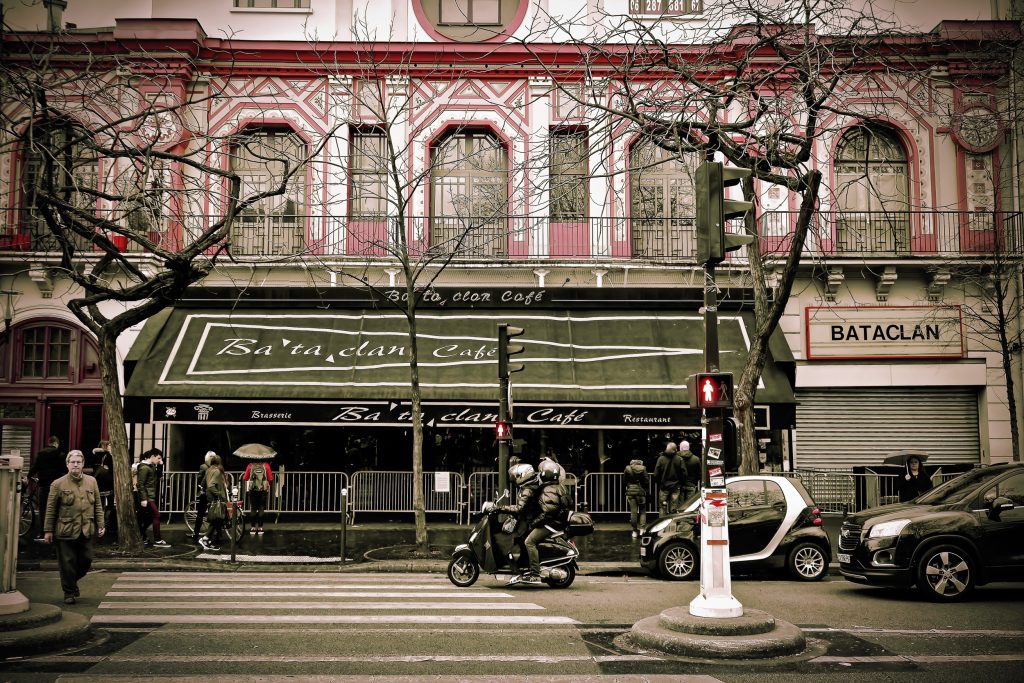
Seeing the Bataclan like this — closed, watched over, and remembered — was the moment I truly felt how much the city was still hurting.
In December 2015, I returned to Paris — a city I’ve loved for as long as I can remember. This visit was different. It came a little more than a month after the November attacks, when coordinated shootings and bombings struck the city, including the Bataclan concert hall. Many lives were lost, families were shattered, and the city felt the shock in its bones.
I didn’t come to photograph tragedy. I came because I needed to see Paris again — not only as a postcard, but as a place that had been wounded and was still standing.
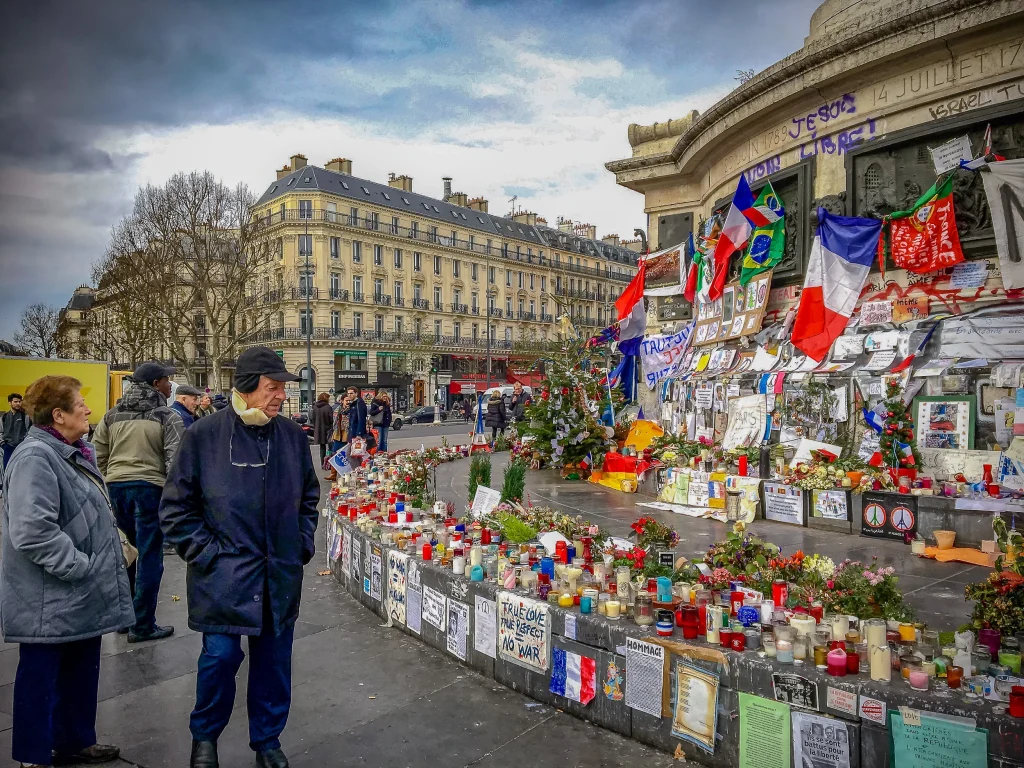
At Place de la République — surrounded by drawings, flags, and tributes — the weight of the moment was written on people’s faces.
Seeing beyond the “pretty Paris”
For years, my camera has been drawn mostly to the beauty of Paris — the bridges, the monuments, the river, the light. Those images still matter to me.
But on this trip, I realized I haven’t always paid enough attention to how the city lives — and how it responds to challenge. Paris has faced many: from the German occupation during World War II to more recent acts of terror. Each time, it absorbs the shock, mourns, and somehow continues.
I’m sharing these photographs now, years later, because I’ve come to see that my work has often focused on the surface beauty of the “City of Light.” This visit reminded me there is another Paris — one shaped by memory, resilience, and everyday life.
A walk to the Bataclan
Walking toward the Bataclan, the surrounding streets looked surprisingly ordinary. Cafés were open. People carried groceries. Traffic moved as usual. And yet there was a quietness underneath everything — as if the city were speaking in a softer voice.
An outpouring of tributes lined the street near the Bataclan, and people moved slowly along the fence, taking it in.
Outside the Bataclan, the mood changed. Barriers remained in place. Notices were taped to railings. The familiar façade now carried a weight that was impossible to ignore.
People didn’t gather like tourists. They paused, looked, and moved on. It felt more like a place of memory than a concert hall.
Place de la République
Later, I walked to Place de la République. The square had become an informal memorial — candles, flowers, handwritten notes, photographs, flags. People moved carefully, making space for one another.
People gathered quietly at Place de la République, reading the messages and tributes left after the attacks.
There was grief here, but also dignity. The city was remembering — quietly, without spectacle.
A deeper appreciation
This visit changed how I see Paris.
I still love its monuments and bridges, but I came away with a deeper appreciation for the everyday life around them — and for the resilience of a city that mourns, remembers, and keeps going.
Cahors lies roughly 110 kilometers north of Toulouse, tucked into southwest France along a dramatic bend in the Lot River. The Lot itself is a long, winding waterway—about 480 kilometers in length—that rises in the Cévennes Mountains near Mont Lozère and flows westward through limestone valleys and vineyards before eventually joining the Garonne River near Aiguillon. In Cahors, the river curves almost completely around the old town, shaping both its geography and its history.
Cahors feels both geographically and psychologically distant from the great urban centers of France. I was there with the Alliance Française of Washington, and traveling with a group that shares such a deep appreciation for French history and culture made every discovery more meaningful. Yet one structure, above all others, has stayed with me: the Pont Valentré.
The Pont Valentré: A Masterpiece of Stone
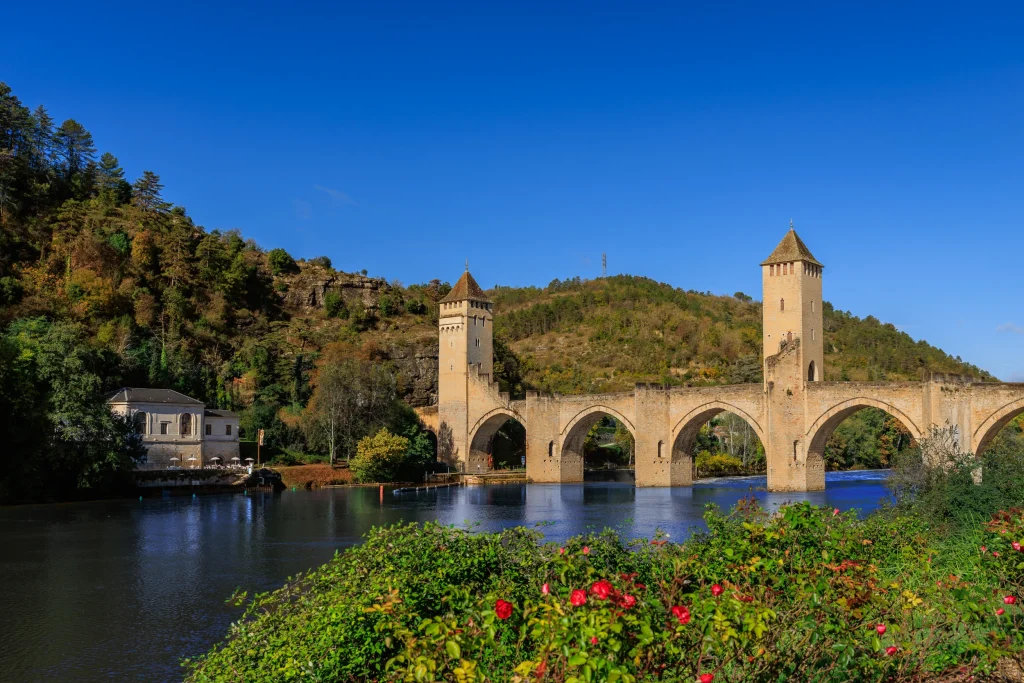
The Pont Valentré, Cahors remains one of the most complete and uncompromising examples of medieval military bridge design in France.
I have seen many of the world’s great bridges. Some are elegant, some monumental, others purely functional. But for me, the quiet power and restrained beauty of the Pont Valentré stands apart. To call it merely “old” is an understatement. It is majestic—a staggering feat of 14th-century engineering that commands the Lot River with calm authority.
Construction of the bridge began in 1308, commissioned by the consuls of Cahors to strengthen the city’s defenses and secure control of this vital river crossing during a period of frequent conflict. Built entirely of local stone, the bridge took nearly 70 years to complete, a testament to both medieval ambition and the sheer difficulty of such a project.
With its three fortified towers, thick arches, and narrow passageway, the bridge was conceived not merely as a crossing, but as a defensive structure—a fortified bulwark designed to protect the city as much as to connect it. What struck me immediately was its absolute integrity. The Pont Valentré does not rely on ornament to impress. Its beauty comes from its perfect proportions, its clarity of purpose, and its sheer defiance of time. Stone laid more than seven hundred years ago still carries weight, meaning, and history—without apology.
Recognized as a UNESCO World Heritage Site, the Pont Valentré is preserved not only for its architectural excellence but as an exceptionally intact example of medieval military engineering integrated into an urban landscape.
Cahors and the Lot River: The Lot curves around the old town, making the Pont Valentré not just a crossing, but a strategic gateway—binding geography, defense, and daily life into a single structure.
There is, of course, the famous legend associated with the bridge. According to local lore, the builder, frustrated by delays, made a pact with the devil to ensure its completion. When the work was finished, the builder outwitted him by assigning an impossible task—fetching water in a sieve—thus saving his soul. Whether one believes the story or not, the bridge feels almost mythic, as though it belongs as much to folklore as to history. When human ingenuity and endurance reach this level, legend feels almost inevitable.
I found myself comparing it to the Pont Alexandre III in Paris, because both are undeniably beautiful. The Parisian bridge is ornate, celebratory, and dazzling—a triumph of decoration and modern confidence. The Pont Valentré, by contrast, is elemental. It does not decorate the landscape; it belongs to it. It is not merely a monument—it is a survivor.
Beyond the Bridge: Château de Haute-Serre
The day continued with a visit to Château de Haute-Serre, a vineyard renowned for producing some of the region’s most distinguished Malbecs. Though it lies only about 10 kilometers—roughly a 15-minute drive—from Cahors, the estate feels far removed from the town. The road gradually leaves the river behind, rising into open countryside until you arrive at a place that feels notably quieter and more self-contained.
The contrast between the rugged medieval stone of the morning and the meticulously cultivated land of the afternoon was striking. At Haute-Serre, I felt an immediate sense of calm—a peaceful stillness born of space, order, and the slow rhythm of agricultural life rather than urban movement.
The estate unfolds across gently rolling terrain, with vines carefully tended and precisely aligned. Yet what impressed me most was the discipline of the operation itself. The winery was immaculate—spotless in a way that spoke to seriousness, precision, and deep respect for the craft. It was, quite literally, so clean that you felt you could eat off the floor.
We enjoyed an elegant three-course luncheon created especially for the Alliance Française of Washington. We began with a cream of pumpkin soup accented by Lardo di Colonnata, garlic croutons, and walnut oil. This was followed by duck breast served with carrot mousseline, kaffir lime, multicolored carrots, and an orange gastrique. Dessert was a refined praline mille-feuille.
Aging Malbec at Château de Haute-Serre: Bottles resting in the cellars of Château de Haute-Serre, near Cahors—wines shaped by patience, discipline, and a deep respect for place.
The food was exceptional, the wine a revelation—structured, expressive, and unmistakably rooted in its terroir. Nothing about the experience felt rushed or performative. There was only a quiet confidence, born of tradition, patience, and care.
Final Reflections
Cahors and its surroundings reward those willing to slow down, learn a bit of history, and truly look. The region feels light-years away from Paris—calmer, quieter, and deeply grounded.
From the enduring stone of the Pont Valentré to the hushed order of Château de Haute-Serre, I was struck by a shared sensibility: places built with seriousness, maintained with care, and allowed to exist without spectacle. Whether medieval or modern, these are places that do not ask for attention—they earn it.
The Pont Valentré is remarkable not because it is decorative, but because it has endured—doing exactly what it was engineered to do for centuries. Paired with the excellence of Château de Haute-Serre and the shared pleasure of traveling with such thoughtful companions, Cahors reminded me that when tradition is taken seriously, it remains very much alive.
Albi sits quietly in the Tarn, a small city of about fifty thousand people built along the river that shares its name. It’s only an hour from Toulouse, yet it feels more distant, as though it existed slightly apart from the rest of the world. I went without strong expectations and found a place that was coherent, beautiful, and welcoming.
View of Albi from the Pont Vieux, where the Tarn gathers the city into a single, harmonious scene.
What first struck me was the brick. In Albi, brick is not an architectural choice or a revival style — it is simply what they had. There was no local stone to speak of, so they used the clay from the riverbanks, fired it in kilns, and built an entire city from it. The result is a palette that changes with the light: pale peach in the morning, rose at noon, deep orange as the sun begins to fall. Every surface seems to absorb sunlight. Even the shadows are warm.
The cathedral of Sainte-Cécile rises from this landscape with a kind of massive grace. Often described as the largest brick building in the world, it has the presence of a stronghold rather than an ordinary church. The forms are heavy, cylindrical, almost defensive. It is genuinely difficult to describe the size of it. The building is enormous — far larger than photographs suggest — and from the ground it is hard to take in at once. You find yourself looking up, craning your neck, searching for a vantage point that will allow the whole structure to make sense. It was built in the aftermath of the Albigensian Crusade, when power needed to be proclaimed in masonry. To see it from the outside, one expects austerity. Yet the interior is surprisingly ornate — painted, gilded, and filled with color. The contrast is striking: a fortress with a jewel box within.
Albi rewards walking without urgency. The old town is intimate and charming, with narrow lanes, timbered facades, and small shops and cafés. At the center is the Marché Couvert, a covered market that feels lively without being loud. I had lunch there: grilled beef, a lovely salad, and a glass of wine. It was simple, fresh, and satisfying. The total was fifteen euros — the kind of meal that makes you feel momentarily lucky to be where you are. Travel days do not need to be grand to be memorable.
The Tarn River gives the city its orientation. The view from the Pont Vieux, the Old Bridge, is especially beautiful. From there, the cathedral rises above the water, reflected in slow green currents, and the town ascends the bank in orderly layers of red brick and tile. It is one of those perspectives that feels complete, as though the elements had always been arranged exactly this way. I could have stayed there for an hour, watching light move across the surface of the water.
Next to the cathedral stands the former episcopal palace, now home to the Toulouse-Lautrec Museum. I knew the posters — the dancers, the Parisian nights — but I did not expect the quieter works: tender drawings, portraits, early studies. Seeing them here, in the town where he was born, gives them a certain intimacy. The rooms are large, the walls thick, and the art seems to inhabit the space naturally. Nothing is strained. The museum feels like part of the city rather than an addition to it.
What most impressed me about Albi was its coherence. The materials speak to one another; the river and the architecture are in dialogue; the scale is human. The tourist office, surprisingly large and beautifully designed, fits the same pattern — practical, confident, and unpretentious. The city does not strain to impress you. It does not perform. It simply exists as itself, and that is enough.
I spent only a day in Albi, but the city stayed with me: the warmth of the brick, the shadowed interior of the cathedral, the quiet lunch in the market, the reflection of towers in the river. I had gone thinking it would be a pleasant excursion from Toulouse. I left thinking I could return quite easily, and perhaps stay longer. Some places whisper rather than shout, and linger in memory because of it. Albi is one of them.
Toulouse doesn’t shout. It doesn’t need to. France’s fourth-largest city has a way of revealing itself slowly—through the glow of its pink brick at sunset, the hum of its cafés, the youthfulness of its streets, and the golden light that pours across the Garonne River as if the whole city has turned its face toward the sun.
I had the privilege of visiting Toulouse as part of a group organized and led by Sarah Diligenti, Executive Director of the Alliance Française of Washington. She is a native of Toulouse, and her affection for the city is contagious. As a long-time member of the Alliance, it was a joy to see her hometown through her eyes. The experience felt less like tourism and more like being welcomed into someone’s place in the world.
The Beautiful Light Along the Garonne
If Paris has the Seine and Lyon the Rhône, Toulouse has the Garonne—and its light is different. Warmer. Wider. More relaxed.
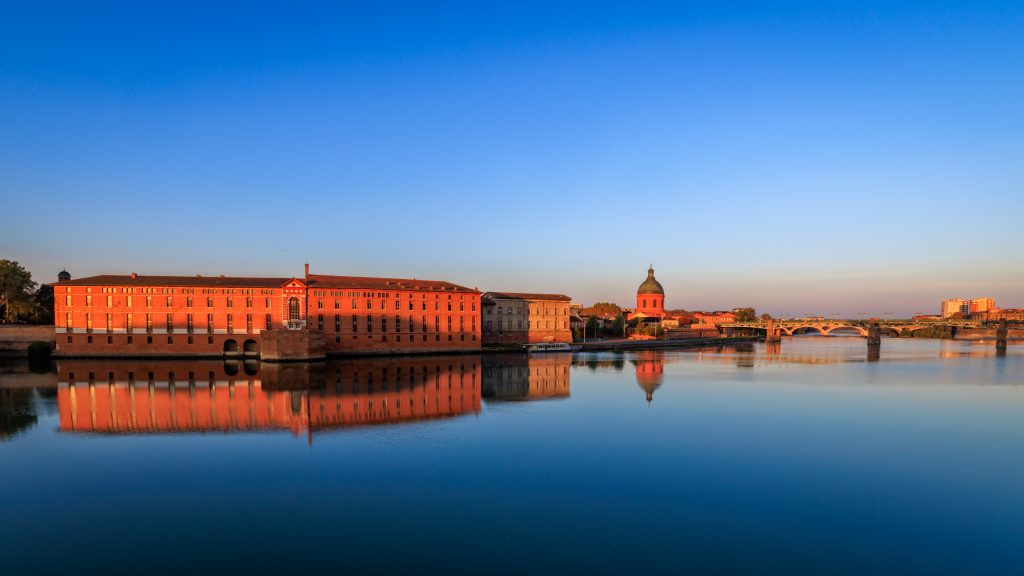
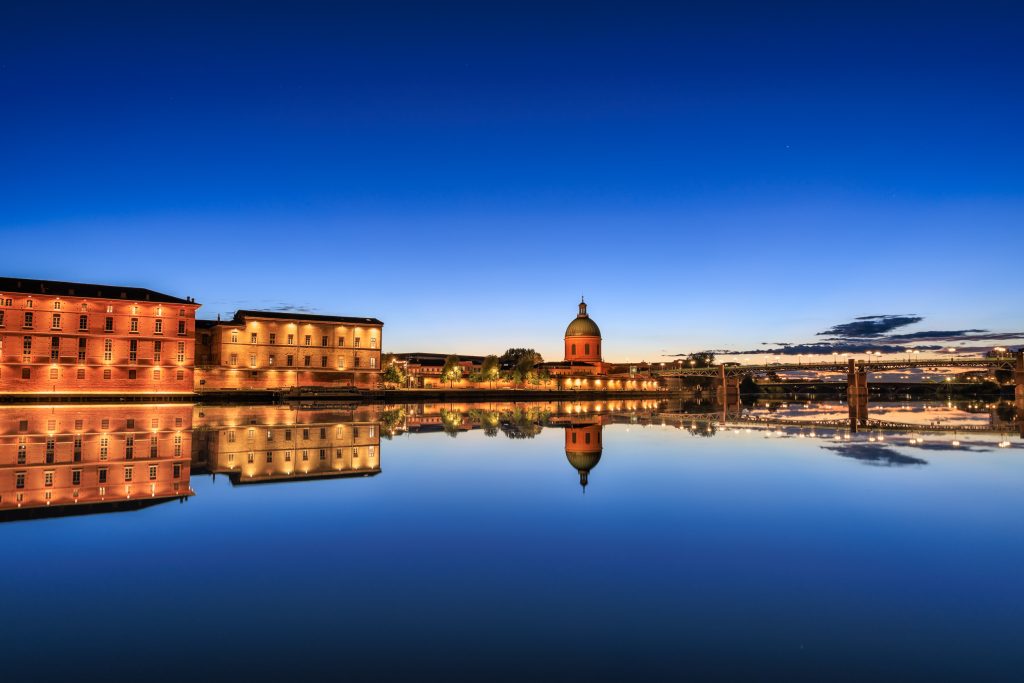
Late afternoon light along the Garonne. The brick turns almost pink, and the reflections on the river are part of what makes Toulouse feel so open and relaxed.
Stand along the Quai de la Daurade in the late afternoon and you’ll see why photographers adore this river. The sun drops low, raking the facades of old brick warehouses and convents, and the water turns a deep metallic blue. The dome of La Grave seems to float. Couples sit on the steps. Friends carry bottles of wine. Life takes on a certain softness.
The Garonne begins high in the Spanish Pyrenees at the Pla de Beret and flows 529 kilometers northward through southwestern France before merging with the Dordogne to form the Gironde estuary, eventually emptying into the Atlantic near Bordeaux. Toulouse grew because of this river—because of its trade, its silt, its life—and the city still orients itself toward it.
Place du Capitole: A Stage Set of Grandeur
Every visitor eventually drifts toward the Place du Capitole, the city’s true living room.
Place du Capitole at sunrise. Toulouse’s city hall and theatre stretch across the square in rose and cream — regal but never pompous.
The square is enormous—regal without being pompous. Its pale stone surface reflects the sky, and the façade of the Capitole, Toulouse’s town hall and theatre, stretches across an entire block like a Renaissance stage set painted in rose and cream.
Sit with a coffee and watch the square turn from morning bustle to afternoon languor. At night it becomes cinematic: couples posing under the arcades, groups of students weaving past, street musicians tuning their guitars. Sarah brought us here first, as if to say: this is where the pulse of the city can be felt.
If you want to understand Toulouse’s confidence, start here.
Couvent des Jacobins: Light You Don’t Expect
From the outside, the Couvent des Jacobins is easy to miss—just another brick wall on a quiet street in a city full of brick walls. But step inside and everything changes.
The light is astonishing.
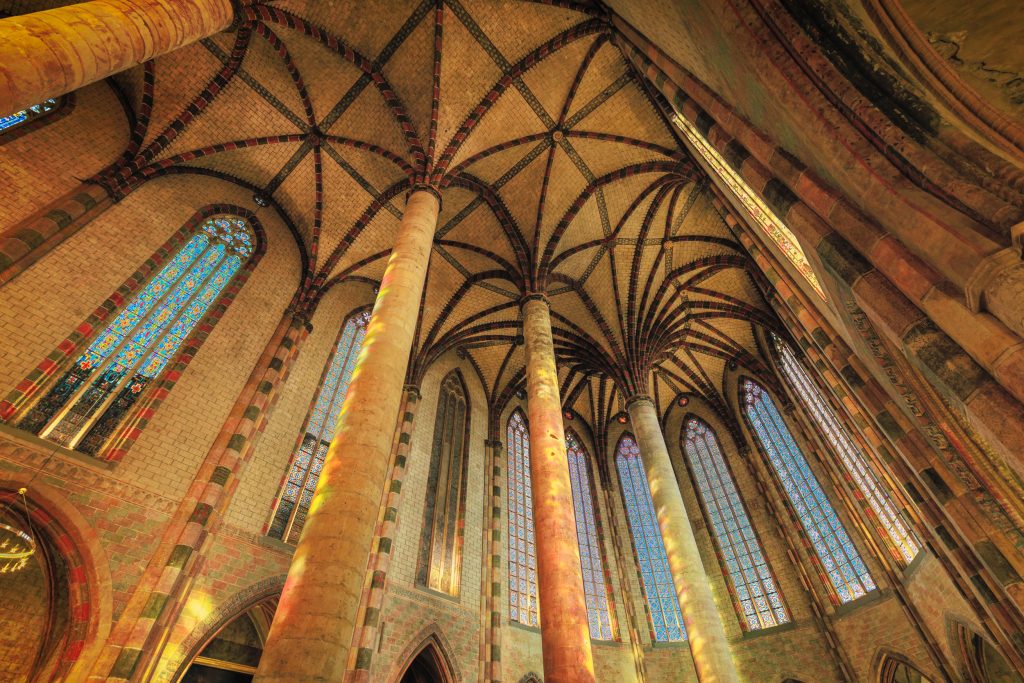
Couvent des Jacobins: Stained glass washes the brick columns in color, rising to a vault of interlaced ribs known as the “palm tree.” The light here is unlike any other Gothic space in Europe — quiet, weightless, and unforgettable.
Columns rise like palm trees, splitting the vault in a pattern unlike any other Gothic space in Europe. Sunlight filters through tall windows and dances across the floor, illuminating the famously delicate “palm tree” column that seems to hold the heavens together. The effect is both austere and uplifting—one of those places where the air feels different, as though centuries of contemplation have seeped into the stone.
It is a place you stumble into once and remember forever.
A City of Students—and Their Energy
Toulouse is often called La Ville Rose for its pink brick, but it could just as easily be called La Ville Jeune. It is one of the largest student cities in France—home to over 100,000 university students across institutions like the University of Toulouse, Toulouse 1 Capitole, Toulouse II Jean Jaurès, and the renowned engineering school, INSA.
This youthful energy is everywhere: in the packed terraces, in the narrow streets around Place Saint-Pierre, in the late-night laughter that spills out of wine bars. The city feels alive because its average age is young—and because young people shape its rhythm.
Toulouse at Night: A Mood All Its Own
After dark, Toulouse becomes reflective.
Toulouse at blue hour. The river absorbs the city’s lights and sends them shimmering back. The mood becomes gentle and reflective after dark.
Lanterns glow under the arcades. The river absorbs the city’s lights and sends them shimmering back. The soundscape softens—just footsteps, distant music, the hum of a bicycle. Something about the combination of brick, shadow, and sky makes your mind wander. It is a place that invites thought, memory, and stories.
The night feels gentle yet filled with possibility—like a city that understands both its past and its future.
Pont Neuf and the banks of the Garonne at dusk. Brick, water, and sky form a single quiet composition.
Notre-Dame de la Dalbade: A Quiet Gem
Visitors often overlook Notre-Dame de la Dalbade, but it deserves a moment.
Named for its once-white facade (la dalbade meaning “whitewashed”), the church stands in the Carmes district and is crowned with one of the most striking ceramic tympanums in France—a vividly colored Last Supper that seems impossibly bright against the brick surrounding it.
Inside, the church has a deep stillness. Sunlight falls in thin beams across the nave, revealing a space filled with the scent of wood and incense. It’s the kind of place that makes you slow down without realizing it.
Marché Victor Hugo: The Beating Heart of the City
If you want to understand how well Toulouse eats, go to Marché Victor Hugo.
It is crowded—in the best way. Fishmongers calling out the day’s catch. Butchers slicing lamb and duck confit with practiced precision. Cheese counters overflowing with pyramids of chèvre, sheep’s milk tommes, and wheels of Roquefort. Produce stacked in brilliant color.
This is not a tourist market. It is where Toulousains shop, gossip, argue, flirt, and order a glass of wine upstairs before lunch. Even if you buy nothing, the atmosphere is irresistible.
The Majesty of Saint-Sernin
And then there is Basilique Saint-Sernin, one of the greatest Romanesque churches in Europe.
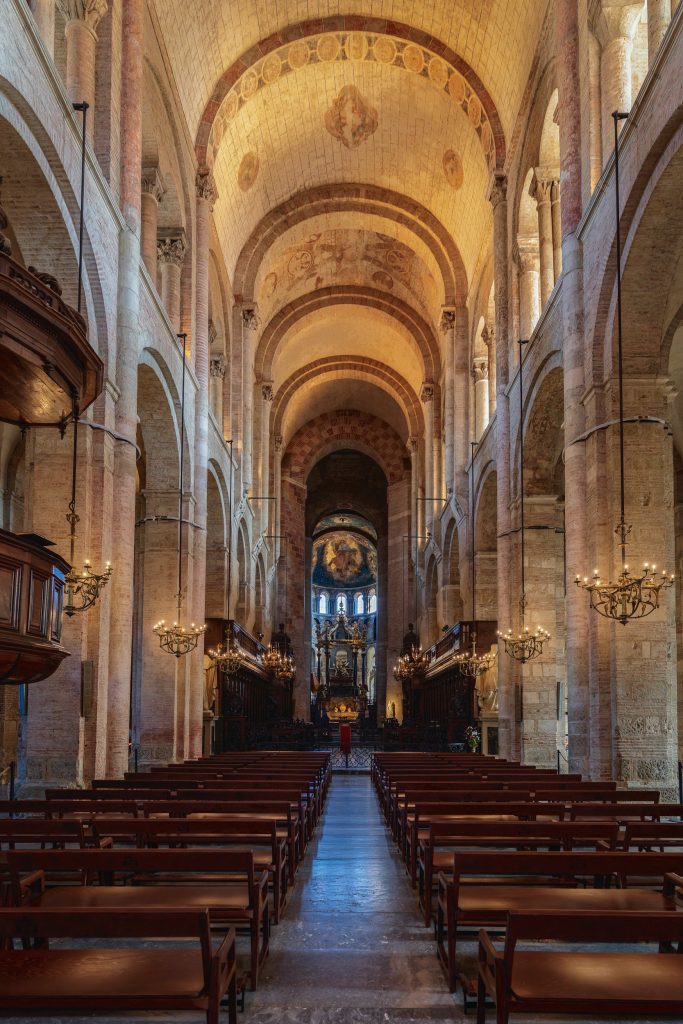
The nave of Basilique Saint-Sernin, one of the great Romanesque churches of Europe. Columns and arches draw the eye toward the light.
Its octagonal bell tower rises above the low roofline of the city like a compass point. The church was once a major stop on the pilgrimage route to Santiago de Compostela, and its size reflects that history—immense, solid, welcoming.
Inside, the columns and arches draw your eyes forward, as if the whole building wants you to move toward the light at the apse. It feels ancient in the deepest, most dignified way.
Toulouse Stays With You
Toulouse isn’t the first French city many travelers think of—but perhaps that’s why it feels so rewarding. It has beauty without pretense, history woven into daily life, and a warmth—of people, of light, of brick—that stays with you long after you leave.
It’s a city that doesn’t need to impress you. It simply does.
I left with photographs, yes—but also with the quiet glow of having been there, and the pleasure of seeing a city through the pride and affection of someone who calls it home.
For nearly fifty years, I’ve carried a love of Paris. For a long time, I thought it was an inheritance—a gift from teachers, photographers, French cousins, and friends. But only recently have I realized that Paris now belongs to me.
The seeds were planted early by my very first French teacher, Mrs. Stewart in Pittsburgh, who always made me feel valued and welcome. She made French not just a subject but a joy—something expansive, a new world opening before me. Later, a college professor urged me to take my first trip to France—a visit that included meeting my French cousins, who graciously introduced me to the City of Light and its culture, followed by a month at the University of Aix-en-Provence.
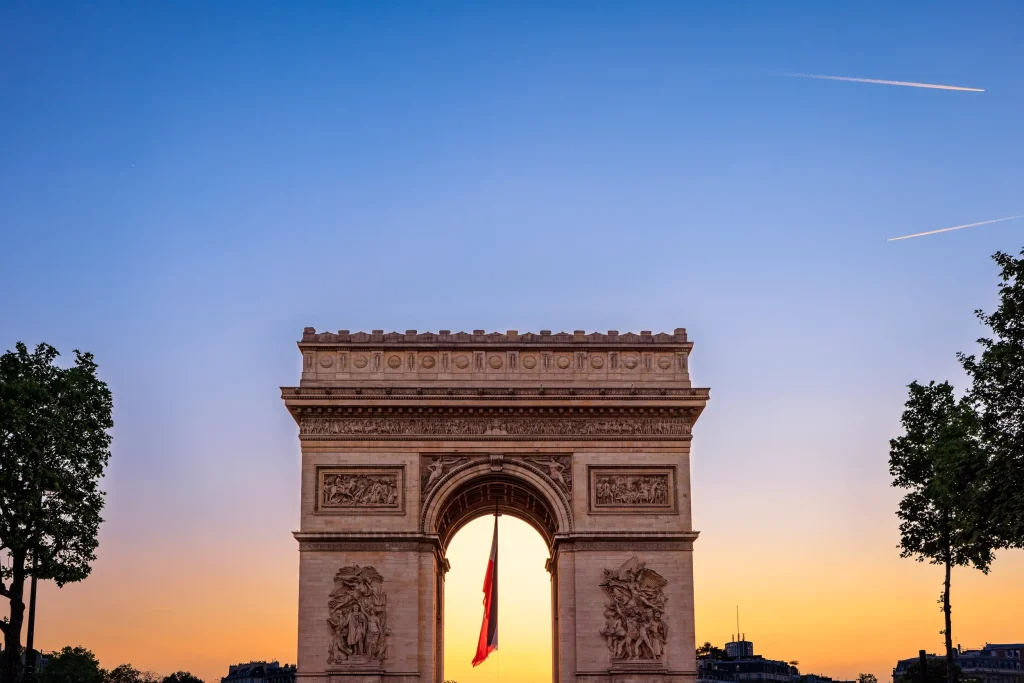
Beneath the tricolor, history lingers: sorrow and triumph etched in stone.
In Paris, seeing the Eiffel Tower and the Champs-Élysées for the first time was overwhelming. I didn’t just see grandeur; I felt the weight of history that has transpired there. Standing on the Champs-Élysées, I was struck by the horror of Nazi Germany marching down it in victory on June 14, 1940, and the profound relief and pride of the American and French armies liberating Paris on August 25, 1944. The German occupation lasted just over four years, and the liberation, led by French and U.S. forces, was met by jubilant Parisians in the streets. That same day, Charles de Gaulle entered the city to proclaim, “Paris! Paris outraged! Paris broken! Paris martyred! But Paris liberated!” The following day, he marched triumphantly down the Champs-Élysées, embodying the spirit of France restored. The weight of those moments in history made me appreciate even more the resilience and beauty of the city I was discovering. I think of those events every time I see the Champs-Élysées.
Yet Paris was only the beginning of my French journey. In Aix, I met a teacher from the Flemish-speaking part of Belgium who shared my love of the country and its language. I also met Marica from Mexico, who was simply fun to be with. One day, we rented a paddle boat on Lac d’Esparron in the south of France. We lost track of time, missed our bus back to Aix, and ended up laughing as a kind stranger gave us a ride to the train station in Manosque so we could make our way home. It’s a small story, but one I treasure—a reminder of youth, friendship, and the kindness of strangers.
Dawn at Trocadéro. The city still asleep, the Eiffel Tower keeping silent watch over Paris.
That same summer, I discovered the music of Véronique Sanson. I loved her then and still do now. I remember listening to her voice while visiting the calanques of Cassis, marveling at their sharp white cliffs and turquoise but icy water. Somehow, the beauty of those landscapes fused in my mind with the beauty of her songs. Even now, hearing her music carries me back to that summer.
After moving to Washington in 1979, I kept up my French. At Georgetown University and the Alliance Française de Washington, I found kind and influential teachers who nourished my love of France and its language and culture. Through them, Paris stayed alive for me, even when I was far away.
I wish I had photographs from my first trip to France. I’ve since learned that even imperfect photos are worth keeping because they hold memories words can’t always capture. Photography, for me, is a way to preserve what matters most.
The Seine carries the last light of day as the Eiffel Tower rises, a beacon above the city of memory and dreams.
It was my father who made these experiences possible, investing in my education and my first trips abroad, shaping me in lasting ways. My teachers opened doors, and friends gave me stories to carry.
Now, with my camera, I carry them all forward. Every photograph I take in Paris is a way of honoring those who helped me get to know the city. Paris is a presence that has grown inside me over a lifetime, stitched together by people, music, landscapes, and light. Just as I once linked Véronique Sanson’s songs to the calanques of Cassis, I now link my own photographs to the Paris I love. Paris lives in my memory, my images, and my heart.
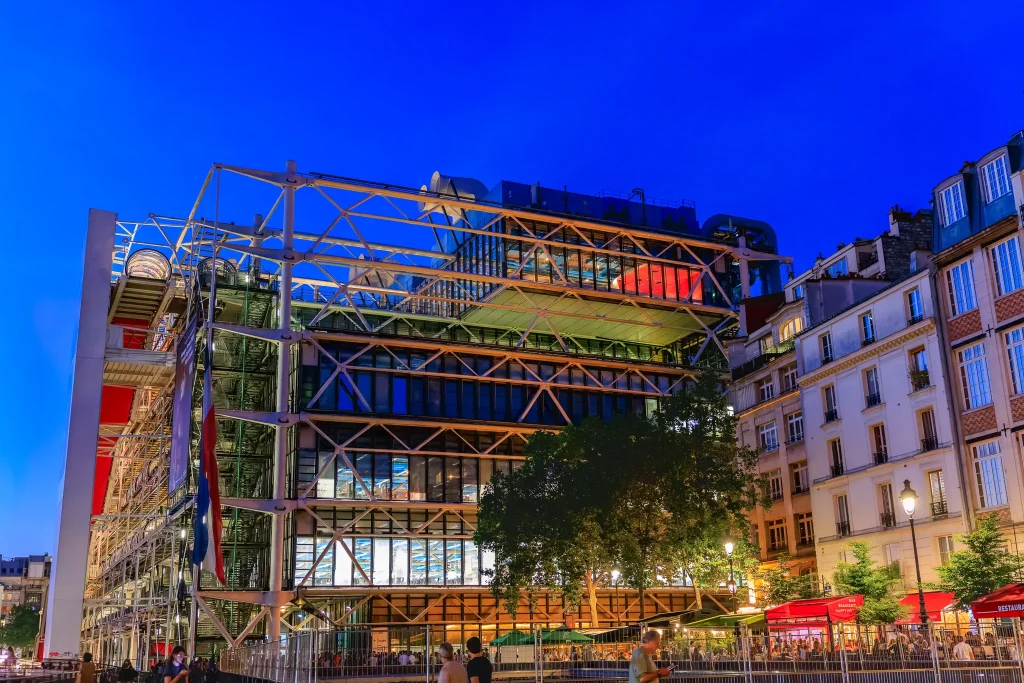
I first visited the Centre Georges Pompidou in 1977, the year it opened. The building felt shocking in its modernity. I had never seen anything like it — exposed pipes and bold colors, right in the heart of Paris. How could this belong in the same city as the Louvre or the Assemblée Nationale?
The Centre Pompidou illuminated at night — a bold icon of modern Paris, 2022.
The idea for the Centre took shape in the late 1960s, when Paris was still unsettled by the protests and strikes of May 1968. President Georges Pompidou, who loved modern art, wanted to create a cultural center that would feel open, democratic, and alive. His vision was to combine a public library, a museum of modern art, and spaces for music and performance under one roof — a place where tradition and the avant-garde could meet.
In 1971, an international competition was launched, drawing more than 600 entries. The jury, chaired by French architect Jean Prouvé, chose the radical proposal of two young architects: Renzo Piano, born in Genoa in 1937, and Richard Rogers, born in Florence in 1933 to a British family. Their design turned architecture inside out. By pushing structure, escalators, and utilities to the exterior, they left the interior wide open and flexible. Prouvé admired their daring — it was exactly the step into a new era that Pompidou had hoped for.
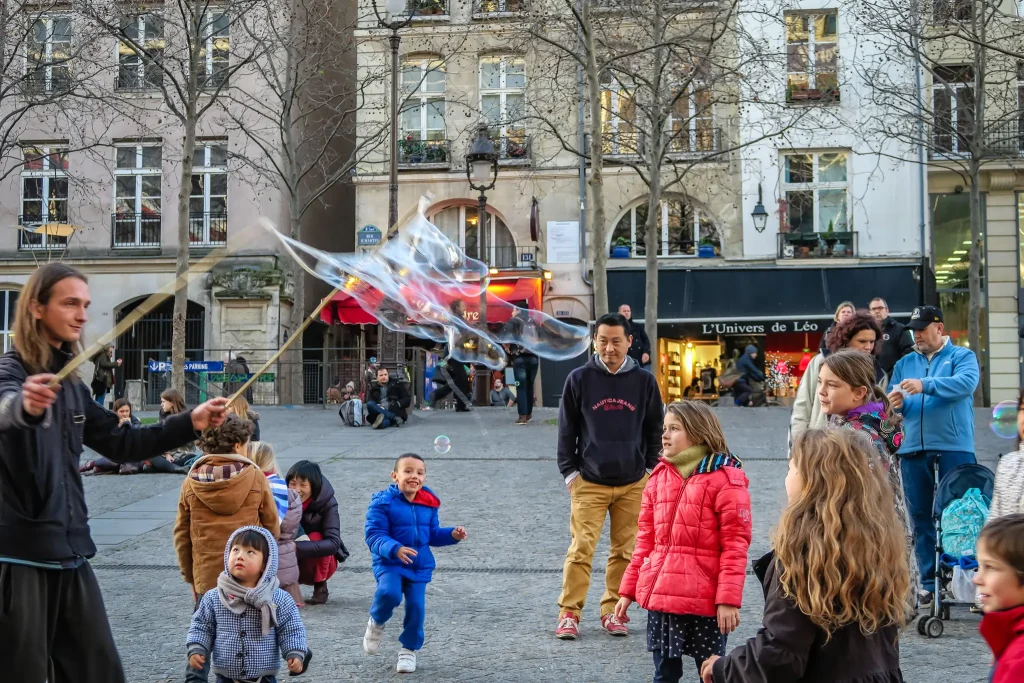
Over the years, as I returned to the Pompidou, I grew to love it. The plaza in front of the museum always recharged me. Young people sprawled on the ground, laughing, playing music, filling the courtyard with life. That sense of openness was not an accident — Piano and Rogers wanted the Centre to be a crossroads of art and community.
The lively plaza in front of the Pompidou, where art and play mingle, 2015.
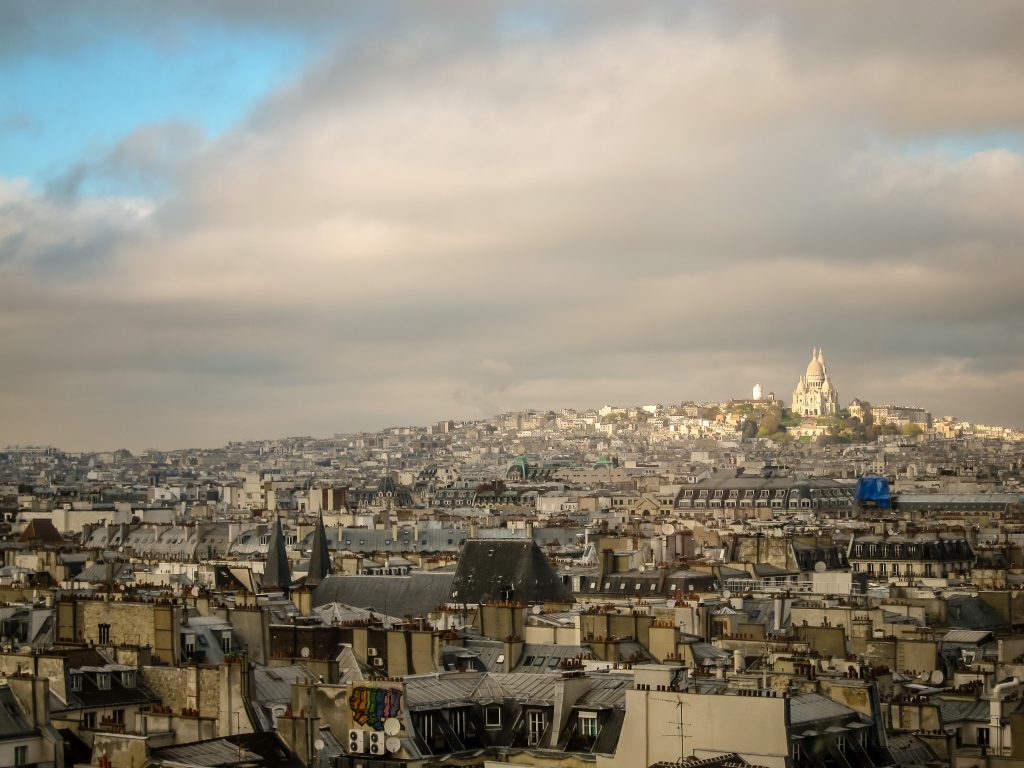
I also remember riding the exterior escalator, climbing above the rooftops of Paris. From there, the city unfolded — Sacré-Cœur glowing on the horizon. It reminded me of Piano’s later projects, like the Shard in London and The New York Times Building in Manhattan, always searching for lightness and views. Rogers, for his part, went on to shape landmarks such as Lloyd’s of London and the Millennium Dome. Both would eventually win the Pritzker Prize — Piano in 1998, Rogers in 2007 — but here in Paris, their collaboration was at its boldest.
From the Pompidou rooftop, Paris stretches to Montmartre, with Sacré-Cœur glowing on the horizon, 2012.
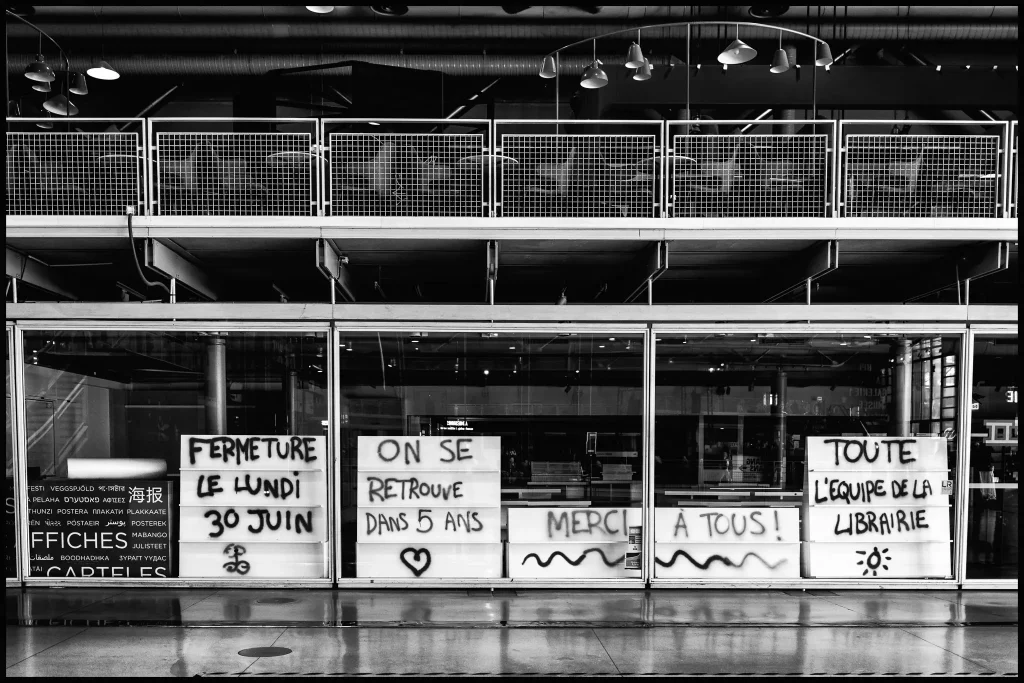
Now, the Pompidou is closed for renovations, with reopening planned for 2030. I don’t know when I will see it again. What I do know is that I will miss it.
The Pompidou began as something I thought was too modern, almost jarring, and became a place I adore. It carries with it the daring of its architects — one Italian, one British — and the conviction of a president and jury who believed Paris could take a step into a new era. For me, it became just that: a space of art, of community, of Paris itself, bold and alive.
Signs in the Pompidou windows announce its closure for renovation — farewell for five years, 2025.
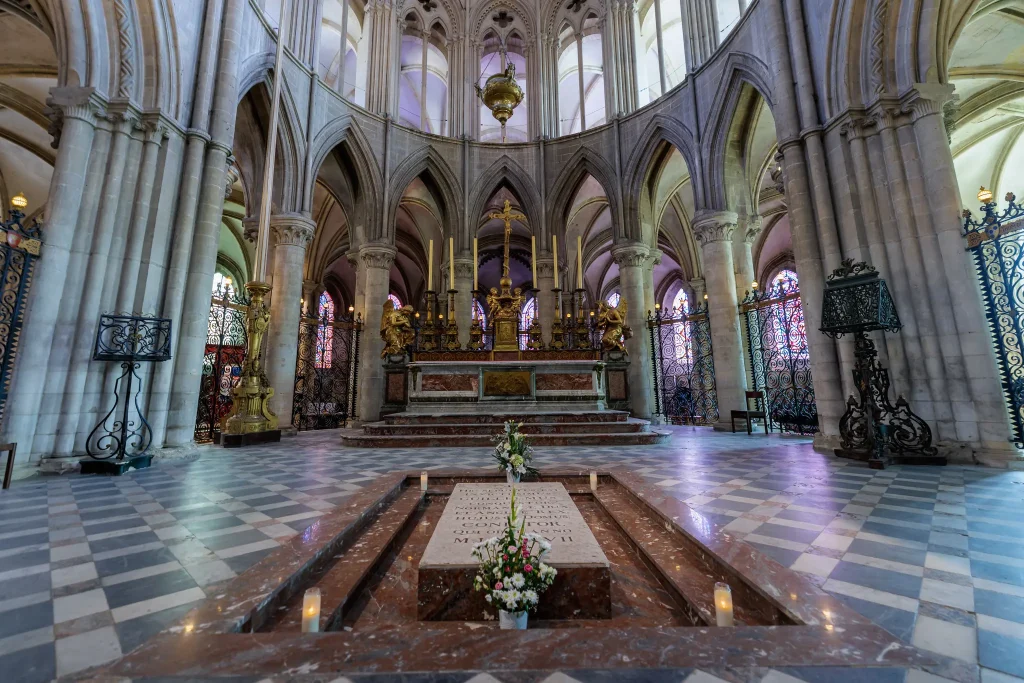
William the Conqueror’s tomb inside the Abbaye aux Hommes in Caen, France.
Born around 1028, William rose from Duke of Normandy to become a formidable force in European history. His decisive victory at the Battle of Hastings in 1066 brought England under Norman rule, setting in motion sweeping changes to the kingdom’s language, law, and social order. He was the first Norman King of England, and his reign reshaped the destiny of a nation.
William founded the abbey as an act of penance, after marrying his cousin Matilda of Flanders against Church law. When he died in 1087, his body was brought here to rest within the walls of the church he had endowed. Yet his remains would not know peace. Over the centuries, his tomb was desecrated multiple times—most violently during the French Revolution. Today, only a single bone, believed to be a femur, is thought to remain.
The tomb we see now, adorned with flowers and lit by candles, is at once modest and monumental. It speaks to the paradox of William’s legacy: a man who conquered kingdoms and changed history, yet whose earthly remains were reduced almost to nothing. The stone slab is a reminder of ambition’s reach and mortality’s certainty—a place of quiet reflection on how even the most powerful lives can end in fragility.
When I stepped inside the restored Notre-Dame de Paris on my recent trip, my jaw dropped. I had braced myself to see scars from the 2019 fire — blackened stone, lingering smoke, a cathedral permanently marked by disaster. Instead, I found a space so clean and luminous it felt renewed. The air was clear, the stone brighter than I remembered, and nothing betrayed the night when flames nearly brought this monument down.
The restored nave of Notre-Dame, luminous and whole, five years after the fire.
That fire broke out on April 15, 2019. It destroyed the spire and much of the roof, and left the world watching in disbelief as one of the most recognizable buildings in Europe seemed on the verge of collapse. In the days that followed, President Emmanuel Macron promised the French people that Notre-Dame would be rebuilt “within five years.” At the time, it sounded impossibly ambitious.
And yet, in December 2024 — just over five years later — the cathedral reopened to the public. The restoration was a massive undertaking. Carpenters and stonemasons worked with traditional tools and materials, rebuilding the roof frame in oak and covering it again in lead. Specialists cleaned centuries of soot from the interior stone, leaving the walls brighter than I ever remember seeing them. The cost was staggering, estimated at around €700 million, but more than €840 million was pledged, much of it from private donors, corporations, and foundations, with the French state overseeing the effort.
Investigators never determined a single definitive cause for the blaze. Arson was ruled out. The most likely explanations point to either faulty electrical wiring or a cigarette left smoldering on the scaffolding that surrounded the roof. Whatever the origin, the fire became a national trauma — and the restoration a matter of pride.
One of the most striking aspects of the restoration is what cannot be seen: the measures put in place to protect the cathedral from another disaster. Notre-Dame is now equipped with advanced fire detection sensors, a sprinkler system designed to protect the attic timbers, and strict new safety protocols for any construction or maintenance work. Dedicated fire safety teams are trained specifically for the building, and regular inspections are built into its ongoing care. The new oak roof frame may look medieval, but it is now guarded by twenty-first century vigilance.
Now, walking through the nave and looking up at the soaring vaults, you would not guess at the near loss of this building. The absence of smoke stains, the brightness of the walls, even the feeling of clarity inside the space all speak to what was achieved. Notre-Dame does not look like a survivor so much as a rebirth — a reminder of how cultural treasures can be both fragile and resilient.
For me, the experience was moving not only because of what I saw, but because of what I didn’t. I saw no evidence of catastrophe. Instead, I saw continuity — a cathedral that, having nearly perished, now feels more present and alive than ever.
You can get a sense of the magnitude of the destruction and the effort involved in the reconstruction in this video:
In the heart of the Marais in Paris lies the Maison Européenne de la Photographie (MEP). It isn’t a grand, imposing museum like the Louvre or the Musée d’Orsay. Instead, it feels intimate, almost hidden — a place where you can stand quietly before a single photograph, letting it work on you without distraction.
Encountering Marie-Laure de Decker
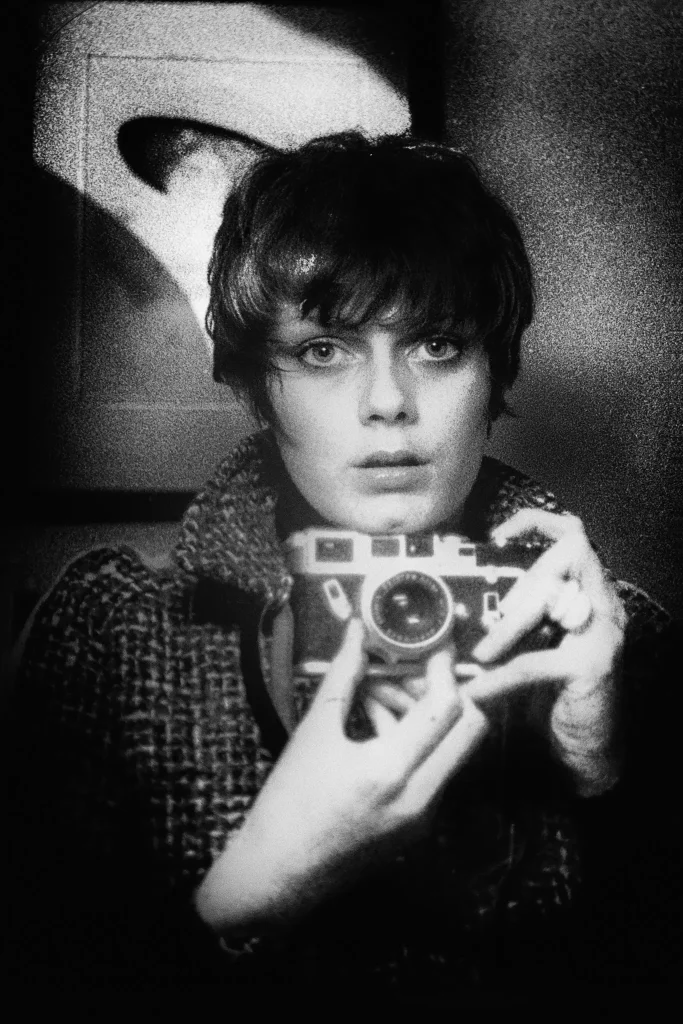
The exhibition that stopped me in my tracks was devoted to Marie-Laure de Decker. Before this visit, I knew nothing about her. Yet her black-and-white images held me still: the grain of film, the intensity of her subjects’ eyes, the strange balance of fragility and strength.
Her story is as remarkable as her photographs. De Decker began as a striking fashion model in Paris. She saved enough money to buy her first Leica and soon turned the camera on the world’s conflicts. Her photographs from Vietnam and Chad carry a rare humanity — not just war and suffering, but dignity, presence, and survival.
Two of her cameras, a well-worn Leica M3 and M4, are on display at the MEP. Ordinary tools, scratched and aged, yet heavy with history and courage.
More Than a Museum
The MEP is not just a gallery of images. It feels like a home for photography itself, where established masters share the stage with emerging voices. Its bookstore is a temptation all its own — shelves lined with rare catalogues, monographs, and books that open like personal invitations into other lives.
And when you step back outside, you’re in the Marais: narrow old streets, bustling cafés, a Paris scaled to human rhythm.
Marie-Laure de Decker – on display at the MEP
What Matters
Standing in front of de Decker’s work, I felt something I sometimes forget: the latest gear matters very little. What endures is the eye, the courage to see, and the willingness to be present.
The MEP reminded me why I fell in love with photography in the first place. It is not only about images. It is about memory, refuge, and meeting the world through another’s gaze.
If You Go
If Paris is in your plans, make time for the Maison Européenne de la Photographie. You may arrive expecting to see photographs. But if you linger, you might leave changed — carrying the weight of another person’s vision, and perhaps, a little more courage to see the world for yourself.
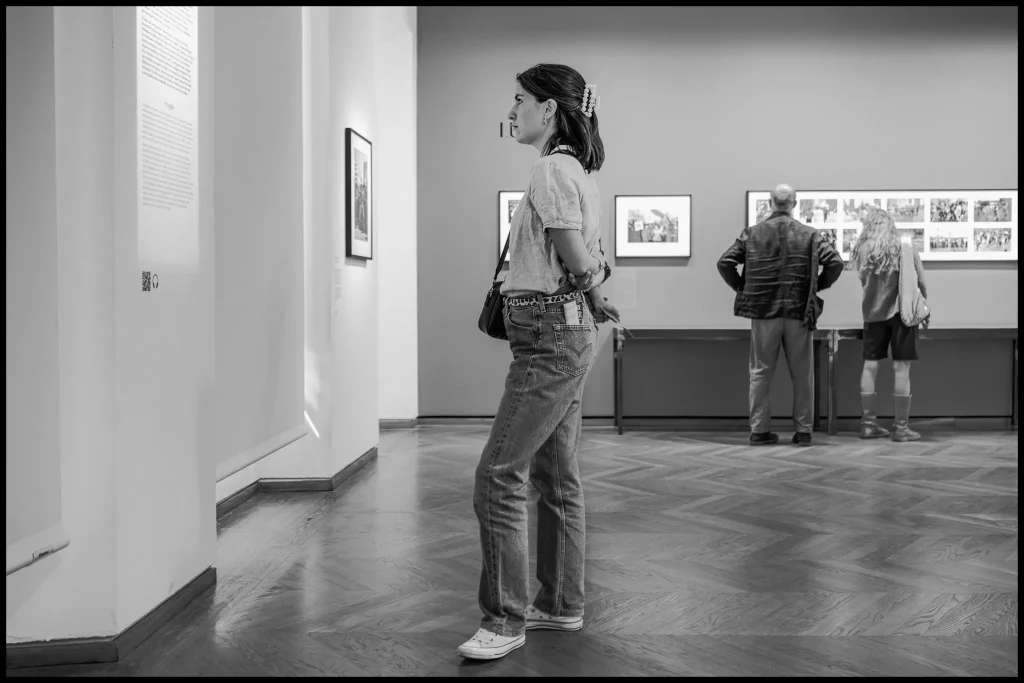
A visitor contemplates the work of Marie-Laure de Decker at the MEP
Robert Clary, a French-born survivor of Nazi concentration camps who later played a feisty prisoner of war in the unlikely 1960s sitcom Hogan’s Heroes, died on November 16, 2022, at his home in Beverly Hills, California. He was 96.
Clary was the last surviving original cast member of the series, which also starred Bob Crane, Richard Dawson, Larry Hovis, and Ivan Dixon as the Allied prisoners. Their captors were portrayed by Werner Klemperer and John Banner, both European Jews who had fled Nazi persecution before the war.
For decades, Clary said nothing publicly about his wartime experience. That changed in 1980, when he decided to speak out after seeing Holocaust deniers attempt to diminish or erase the truth of Nazi crimes. His silence broke with painful clarity: twelve members of his immediate family — his parents and ten siblings — had been murdered. Clary himself was deported to Buchenwald, where he was liberated on April 11, 1945. He was the only member of his family to survive.
Beyond his acting career, Clary committed himself to Holocaust remembrance. Beginning in 1980, he spoke at high schools and community groups, participated in survivor gatherings in Jerusalem, volunteered with the Museum of Tolerance, and became deeply involved with the USC Shoah Foundation. He was among the first 100 survivors interviewed for their archive and later conducted 75 interviews himself, ensuring that others’ stories would be preserved.
Hogan’s Heroes aired on CBS from 1965 to 1971, running for six seasons and 168 episodes. It remains the longest-running American sitcom set against the backdrop of World War II.
Unrealistic as it was, I loved the show. It made me laugh then, and it still makes me laugh today. The series is available on Amazon Prime.