Walking Through Silence: A Son’s Journey to Auschwitz in 2025

The name Auschwitz is the German version of the Polish town Oświęcim, located about 40 miles (64 km) west of Kraków. After Germany invaded Poland in 1939, the region was annexed into the Third Reich.

In 1940, Nazi Germany established a concentration camp on the outskirts of Oświęcim, known today as Auschwitz I, or the Main Camp. In 1941, they began building a much larger killing center two miles away in the village of Brzezinka, renamed Birkenau. This site — Auschwitz II — became the heart of the extermination process.

That is the geography and the history. But what I found when I arrived went far beyond what books and maps can convey.

Despite years of studying photographs, listening to survivor testimonies, and watching documentaries, nothing prepared me for Auschwitz II–Birkenau. Not its immense scale, nor the unsettling quiet that hung over the gray May morning in 2025 when I arrived.

In September 1982, I visited Dachau with my father. He had been imprisoned at HASAG, a Nazi forced labor camp in Częstochowa, and was later transferred through a series of camps as the Nazis evacuated prisoners westward in the final stages of the war. In 1944, he was sent from HASAG to Gross-Rosen, then to Flossenbürg, and finally to Dachau.

One of his most harrowing memories was the transfer from Flossenbürg to Dachau. Along with 500 other prisoners, he was first forced to march, then packed into freight cars “like cattle,” as he later described in a 1973 interview with the Pittsburgh Press. Only 18 of the 500 survived the journey. My father was one of them.

During our visit to Dachau in 1982, my father shared this story in German with a group of high school students. Hearing him speak about what he had endured—on the very ground where his imprisonment had ended—moved me deeply. Yet even with that experience, Birkenau struck me in ways I hadn’t expected.

Although Dachau had a gas chamber, historical evidence suggests it was never used for mass executions. It was equipped and capable—part of the same machinery of terror—but not used systematically for mass murder like the crematoria at Auschwitz-Birkenau. Most deaths at Dachau occurred through forced labor, shootings, disease, and medical experiments. Still, standing in that room with my father years ago was sobering. Even unused, the gas chamber embodied the intent of a system built on death.

His brother—my uncle—was deported to Auschwitz and survived. He was among those liberated when the Red Army arrived in January 1945. These are not just historical facts to me; they are the roots of my identity.

So I came to Auschwitz not as a historian, nor just as a photographer, but as a son and a nephew. I didn’t come seeking understanding—I don’t believe Auschwitz can be understood. I came to listen, to stand where memory persists, and to bear witness.

What struck me most wasn’t a particular building or exhibit, but the vastness of Birkenau. It spans roughly 346 acres—more than half a square mile of barracks, chimneys, tracks, and ruins. It felt like a mechanized landscape of erasure, a place where lives were reduced, processed, and obliterated. The train tracks still slice through the camp. Rows of chimneys stretch toward the forest line. The emptiness felt both infinite and suffocating. At one point, I stopped walking and heard only the gravel under my shoes and the wind moving through the wire. It was a silence not of peace, but of reverberation.

Auschwitz is one of the most visited Holocaust memorial sites in the world. In recent years, more than two million people a year have come—students, families, descendants of survivors, visitors from every corner of the globe. That fact lingered with me as I walked. I knew I was one of many, yet I felt completely alone.

During my visit, I saw two groups of Israelis. The first were students, draped respectfully in Israeli flags, walking the grounds where their history was nearly erased. The second were soldiers in uniform—quiet, focused, listening intently to their guides. They were not tourists, but heirs to a story that had nearly ended here. Their presence filled me with quiet pride and a sense of defiance. It felt like an answer—a living affirmation of survival and responsibility.

I also visited the crematorium at Auschwitz I—preserved as part of the museum—and later, the ruins of the much larger gas chambers and crematoria at Birkenau. These were the industrial centers of death.

The crematorium at Auschwitz I surprised me with its scale. It was smaller and more intimate than I had expected—but no less chilling. It was an early site of killing, later eclipsed by the vast machinery of death at Birkenau. There, the system of extermination became larger, more efficient, and partially hidden underground. Seeing the shattered remains of those later structures brought the full scope of the killing into terrifying clarity.

At Birkenau, the ruins sit in quiet collapse, half-swallowed by the earth. It’s one thing to know what happened there. It’s another to stand where it happened. The deliberate effort to erase these places—and the lives taken within them—was itself part of the crime.

I’m grateful to the many Poles who have preserved this site with care. I recognize that Auschwitz was built and operated by Germans, and that the responsibility for the Holocaust rests with them. But it would be dishonest to say I felt only gratitude. My visit stirred unease. Poland’s relationship with its Jewish past is complicated—marked by courage and complicity, remembrance and denial. Antisemitism did not begin or end with the camps. That truth is hard to ignore.

Still, I didn’t come to accuse. I came with questions. I came because I needed to be in the place where history and memory hang so heavily that even the air feels changed.

I left without answers. But I left with something else: a deeper connection to the voices that once filled this place, and a stronger sense of responsibility to keep their stories alive.

Memory alone is not enough. But without memory, nothing remains.
Pan Am ‘First Moon Flights’ Club

Between 1968 and 1971, Pan American World Airways issued over 93,000 “First Moon Flights” Club cards to those eager to make a reservation for the first commercial flight to the Moon. The cards were free. I was a proud member.

The Club originated from a waiting list that is said to have started in 1964, when Gerhard Pistor, an Austrian journalist, went to a Viennese travel agency requesting a flight to the Moon. The agency forwarded his request to Pan Am, which accepted the reservation two weeks later and replied that the first flight was expected to depart in 2000.

On July 20, 1969, Neil Armstrong became the first human to step foot on the moon.

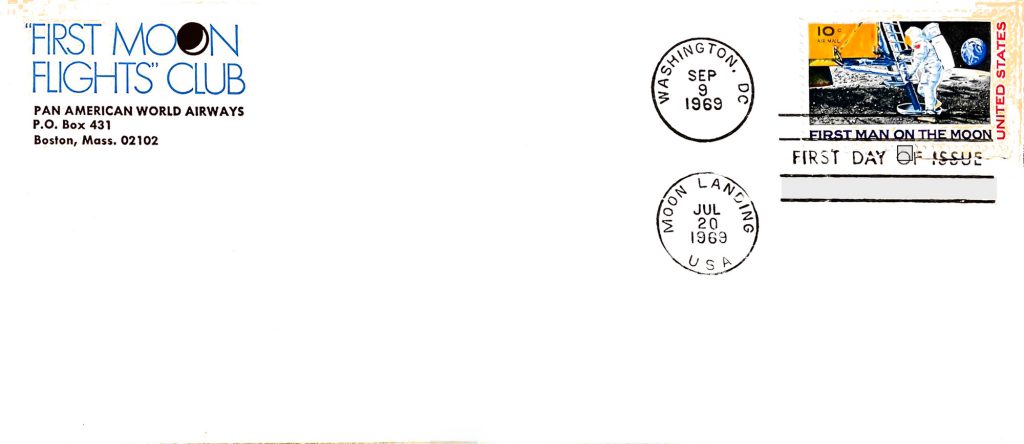
“First Man on the Moon” stamp depicting Neil Armstrong stepping from the Apollo 11 lunar module Eagle.

On September 9, 1969, the United States Postal Service issued a 10 cent postage stamp showing an astronaut walking on the surface of the moon. It was called the “First Man on the Moon” postage stampAccording to the National Postal Museum, the stamp was made from the same master die that the astronauts took with them to the moon. Additionally, it was the largest stamp the United States had issued up to that point.

Pan Am sent members of the “First Moon Flights” Club “First Day of Issue” envelopes. I was excited to get mine and have kept it all this time. I now doubt I will make it to the moon. But it was an exciting thought.

Unfortunately, Pan Am did not survive. It went bankrupt in 1991.

Guided Tour of the U.S. Ambassador’s Residence, Paris

The residence of the United States Ambassador to Paris is at 41 rue du Faubourg Saint-Honoré in the 8th arrondissement. It is known as the Hôtel de Pontalba. It was built by Louis Visconti for the New Orleans–born Baroness Micaela Almonester de Pontalba between 1842 and 1855. Edmond James de Rothschild acquired the building in 1876.

During the German occupation of France, the mansion, then owned by Baron Maurice de Rothschild, was requisitioned as an officers’ club for the Luftwaffe. After the war, it was rented out to the British Royal Air Force Club, and then to the United States.

In 1948, the American government purchased the building, primarily for the United States Information Service. These offices were moved to the Hôtel Talleyrand as restoration was completed in 1971 during the tenure of Ambassador Arthur K. Watson. The building then became the official residence of the ambassador. This magnificent structure has only been the Ambassador’s residence for a little more than fifty years.

Read more

Remembering Maisie Hitchcock

I recently learned that, Maisie Hitchcock, a guide on a Rick Steves tour of Switzerland I took in 2018 died peacefully of ovarian cancer on August 9, 2023 in the company of her family.

Maisie was a kind, gentle guide who did an excellent job showing us the highlights of Switzerland. Although she was English, she lived in Berlin and spoke fluent German.

Maisie enjoyed people and knew how to relate to each person as an individual. Maisie’s father, Robyn Hitchcock, is an English singer-songwriter and guitarist. He wrote a loving memory of his daughter on Instagram.

During that 2018 trip, my suitcase broke and I asked Maisie where I could buy a new bag. Maisie helpfully sent me to Manor in Lugano where I bought a bag that I continue to use on my travels.

May Maisie’s memory be a blessing for many years to come.

Podcast Pick: Travel with Rick Steves

Travel with Rick Steves is a weekly, one-hour podcast featuring guest experts and listener calls about travel, cultures, and people around the world. In my view, it’s the best travel podcast available.

Rick Steves is well-traveled, articulate, and endlessly curious. While his guidebooks and organized tours focus mainly on Europe, the podcast ranges far beyond, covering destinations and cultures across the globe.

Guests often include professional guides and authors who contribute to his tours and books. The conversations are timely, informative, and inspiring. Notable guests have included writers such as Paul Theroux and the late David McCullough (1933–2022).

I found McCullough’s interview especially moving. He began his explorations in my hometown of Pittsburgh, Pennsylvania, and went on to write extensively about American history—from The Johnstown Flood to his Pulitzer Prize–winning works. Listening to him talk with Steves was a reminder of how travel and curiosity can begin close to home and expand outward to the wider world.

That’s the caliber of guest Rick Steves brings to his listeners—week after week.

Leica Q3 Review From a Canon Photographer

Emmanuel Nataf writing on PetaPixel discussing his hit rate on the Leica Q3 compared with the Canon R5:

Going back to my “hit rate,” I simply can’t get anywhere near my R5. Part of it is due to the ergonomics of the Q3: a typical Leica without joystick to move the focus and poorly placed dials (the worst one being for exposure, placed on the outer part of the body and hard to reach with your thumb). With the temperatures dropping in the past few weeks, I used the Q3 with gloves and missed countless street shots by pushing the Play button instead of the arrows, definitely killing my shots. You may wonder why I’m not using subject tracking: because switching between subjects rapidly with the Q3’s buttons is completely unreliable.

The second reason for the low hit rate is the autofocus: average in poor lighting conditions and terrible in motion. With the Q3, I’ve had to stop shooting while walking. I have to stop, compose my image and shoot when the right subject comes into the frame — a much less spontaneous experience than what I’m used to.

Lastly, the camera is painfully slow to wake up. It should be on within a few milliseconds, but it takes the Q3 a second or two to start… far too long when trying to capture an instant.


I too own both a Canon R5 and a Leica Q3. The R5 is my main camera. I love it but it is big and heavy compared to the Q3. The Q3 is small, a pleasure to hold and the image quality is great, maybe even a little better than the R5.

  • I agree that the Q3 is slow to start. But I just leave it on and then it starts pretty fast. Sure it drains the battery but the batteries aren’t big or heavy. It’s easy to carry extra batteries.
  • I adjust exposure using the camera dial and find that works well for me. The camera can be adjusted almost infinitely. You just have to experiment and see what works for you.
  • I agree that the R5’s autofocus is better than the Q3 but find that I can shoot on the fly with the Q3. I feel I’ve gotten some nice street photos with the Q3. The eye detection on the Q3 works very well.

I made the photos in this post with the Q3 while on a trip to Japan in 2023.

In my opinion, when it comes to small, light weight full-frame cameras, Leica has the market all to itself. Would I love to see more competition in this category? Sure. But I don’t see that happening anytime soon.

I am happy to have the Q3 in my bag along with the Canon R5.


Update: April, 2024: On a recent trip to Europe my Q3 malfunctioned. The SD card would not click in the slot. After returning home, I took the camera back to the Leica Store in Washington DC. They returned the camera to Leica Repair in New Jersey. On April 30, 2024 I received the following email message:

4/30
Your equipment has been inspected by our technician. Your repair has been processed and placed in queue. No action is required.

Error description

strong traces of use adjust/replace printed circuit SD card slot faulty

I don’t yet know how long the repair will take. I miss the camera. I really like it. I will continue to update.


Update: May 21, 2024:

Dear Leica Customer,

During the repair of your Leica product, the technician found that a
part required to fully repair your equipment to Leica standards is
currently out of stock.

Our colleagues and worldwide suppliers are working together to resolve
this issue as quickly as possible. However, this will most likely delay
the completion of the repair.

We apologize for the inconvenience and sincerely appreciate your
patience.  If you have any further questions or concerns, please do not
hesitate to contact Customer Care at 201-995-0051 ext. 9930 or email
repair@leicacamerausa.com

Sincerely,

Your Leica Team

Leica Camera USA INC.
Customer Care


I am thinking of buying a Leica M11-P but this experience with the Q3 gives me pause. Still one Leica does not feel like it’s enough for me.


Update: May 24, 2024

I called Leica Repair today to see how long the repair will take. They answered the phone right away and explained the part I need (the SD card holder) must be manufactured and shipped from Germany. The wait will probably be a couple of months. They offered me a Q3 loaner for the duration of the repair, which sounds great to me. They will send me the loaner next week. When my camera is repaired they will notify me. I will then return the loaner and they will then ship my camera to me. I am glad I called.

I added that I’m thinking about buying an M11-P and asked how long repairs generally take. The reply was 60 days – and longer if the camera has to go back to Germany. Analogue repairs take much longer – nine months or longer.

I guess Leica is a small company and this is the price of admission.


Update: May 29, 2024

My Q3 loaner arrived today. Once I held the camera in my hands, I realized just how much I missed it. Luckily, I saved my profile settings on my Mac so I only had to transfer them to an SD card and load them into my loaner.


Update: August 7, 2024

Leica notified me a few days ago that my Q3 has been repaired. Leica sent me a prepaid shipping label and I returned the Q3 loaner. Today, my Q3 arrived well-packaged and working just fine. The entire process took about 100 days. With the loaner, I am happy with Leica service.


SF’s ‘Bay Bridge Lights’ to Go Dark

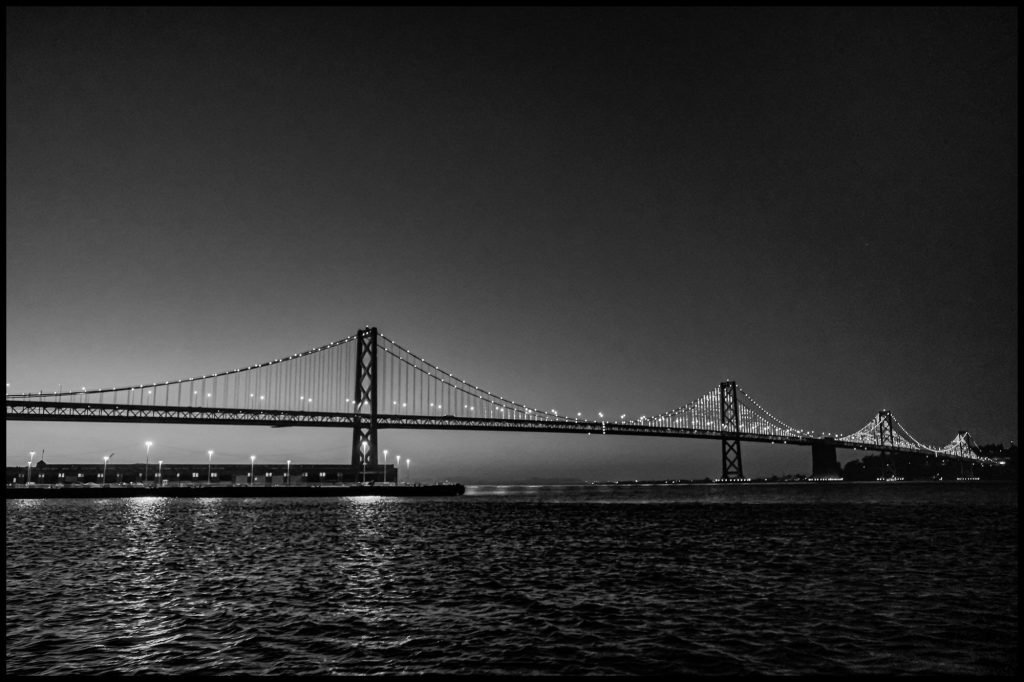
I made this photograph of the San Francisco–Oakland Bay Bridge in 2019. This was only possible because of the beautiful lights on the span. The lights have been on the bridge since 2013 when a public art installation called “The Bay Lights” was activated on the bridge.

The installation was designed by artist Leo Villareal and consists of 25,000 LED lights. This beautiful display stretches 1.8 miles across 300 cables on the western span of the Bay Bridge. Sadly, after ten years the display is worn out and and, according to the San Francisco Chronicle, will go dark on March 5, 2023. However, efforts are underway to raise $11 million to keep “Bay Lights” shining on the Bay Bridge.

I hope they succeed.

Neon Museum, Las Vegas

The Neon Museum in Las Vegas features signs from old casinos and other businesses displayed outdoors on a 2.27 acre campus. The Neon Museum has an outdoor exhibition space known as the Neon Boneyard. Boneyard is traditionally the name for an area where items no longer in use are stored.

Efforts to establish a neon sign museum date to the late 1980s, but stalled due to a lack of resources. On September 18, 1996, the Las Vegas City Council voted to fund such a project, to be known as the Neon Museum. The organization started out by re-installing old signage in downtown Las Vegas, to attract more visitors to the area.

Young Electric Sign Company (YESCO) had manufactured many neon signs in the city, and the company had a storage site for old signs which would eventually become part of the Neon Museum collection. In 2000, as YESCO prepared to close its storage lot, the city provided the museum with land to start its own. Tours of the new site, known as the Neon Boneyard, began in 2001, by appointment only.

The lobby of the former La Concha Motel, located on the Las Vegas Strip, was donated to the museum and moved there in 2006, eventually becoming its visitor center. Construction to convert the lobby began in May 2011, and the museum officially opened to the general public on October 27, 2012, eliminating the appointment system.

Each of the more than 250 signs in the Neon Museum’s collection offers a unique story about the personalities who created it, what inspired it, where and when it was made, and the role it played in Las Vegas’ distinctive history.

The Museum has announced plans for relocation and expansion in downtown Las Vegas’ Art District. The plan is to nearly triple the size of its current location. Currently, only 35 percent of the museum’s collection is visible to the public.

The Neon Museum is located at 770 Las Vegas Blvd. N, Las Vegas NV, 89101. You can buy tickets here.


Sources: The Neon Museum | Wikipedia


Alta, Norway

Alta is located at 70 degrees north, far above the Arctic Circle. Alta is considered the northernmost city in the world with a population surpassing 10,000. The 9.81-square-kilometre (2,420-acre) town has a population (2023) of 15,931. At this latitude, nature is in total control.

Alta is a good place to see the Northern Lights due the region’s relatively stable climate and minimal light pollution, particularly when heading out of town into the surrounding wilderness. The Aurora has been known to be seen here for up to 200 nights a year. 

Alta is a center of transportation in Finnmark county. The town has port facilities along Altafjorden, just alongside Alta Airport in Elvebakken. The airport has direct flights to Oslo and certain other big cities in Norway like Tromsø. The European route E6 highway also runs through the town and the European route E45 has its northern terminus in the town. The main industries present in Alta include a concrete product factory; several wood mills and sawmills; and dairy, horticulture trade, and maritime services.


Resources: Wikipedia – Alta | Alta Tourist Site | Aurora Zone – Alta


One of the Most Famous Paintings Ever Created, on View at the National Gallery of Art

Impression, Sunrise,” which usually lives in Paris at the Musée Marmottan Monet, is in the United States for the first time. It’s the star item in “Paris 1874: The Impressionist Moment,” at the National Gallery of Art in Washington, DC.

“Paris 1874: The Impressionist Moment,” is an important presentation of 130 works including a rare reunion of many of the paintings first featured in that now-legendary Société Anonyme exhibition 150 years ago, which is recognized as the event that gave birth to French Impressionism. On April 15, 1874, the first impressionist exhibition opened in Paris. Hungry for independence, Monet, Renoir, Degas, Morisot, Pissarro, Sisley and Cézanne decided to free themselves from the rules by holding their own exhibition, outside official channels: impressionism was born.

You can see paintings by Paul CézanneClaude MonetBerthe Morisot, and Camille Pissarro and meet their lesser-known contemporaries. See the art norms they were rebelling against and learn what political and social shifts sparked their new approach to art.

The show is on view until January 19, 2025 at the National Gallery of Art. This exhibition is not ticketed. You may need to join a line on busier days. Weekends tend to be most crowded.


Sources: National Gallery of Art | Musée d’Orsay | Wikipedia | The Washington Post | The Wall Street Journal